Share This Article
No items found.

Understanding what is office hoteling is essential. Office hoteling is a workplace strategy where employees reserve a desk or workspace in advance for a specific day, rather than being assigned a permanent seat. Unlike hot desking, which relies on unreserved, first-come-first-served seating, hoteling uses booking software so people, teams, and facilities managers all know in advance who is sitting where. This lets companies shrink their real estate footprint while still giving employees a guaranteed, predictable workspace when they come in.
Answering what is office hoteling means starting with the booking system: it's desk access by reservation, not by arrival time or assigned nameplate.
Hoteling, hot desking, and traditional fixed seating sit on the same spectrum, how much a desk belongs to one person versus the whole office, but they land in different places. Fixed assignment gives each employee a permanent desk whether they use it three days a week or none. Hot desking removes the assignment entirely, letting anyone sit anywhere on a first-come, first-served basis, with no reservation required [1]. Office hoteling keeps the open-seating principle but adds a booking layer: employees reserve a workspace before they arrive, the same way they'd book a hotel room [1]. This is particularly relevant for what is office hoteling.
The mechanism that separates them is advance visibility. Hot desking tells you nothing until someone physically sits down, there's no way to know which desks will be free on a given Tuesday. Hoteling solves that by putting a reservation system in front of the desk, so employees, team leads, and facilities managers can all see who's coming in and where they'll sit before the day starts [2].
That visibility matters more as teams grow. A 40-person floor can run on hot desking without much friction. A 4,000-person portfolio spanning multiple cities cannot, facilities teams need booking data to plan cleaning, catering, and space allocation, and employees need certainty that a desk will actually be there when they show up [4].
Three principles separate hoteling from simple unassigned seating:
These principles are why hoteling counts as a deliberate strategy rather than a cost-cutting afterthought. In casual conversation, "hoteling" and "hot desking" often get used interchangeably, and that loose usage causes real problems during rollout, employees expecting hot-desking spontaneity get frustrated by a booking requirement, while employees expecting guaranteed hoteling reservations get burned by a hot-desk free-for-all [1]. Upflex separates the two explicitly: its desk booking workflows give employees a reserved, confirmed workspace, while its UnifyAI engine forecasts attendance with 97% accuracy so facilities teams know exactly how many desks to hold open before anyone books.
A hoteling system runs on three steps: employees book a desk before arriving, check in when they get there, and the system releases unused reservations back into inventory. Understanding what is office hoteling in practice means following a single reservation through that full cycle.
The cycle starts before anyone leaves for the office. An employee opens a booking app, sees which desks, rooms, or zones are open on a given day, and reserves a spot tied to their planned in-office schedule, often synced to when the rest of their team is coming in [2]. This is the core mechanic that distinguishes hoteling from hot desking: hoteling is reservation-based, while hot desking lets workers grab whatever is free on arrival with no advance booking [1].
Once on-site, the employee checks in, by badge, QR code, or app tap, which confirms the reservation and marks that desk as occupied in real time. If no one checks in within a set grace window, the system auto-releases the desk so it's available for someone else that same day. Without this no-show rule, a hoteling program quietly degrades into the exact problem it was built to solve: desks marked "booked" that sit empty all day while other employees can't find a seat. When considering what is office hoteling, this point stands out.
Managers use the same occupancy data on the other end. Instead of guessing who might show up, they can see booking patterns across the floor and actively schedule collocation days, pulling a team together on Tuesdays and Thursdays, for example, rather than hoping attendance lines up by chance. Upflex's UnifyAI engine takes this a step further by forecasting attendance with 97% accuracy, so coordination decisions are based on predicted turnout rather than last week's average.
Rollouts work better as a pilot than a company-wide switch. Start with one floor or department, run it for a few weeks, and fix booking rules before scaling [2].
These friction points, double-booked desks, no-shows, and scrambled sanitation windows between back-to-back reservations, are the most commonly cited drawbacks of hoteling [3]. Policy design, not software alone, is what keeps them from becoming daily complaints.
Office hoteling saves money because fewer desks serve more employees, you provision seats for peak occupancy across booking windows, not one desk per headcount. That mechanism is the entire financial case, and everything else is implementation detail.
Under a traditional assigned-seat model, every employee on payroll gets a desk whether they show up or not. A company with 1,000 employees leases space for roughly 1,000 workstations, plus circulation, storage, and meeting rooms, even when average attendance runs at 40-60% on a given day. Hoteling breaks that one-to-one link. If attendance forecasting shows that no more than 55% of a team is ever in the building at once, that team needs desks for 55% of headcount, not 100%.
The upfront investment isn't trivial, but it's modest compared to the rent you're paying on empty desks. Costs typically fall into four buckets: software licensing for the booking and forecasting platform, furniture or sensor hardware if you're retrofitting a floor, change-management time to train employees and managers on new norms, and IT integration effort to connect booking data with calendars, badge systems, or HR platforms. None of these are recurring at the scale of real estate, they're one-time or low-marginal-cost line items next to a multi-year lease. For those exploring what is office hoteling, this matters.
Traditional leased-and-assigned space carries full rent, utilities, and overhead on every desk regardless of whether anyone sits there, an unused workstation costs the same as an occupied one [1]. Hoteling shifts spend from fixed square footage toward a smaller real estate footprint plus a software layer. Instead of paying for capacity you don't use, you pay for a system that matches the capacity you actually need to the demand you actually have. That's the trade Upflex is built around: its UnifyAI engine forecasts attendance with 97% accuracy, so real estate teams can size floors to real demand rather than headcount, and the platform has supported real estate spend reductions of 40%+ in organizations that consolidated on that basis.
Most organizations that succeed with what is office hoteling roll it out in phases rather than converting an entire portfolio overnight. A typical path starts with a pilot on one floor or one business unit, runs long enough to collect real occupancy data across several weeks, then expands to additional floors once booking patterns confirm the space can safely shrink. Only after that phased rollout does a full-portfolio consolidation decision, closing a lease, downsizing a headquarters, get made with confidence.
Three metrics matter most when tracking return: occupancy rate versus provisioned capacity, real estate cost per employee, and total space reduction achieved over time. Tracked consistently, these numbers turn a hoteling rollout from a workplace experiment into a documented real estate decision the CFO can sign off on.
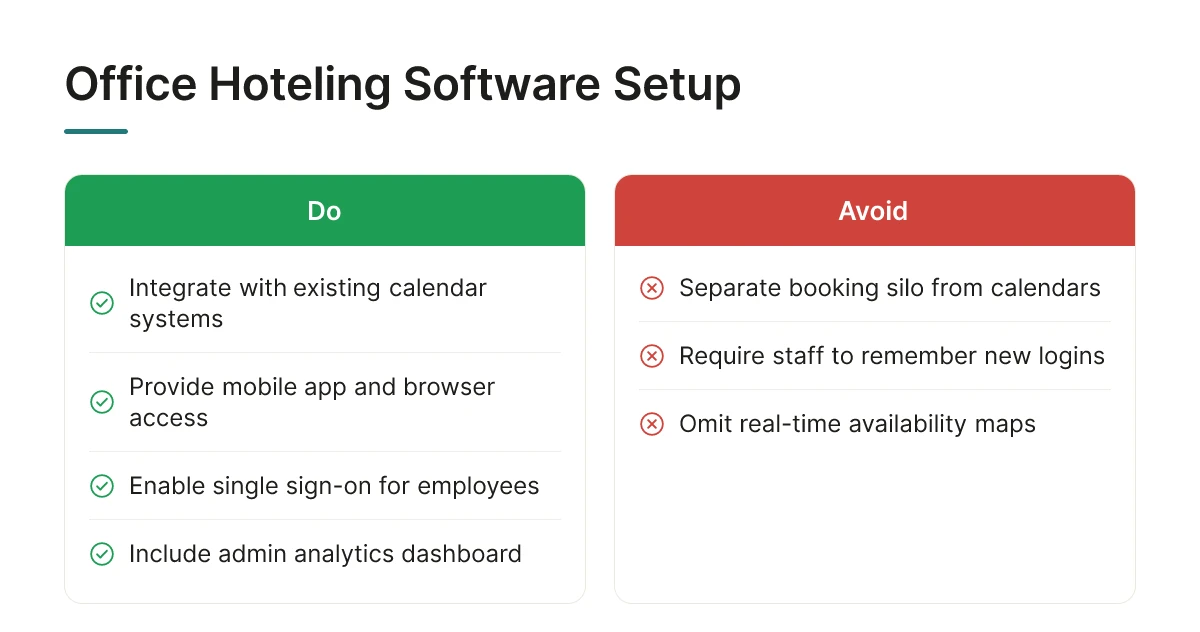
Running office hoteling reliably requires four software layers working together: a booking interface, a live availability map, calendar/SSO integration, and an admin analytics dashboard.
Employees need a simple way to reserve a desk before they arrive, through a mobile app, browser, or both, and a real-time map that shows which workspaces are open, reserved, or checked out. That front end only works if it connects to the calendar system employees already use, so a booking shows up next to their meetings instead of living in a separate silo. Single sign-on matters here too: asking staff to remember another login is a reliable way to kill adoption before it starts.
Behind the employee-facing layer sits the part that matters most to corporate real estate and finance leaders: the admin analytics dashboard. This is where raw booking data turns into a picture of how space actually gets used.
The best hoteling software is the one that turns booking data into forecasting and occupancy analytics, not just a reservation log, because a system that only lets people book desks tells you what happened yesterday, not what to do about your lease next year. This directly impacts what is office hoteling outcomes.
Booking volume alone is a weak signal. It captures intent, not actual arrival, and it says nothing about which days, floors, or teams are consistently over- or under-subscribed. Facilities teams making portfolio decisions need occupancy trends over months, not a snapshot of today's reservations. This is the gap Upflex is built around: its UnifyAI engine forecasts attendance with 97% accuracy, giving real estate leaders enough lead time to right-size a floor, consolidate a lease, or open access to on-demand workspace instead of signing new square footage.
When evaluating a platform, weigh it against four criteria: how easily employees actually adopt it, how deeply it integrates with existing calendar and directory systems, how granular its reporting gets (by team, floor, day of week), and whether it scales across a multi-site, multi-country portfolio without turning into a patchwork of regional tools.
IT teams should expect four integration points to need real engineering work: calendar sync, single sign-on, badge or access-control systems, and network provisioning for reconfigured zones.
Calendar sync sounds trivial until a hoteling platform has to reconcile conflicting invites across Outlook and Google Workspace at scale. Badge systems raise a harder question: many hoteling deployments tie a reservation to physical access, which means the booking platform and the access-control vendor need to talk to each other in near real time. Network provisioning is often overlooked, if hoteling shifts where people sit week to week, IT has to make sure Wi-Fi coverage and port density match the new zones, not the old fixed-desk floor plan.
Location and attendance data raise privacy questions that deserve a policy before rollout, not after. Employees will ask who sees their booking history and how long it's retained, answer that clearly, anonymize reporting at the individual level where possible, and involve HR and legal early rather than treating this as purely an IT rollout decision.
Office hoteling raises employee satisfaction for some workers and lowers it for others, and the split usually comes down to policy design rather than the concept itself. Losing a permanently assigned desk removes a routine and a piece of personal territory that some employees rely on for a sense of stability. Other employees, particularly those who value autonomy or split time across locations, treat the same flexibility as a benefit rather than a loss. This is particularly relevant for what is office hoteling.
The design choices an organization makes around desk-sharing determine which outcome dominates. Guaranteed booking priority for roles that need consistent access, such as managers running frequent in-person meetings, prevents the daily scramble that erodes goodwill. Anchoring specific teams to specific days keeps collaborators together instead of scattering them across the floor. Storage lockers for personal items address a smaller but persistent complaint: employees who can't leave a family photo or a spare charger at a desk often feel like guests in their own office.
Both effects show up in workplace discussions, and neither is universal, the deciding factor is usually how well managers communicate the system, not the system itself. Some employees report a reduced sense of belonging when they can't identify a "home base" in the office, which can chip away at engagement over time. Others describe increased autonomy: the ability to choose a quiet corner for focused work one day and a collaborative area the next, matched to the task at hand.
Manager communication moderates both outcomes. Teams that understand why hoteling exists, how booking works, and what to expect on a given day adapt faster than teams left to figure out an unfamiliar system on their own. Answering what is office hoteling clearly during rollout, not just circulating a booking app, prevents much of the early frustration that gets misattributed to the model itself.
Regulated industries need to treat hoteling as a compliance question, not just a facilities decision. Attendance and booking data collected through desk-reservation systems can qualify as employee records subject to retention and privacy rules, so legal and HR teams should confirm how long that data is kept and who can access it. Accessibility requirements don't disappear under hoteling, organizations still need a defined number of reserved, accessible desks that meet applicable standards, available on demand rather than by chance. Financial services, healthcare, and legal firms also need to address confidentiality at shared stations, since client information left on a screen or a desk after a reservation ends creates exposure that assigned seating didn't.
Satisfaction and retention connect directly. Predictable access to a workspace removes a friction point that, left unresolved, compounds with other hybrid-work irritations, unclear schedules, inconsistent policies, poor communication, until employees start looking elsewhere. Platforms like Upflex address this by pairing attendance forecasting with desk booking, so employees see availability before they commute in rather than discovering a full office on arrival.
Office hoteling delivers the most value for hybrid teams, but it can still work for fully in-office companies with fluctuating headcount, frequent travel, or multiple business units sharing one floor. Without variable attendance, the cost savings shrink because most desks get used every day. Companies with steady, five-day attendance typically get more value from assigned seating.
Many hybrid organizations target a ratio between 0.5 and 0.8 desks per employee, though the right number depends on actual attendance patterns. Setting the ratio too low without real utilization data risks desk shortages on peak collaboration days. When considering what is office hoteling, this point stands out.
Most employees need only a short walkthrough since booking a desk works much like reserving a meeting room. The bigger adoption challenge is behavioral, getting people to book ahead, cancel unused reservations, and follow shared etiquette rather than learning the software itself.
The desk usually sits empty unless the system has a no-show policy that releases it automatically. Most office hoteling platforms include auto-release rules, freeing a desk after a set check-in window, to prevent phantom bookings from distorting utilization data and blocking availability for colleagues.
Office hoteling only pays off when it's driven by real attendance data, not guesswork about which days teams show up. Getting the desk ratio right, setting clear no-show policies, and giving employees visibility into where their team sits are what separate a hoteling program that sticks from one that gets abandoned after six months. Platforms like Upflex address the forecasting gap directly, UnifyAI predicts attendance with 97% accuracy so real estate leaders can right-size their footprint with confidence rather than intuition. Before rolling out hoteling company-wide, audit four weeks of actual badge or booking data for your highest-traffic floor and use it to set your starting desk ratio.
Explore more from our content library: