Share This Article
No items found.

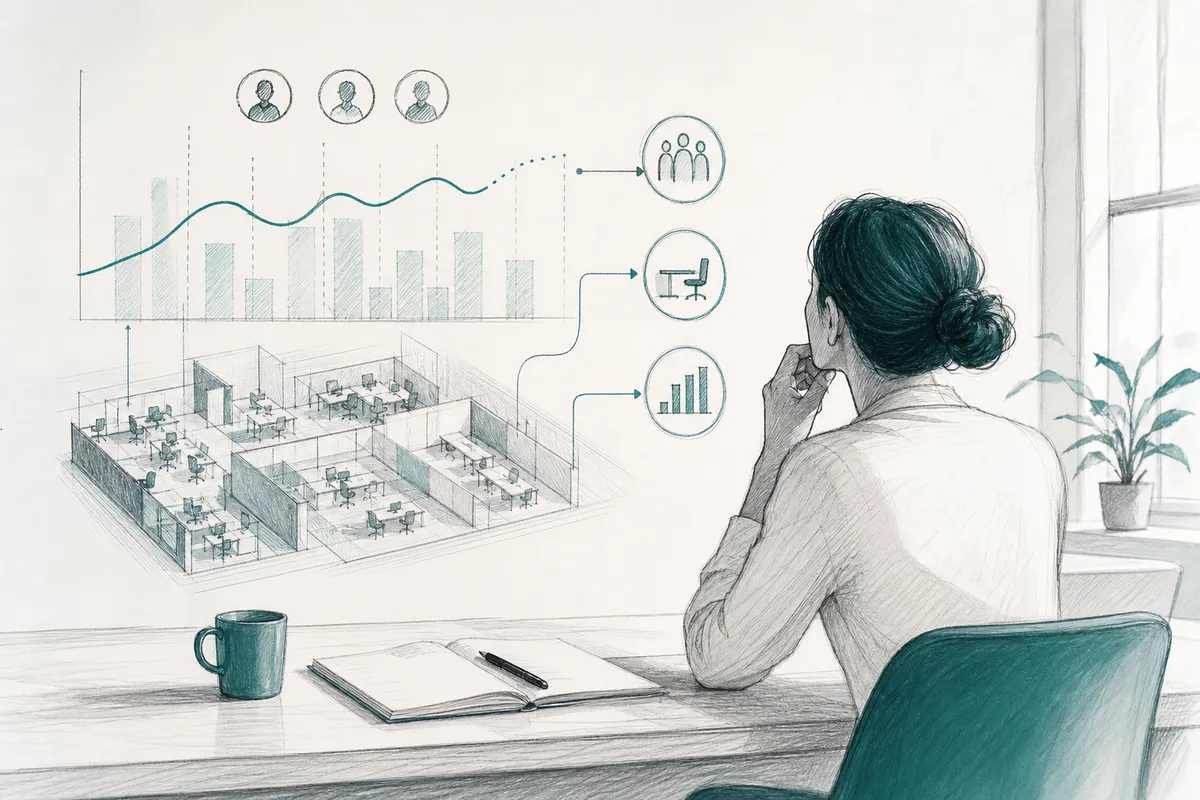
Predictive workplace demand forecasting uses historical attendance data, labor market signals, and machine learning to anticipate how many people will need workspace, and when, before the need arrives. Unlike supply chain forecasting, which predicts product volumes, workplace demand forecasting targets staffing levels, desk utilization, and skill availability across a hybrid workforce. Organizations using mature forecasting systems report attendance prediction accuracy above 95%, enabling real estate consolidation and measurable cost reduction.
Predictive workplace demand forecasting applies statistical models and machine learning to anticipate workforce presence, skill requirements, and space utilization, not inventory levels or product volumes.
Supply chain forecasting predicts units, lead times, and raw material needs. Workplace demand forecasting predicts headcount by location, desk demand by day, and labor skill mix across rolling time horizons, from next week's office attendance to next year's hiring pipeline. The inputs, model structures, and decision outputs are fundamentally different. For a broader grounding in how demand forecasting works across domains, IBM's overview of demand forecasting provides a useful baseline before examining the workplace-specific variables.
For Corporate Real Estate leaders, an accurate forecast directly determines whether a lease renewal makes financial sense. For HR leaders, it sets hiring timelines and flags skill gaps before they become operational problems.
Without forecast data, both functions rely on lagging indicators, badge swipes, headcount reports, exit interviews, that describe what already happened. Predictive forecasting shifts the decision window forward, giving leaders enough lead time to act on real estate portfolio consolidation or workforce planning before costs compound.
Upflex's UnifyAI engine demonstrates what mature workplace forecasting looks like in practice: it predicts office attendance with 97% accuracy, giving Corporate Real Estate teams the confidence to right-size their portfolio rather than hedge with excess square footage.
Workplace variables behave differently from product demand curves [1]. Employee turnover, hybrid schedule variability, and skill shortages don't follow the same seasonal rhythms as consumer purchasing, they respond to labor market conditions, internal policy changes, and team-level dynamics that standard supply chain models aren't built to capture.
Effective workplace demand forecasting incorporates inputs like voluntary attrition rates, role-specific vacancy timelines, and day-of-week attendance patterns. Those variables require model architectures tuned specifically to workforce behavior, not unit economics [2].
A workplace demand forecasting system ingests attendance signals, runs them through a trained model, and outputs day-level or week-level occupancy predictions your team can act on.
The data pipeline draws from multiple sources simultaneously: badge swipe records, calendar invites, HRIS headcount data, project schedules, public holidays, and local events such as conferences or transit disruptions. Each source contributes a different signal, badge data shows who actually arrived; calendar data shows who planned to arrive. The gap between those two numbers is where most forecasting systems find their edge.
Once ingested, raw data goes through feature engineering, transforming timestamps and headcount fields into variables the model can weight, such as "team A's Tuesday attendance rate in Q3" or "post-holiday return lag." The model trains on those features, generates a prediction, and then closes the loop: actual attendance figures feed back in after each cycle, retraining the model on the delta between predicted and observed. That feedback loop is what separates a static spreadsheet from a live predictive workplace demand forecasting system.
Forecast horizons also vary by use case. Daily desk booking predictions need accuracy at the individual-team level, while 12-month real estate planning forecasts operate at portfolio scale. Models must be tuned separately for each horizon, a single model calibrated for daily booking will systematically underfit the variance needed for lease-renewal decisions.
Hiring surges and attrition spikes degrade forecast accuracy fast when models treat headcount as a fixed input rather than a dynamic variable.
A team that grows from 40 to 65 people in a quarter doesn't simply scale its attendance linearly, new hires often work differently from tenured employees, showing lower in-office rates in their first 60 days. Similarly, a wave of departures in one department can make a floor that looked 70% utilized suddenly drop to 45%, invalidating space allocation decisions made on older predictions.
Remote work norms compound this. If a business unit shifts from three in-office days per week to two following a policy update, any model that encoded the old pattern as a static assumption will overforecast demand for weeks until enough new observations retrain it [1]. The fix is to flag policy-change events as model inputs, not just attendance outcomes, so the system recalibrates immediately rather than waiting for the feedback loop to catch up organically. Understanding how modern supply chain and workforce forecasting methodologies converge is explored further in SAP's resource on demand forecasting for the modern supply chain, which highlights the data pipeline principles that apply equally to workforce contexts.

Forecast accuracy in workplace demand depends on five variables that generic demand models don't measure: turnover rate, role-based attendance, co-location requirements, hiring cycles, and skill gap timelines.
Voluntary turnover rate is the most disruptive input, a single wave of departures can shift space demand by 10–20% within a quarter. Role-based attendance patterns add another layer: a finance team that comes in every Tuesday behaves nothing like a sales team that travels Monday through Thursday. Predictive workplace demand forecasting models that ignore these distinctions produce headcount projections that are technically correct but operationally useless.
Hybrid work introduces non-linear attendance curves that supply chain models aren't built to handle. Tuesday and Wednesday typically draw 40–60% more badge swipes than Monday or Friday, according to workplace utilization studies from JLL and CBRE. Day-of-week weighting, assigning different demand coefficients to each day, is a basic requirement for any model running against a hybrid office population.
Skill gap forecasting is a separate variable entirely. The question isn't just how many people will be present, but which skills will be available and when. A planned product launch that requires 12 senior engineers hits differently if half of them are on a hiring pipeline with a 90-day lead time.
External labor market signals sharpen the picture further. Layering in local unemployment rates, competitor hiring activity tracked through job board data, and graduate cohort timing gives HR leaders early warning of supply-side shifts before they register in internal headcount data. The IBM demand forecasting framework outlines how external signal integration strengthens model accuracy, a principle that applies directly to workforce and real estate planning.
Variable quality directly determines financial outcomes. Organizations that instrument more workplace-specific inputs consistently achieve higher forecast accuracy, and that accuracy translates into measurable real estate savings. Upflex clients using the UnifyAI attendance forecasting engine, which processes role-based and day-of-week attendance signals, achieve 97% forecast accuracy and report real estate spend reductions of 40% or more. The causal chain is direct: better input variables produce tighter predictions, tighter predictions justify portfolio consolidation decisions, and consolidation cuts fixed costs.
The inverse is equally true. A model fed only headcount and floor plans, without turnover rates, skill timelines, or hybrid attendance curves, will consistently over-provision space and under-flag hiring risk, leaving both real estate and workforce budgets exposed.
Statistical models offer interpretability and work with limited data; ML models handle complex patterns but need larger datasets, most enterprises benefit from both.
Traditional methods like ARIMA and exponential smoothing are well-suited to predictive workplace demand forecasting when attendance patterns are stable and historical data is sparse. They produce outputs that HR and finance stakeholders can read and explain to leadership, a real advantage when budget decisions hinge on the forecast.
ML approaches, gradient boosting and neural networks in particular, detect non-linear relationships that statistical models miss: the interaction between weather, day of week, team composition, and a product launch deadline, for example. The trade-off is data volume. These models typically require 12 to 24 months of clean historical records before they produce reliable predictions. For a detailed comparison of how these model types perform across different forecasting contexts, SAP's demand forecasting resource covers the architectural trade-offs between statistical and machine learning approaches.
A hybrid architecture uses statistical baselines for predictable, recurring attendance patterns and layers ML on top to flag anomalies, sudden spikes during a return-to-office mandate, or drops caused by an organizational restructure. This combination raises accuracy potential significantly.
The cost is complexity. Hybrid models require longer validation cycles, dedicated data science resources, and careful governance to avoid conflicting outputs. Organizations without in-house data science teams should look for vendors that abstract this complexity, Upflex's UnifyAI engine, for instance, delivers 97% attendance forecast accuracy without requiring customers to manage the underlying model architecture themselves.
Explainability remains a genuine constraint. Black-box ML outputs frustrate finance and HR stakeholders who need to justify headcount or lease decisions. A statistical-first or hybrid architecture, where the ML layer supplements rather than replaces interpretable baselines, tends to earn faster internal sign-off.
Workforce size and schedule consistency are the two variables that matter most when choosing a model type.
Effective predictive workplace demand forecasting depends on four integration points: HRIS platforms, calendar tools, badge systems, and space management software.
Each data source serves a distinct role. Your HRIS supplies headcount, role, and team structure data. Calendar and collaboration tools, Microsoft 365 and Google Workspace are the most common, surface attendance signals before employees physically arrive. Badge and access control systems provide ground-truth validation of who actually came in. Space management software closes the loop by recording which desks and rooms were used.
The most common reason forecasts underperform in the first 90 days is fragmented HR data at the integration layer. When headcount records live in one system, scheduling data in another, and badge logs in a third with no clean join key, the model trains on noise rather than signal.
On the technical side, you need API access to each source system, a minimum of 12 months of historical attendance or booking data, and a defined governance process for model retraining as workforce composition changes. Without that retraining cadence, accuracy degrades as teams restructure or hybrid policies shift.
Deployment options split into two tiers. Purpose-built workplace intelligence platforms, Upflex sits in this category, with its UnifyAI engine and pre-built connectors, operate at a premium/enterprise price point but deliver faster time-to-value because the integrations are ready out of the box. General BI tools at a budget-friendly to mid-range tier offer more configuration flexibility but require significant custom build to reach comparable forecast accuracy.
The practical path for most enterprises is augmentation, not replacement. Forecasting layers should sit on top of existing HRIS investments, pulling data without duplicating workflows. Organizations that treat forecasting as an add-on to current workforce management platforms, rather than a competing system, see faster adoption and cleaner data pipelines from day one.

Modern AI-driven systems can reach 97% attendance forecast accuracy, Upflex's UnifyAI engine hits that benchmark in production environments. Accuracy at that level depends on consistent data inputs: calendar integrations, badge reads, and booking signals all feeding the model continuously. Simpler rule-based or statistical methods typically land in the 70–85% range, which is enough for rough capacity planning but too imprecise for decisions like lease consolidation or floor decommissioning.
Most AI forecasting models need a minimum of three to six months of utilization data before predictions stabilize into reliable patterns. Badge access logs, desk booking records, and calendar data from that period give the model enough signal to distinguish recurring weekly rhythms from one-off anomalies. Organizations with less history can still run forecasts, but should treat early outputs as directional estimates rather than decision-grade predictions until the dataset matures.
Mid-sized companies with 200 or more employees and at least two office locations see clear returns from workplace demand forecasting. The business case is strongest where real estate is a top-three operating cost and attendance is genuinely unpredictable across hybrid teams. Smaller organizations with a single office and stable headcount may find that simpler scheduling tools cover their needs, the ROI on a full forecasting platform scales with portfolio complexity and the cost of carrying underused space.
Good forecasting platforms treat disruptions as a model-retraining event rather than an edge case. When a return-to-office mandate takes effect, the system ingests the new attendance signals over the following four to eight weeks and recalibrates its baseline. Upflex's UnifyAI engine, for example, continuously updates predictions as new scheduling and booking data flows in, so the model reflects current behavior rather than pre-disruption patterns. Manual override inputs, like a policy change date, help the system weight recent data more heavily during the transition window.
Workforce planning is a broader strategic process that covers hiring, succession, and skills development over multi-year horizons. Predictive workplace demand forecasting is a narrower, data-driven discipline focused on anticipating near-term space utilization, headcount presence, and skill availability, typically across daily, weekly, and quarterly windows. The two practices complement each other: forecasting provides the granular, real-time signal that makes long-range workforce planning decisions more accurate and defensible to leadership.
Predictive workplace demand forecasting shifts real estate decisions from gut feel to measurable evidence. The organizations getting the most from it share three practices: they feed the model clean, continuous data from multiple sources; they tie forecast outputs directly to portfolio decisions like lease renewals and floor consolidations; and they track co-attendance outcomes, not just occupancy rates, to confirm that space reductions don't erode team collaboration.
If your organization is approaching a lease decision or a return-to-office initiative in the next 12 months, start by auditing the utilization data you already hold, badge logs, booking records, calendar signals, and identify the gaps. That audit will tell you exactly how ready your data is to support a forecasting model, and where to invest first.
Explore more from our content library: