Share This Article
No items found.


Workplace ROI measurement is the process of quantifying the financial and operational return generated by workplace investments, from real estate and technology to training and flexibility programs. It works by comparing measurable benefits (cost savings, productivity gains, retention improvements) against total program costs. Organizations that measure workplace ROI consistently make faster real estate decisions, reduce wasted spend, and build a defensible business case for every workplace initiative.
Workplace ROI measurement compares total program benefits, financial and operational, against total investment costs, expressed as a percentage or dollar ratio.
That definition matters because "ROI" gets used loosely. A vague sense that a new office policy "feels productive" is not ROI measurement. A structured calculation that sets a documented baseline, captures all cost inputs, and quantifies outputs in the same currency, that is.
The formula itself is straightforward: (Total Benefits − Total Costs) ÷ Total Costs × 100. What makes workplace ROI distinct from general business ROI is the range of benefits it must capture. Direct savings, reduced square footage, lower lease costs, consolidated facilities, are only part of the picture. Indirect returns like lower employee turnover, higher output per person, and improved talent attraction carry equal weight and must be quantified, not assumed.
On benchmarks: any positive return clears the basic bar. A 20–30% ROI is considered solid for workplace initiatives. Returns above that signal a high-performing program worth scaling across the portfolio.
Organizations that skip structured measurement default to legacy space assumptions, office footprints sized for pre-2020 attendance patterns that no longer reflect reality. That gap between assumed and actual utilization is where real estate spend inflates. Companies with active measurement programs are better positioned to cut 40%+ in real estate costs [3] because they can prove which space is underused and act on that data with confidence.
"You can't manage what you don't measure — and in workplace strategy, the cost of not measuring is paid in wasted square footage, unnecessary lease commitments, and talent you didn't retain." — Jack Phillips, Chairman at ROI Institute
Traditional workplace ROI tracks square footage, lease cost per head, and facility operating expenses. Remote and hybrid programs require a different metric set.
When employees work from home, the cost inputs shift: home-office stipends, collaboration software licenses, and digital infrastructure replace much of the physical overhead. The benefit side shifts too, you can no longer measure output by desk occupancy. Instead, you track digital productivity proxies: project completion rates, output volume per employee, and meeting attendance data.
Hybrid programs sit between both worlds and carry the added complexity of variable attendance. Without forecasting tools that predict who will be in the office and when, space allocation decisions revert to guesswork, and guesswork is expensive. According to Upflex's research on workplace flexibility ROI, platforms that combine attendance forecasting with utilization data give corporate real estate teams the inputs they need to run an honest ROI calculation rather than one built on assumptions.
Workplace ROI measurement uses one formula: ROI (%) = [(Total Benefits − Total Costs) ÷ Total Costs] × 100, applied to quantified workplace data.
Each variable maps directly to real numbers. Benefits include reduced attrition costs, productivity gains, and real estate savings. Costs include program spend, implementation, and ongoing management overhead. Run the formula without populating both sides completely, and the output is misleading.
Before any calculation, you need a baseline. ROI is meaningless without a pre-initiative benchmark, establish one using historical headcount costs, absenteeism rates, or space utilization data from the 12 months before a program launches. Without it, you have no denominator for improvement.
Four benefit categories must be monetized for training and workplace program ROI specifically:
Replacement hiring costs deserve particular attention. According to SHRM's guidance on measuring training ROI, the cost to replace an employee ranges from 50% to 200% of annual salary [1], depending on role complexity. Tracking that figure before and after a program gives you a hard dollar benefit to plug into the formula.
Platforms like Upflex generate space utilization data automatically, occupancy rates, co-attendance frequency, desk booking patterns, which feeds directly into the real estate savings variable without manual data collection.
Three problems consistently distort workplace ROI calculations. First, the attribution problem: isolating the effect of a workplace program from concurrent business changes, a new manager, a product launch, a market shift, requires a control group or a pre/post design with documented external variables.
Second, converting soft metrics like engagement scores into dollar figures demands a defensible conversion methodology, not a guess. Tie engagement to turnover probability using your own historical data [2], then apply your replacement cost figure.
Third, organizations without HRIS or space utilization systems face data gaps that make benefit quantification impossible. Partial measurement, tracking only costs, not benefits, systematically undervalues workplace programs and produces the cuts that damage long-term performance most.
"The organizations that struggle most with workplace ROI aren't failing to collect data — they're failing to connect the data they already have. Space data and people data live in separate systems, and the insight only emerges when you bring them together." — Diane Gherson, Former CHRO at IBM
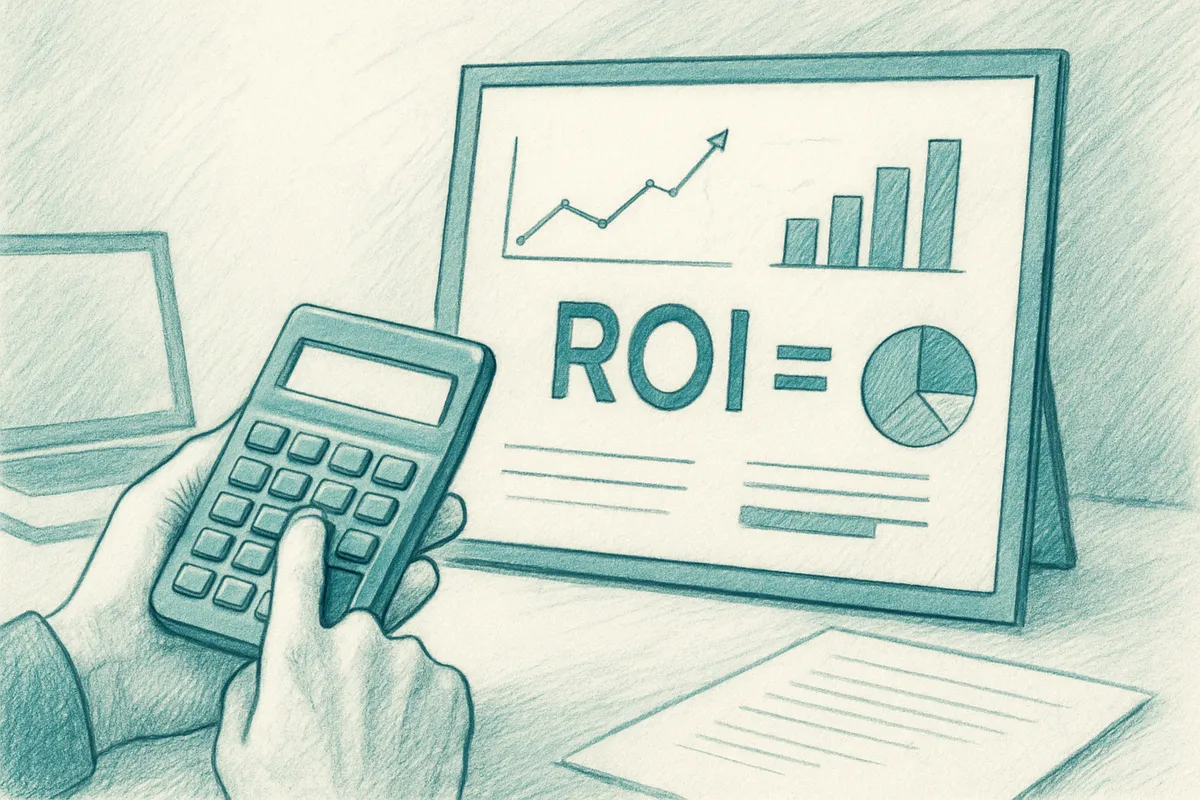
Three frameworks dominate workplace ROI measurement: the Kirkpatrick Model, the Phillips ROI Methodology, and custom composite scorecards, each suited to a different organizational context.
Kirkpatrick's four levels, Reaction, Learning, Behavior, and Results, were designed for training evaluation and excel there. The model captures whether employees responded well to a program, whether they retained knowledge, whether behavior changed, and whether business results followed.
Its weakness for real estate or flexibility initiatives is structural: it stops short of converting outcomes into financial terms. A corporate real estate leader cannot bring a Kirkpatrick report to a CFO review and expect budget approval based on "positive behavioral change."
Phillips adds a fifth level to Kirkpatrick's framework: explicit financial conversion. It also introduces an isolation technique, a controlled step that separates the program's contribution from external variables like market conditions or headcount shifts. That isolation step is what makes Phillips the gold standard for CFO-ready reporting, because it answers the question finance always asks: "How do we know this program caused the result?"
Organizations with mature data infrastructure often build proprietary scorecards that combine utilization rates, eNPS scores, attrition cost, and space cost per head into a single composite metric. Upflex customers, for example, can draw on utilization data and attendance forecasting outputs to populate these scorecards across a multi-site portfolio. The trade-off is front-loaded: reliable output requires significant data infrastructure investment before the model produces numbers worth acting on.
The decision rule is straightforward. Use Kirkpatrick for early-stage program evaluation, when speed matters more than financial precision. Apply Phillips when you need to justify budget to finance leadership, its isolation methodology holds up under scrutiny. Build a custom model when you're managing a multi-site hybrid portfolio at scale and need a single composite view that reflects your specific cost structure and workforce dynamics.
Kirkpatrick is fast but not boardroom-ready. Phillips is rigorous but resource-intensive. Custom models are precise but demand the data foundation to earn that precision.
Converting soft outcomes into dollars requires assigning a replacement cost, output delta, or hiring metric to each benefit, then multiplying by headcount or frequency.
Retention ROI starts with your voluntary attrition rate. Multiply it by average replacement cost, HR literature consistently estimates this at 50–200% of annual salary, depending on role seniority [2], and you get a baseline dollar figure. Any workplace initiative that measurably reduces attrition can be credited against that number to produce a defensible return.
Productivity ROI follows a similar structure. Establish a revenue-per-employee or output-per-hour baseline before the initiative launches. After a defined period, typically one quarter, measure the same figure, calculate the delta, and multiply by headcount. That product is your total productivity gain in dollar terms, the kind of number a CFO can act on.
Talent acquisition ROI is trackable through your ATS. A stronger employer brand, built partly on workplace quality, reduces time-to-fill and cost-per-hire. Both metrics are already captured in most recruiting systems; converting them to dollars is straightforward once you know your average cost per open requisition-day.
Employee experience and culture scores, eNPS, engagement survey results, are leading indicators, not financial metrics on their own [2]. The financial conversion requires internal historical data: link a one-point eNPS improvement to an observed reduction in attrition or a measurable productivity increase, then apply that ratio forward. According to Reward Gateway's analysis of employee experience ROI, organizations that systematically connect engagement data to financial outcomes consistently outperform those that treat them as separate reporting streams.
Workplace ROI measurement also requires industry-calibrated benchmarks. Technology and professional services firms typically see the highest productivity returns from flexibility programs; manufacturing and logistics operations see stronger ROI from safety and scheduling initiatives. Before applying any benchmark, source it from a relevant industry association and adjust for your company's headcount and cost structure.
Four tool categories cover the full spectrum of workplace ROI measurement: space utilization platforms, HRIS and people analytics tools, FP&A software, and integrated workplace management systems.
Space utilization platforms pull sensor and badge data to show which desks, floors, and meeting rooms are actually occupied, and when. HRIS and people analytics tools track attrition rates, engagement scores, and output per employee. FP&A software models real estate costs against headcount and lease commitments. Integrated workplace management systems (IWMS) combine space and people data in a single dashboard, giving corporate real estate and finance leaders one source of truth instead of three disconnected reports.
The gap between "employees feel better" and "the business saved money" closes when platforms ingest both data types simultaneously. A system that correlates engagement survey scores with desk-booking frequency can surface patterns, for example, teams with higher booking flexibility showing measurably lower attrition, that a manual spreadsheet analysis would never catch. Upflex's UnifyAI engine applies this logic at scale, pairing attendance forecasting with utilization data to produce the kind of before-and-after comparisons that justify real estate portfolio decisions.
When evaluating any ROI tracking platform, look for four capabilities:
Tool tiers follow a predictable pattern. Budget-friendly options cover a single data stream, space or people, not both. Mid-range platforms integrate two or three sources. Premium and enterprise solutions add AI-driven forecasting and scenario modeling across the full portfolio.
Organizations without dedicated tooling don't need to wait for perfect infrastructure. A structured spreadsheet using publicly available cost benchmarks, average cost per square foot by market, median attrition replacement cost, gives you a working measurement cadence from day one. The discipline of consistent data collection matters more than the sophistication of the tool you start with. Migrate to purpose-built platforms as your measurement practice matures.

A 20% ROI means you gained $1.20 for every $1.00 invested, a positive but modest return for most corporate real estate decisions. Whether 30% is "high" depends on the initiative type and your cost of capital. A desk-consolidation project that cuts fixed lease costs tends to produce returns above 40%, while employee experience programs often land in the 15–25% range because benefits like retention savings are harder to fully quantify.
The most common barrier is the absence of a pre-program baseline, without documented utilization rates, turnover costs, or productivity benchmarks, you have nothing to measure against. Organizations also struggle to assign dollar values to soft outcomes like engagement or collaboration quality [2]. A third challenge is data fragmentation: badge systems, desk booking tools, and HR platforms rarely share data, so building a single view of costs and outcomes requires deliberate integration work before measurement can begin.
Training ROI is calculated by dividing net program benefits, productivity gains, error reduction, faster time-to-competency, by total program costs, then multiplying by 100 [1]. The metrics that matter most are post-training output per employee, reduction in quality errors, and time-to-proficiency for new hires. Kirkpatrick's four-level model and Phillips's ROI Methodology are the two most widely used frameworks for converting those outcomes into a defensible dollar figure [1].
Yes, a structured spreadsheet tracking space costs, headcount, and utilization rates produces credible ROI data without specialized tools. Start with three inputs: total real estate cost per employee, average desk occupancy, and voluntary turnover rate. Mid-market companies that build this baseline manually often find they have enough data to justify a platform investment within one or two quarters of consistent tracking.
Quarterly reviews are the recommended minimum for active workplace programs. Annual reporting misses seasonal attendance shifts, mid-year policy changes, and the early warning signs of underperforming initiatives. Organizations managing hybrid or multi-site portfolios benefit from monthly utilization snapshots paired with quarterly financial reconciliations, ensuring that real estate decisions are always grounded in current data rather than year-old assumptions.
Workplace ROI measurement is only as reliable as the baseline you build before any initiative launches. Document your cost-per-seat, utilization rate, and turnover figures now, those three numbers will determine whether your next real estate or hybrid work decision looks defensible to a CFO or guesswork in hindsight.
Two actions matter most: first, connect your space data to your people data so you can see cost and behavior in the same view; second, set a measurement cadence, quarterly reviews catch drift that annual reports miss entirely.
As a concrete next step, pull your last 12 months of badge or desk booking data and calculate your actual peak versus average occupancy gap. That single number tells you how much space you are paying for that no one is using, and it is the starting point for every ROI conversation worth having. Platforms like Upflex surface that gap automatically, with attendance forecasting accurate to 97%, so your next portfolio decision rests on data rather than assumption.
Explore more from our content library: