Share This Article
No items found.


Workplace real estate agility is the ability of an organization to rapidly scale, shrink, or reconfigure its physical office footprint in response to changing workforce demand, without being locked into long-term leases or fixed costs. Companies that build this capability cut real estate spend by 30–40% while maintaining or improving employee experience. In 2026, with hybrid work patterns still volatile and economic pressure on CRE budgets intensifying, agility has moved from competitive advantage to operational necessity.
Workplace real estate agility is the capacity to adjust portfolio size, location mix, and lease commitments dynamically, based on live demand data, with decisions that can be reversed.
That last word matters. Generic "flexibility" often means short-term leases or open floor plans. Agility means something more specific: the organizational ability to act on utilization signals quickly, change course without catastrophic exit costs, and treat space as a variable input rather than a fixed overhead line. Speed, data-dependence, and reversibility are what separate it from traditional portfolio management.
"Agility in real estate is not about doing things faster — it is about building the organizational capacity to change direction without penalty when the data tells you to." — Scrum Alliance Research Team, Agile and Real Estate: Success of Agility in Evolving Industry
Consider a 500-person company that exited a 50,000 sq ft headquarters lease and replaced it with a 20,000 sq ft anchor office plus access to an on-demand workspace network for distributed employees. The result: $2.1M in annual savings, with employees retaining access to professional workspaces in every city where they live.
That model is now the benchmark, not the exception. Companies with rigid portfolios carry 30–40% more real estate cost than their actual occupancy demands [2], a gap that post-pandemic utilization data has made impossible to ignore. Average office utilization in most major markets still sits below 60% [2], meaning a significant share of every square foot a company pays for sits empty on any given day.
Three forces make this urgent in 2026 specifically: hybrid attendance remains volatile and hard to predict week-to-week; per-square-foot costs in gateway cities like New York and London have continued to climb; and CFOs are explicitly pushing to reclassify real estate from fixed to variable cost on the balance sheet.
Yes, and the reason is arithmetic. Commercial leases run 3–10 years [2]. Organizations that didn't restructure their portfolios between 2022 and 2024 are now mid-cycle, locked into overcapacity they can't easily exit.
For those teams, building portfolio agility isn't a future-state aspiration. It's the active work of minimizing damage from decisions already made, while building the data infrastructure and lease structures that prevent the same trap at the next renewal.
An agile approach to real estate breaks into four distinct types: financial, spatial, temporal, and organizational, each requiring its own measurement approach.
Agile methodology maps directly onto corporate real estate when you replace software sprints with portfolio cycles. The four pillars work as follows:
The most commonly neglected pillar is organizational agility. Most CRE teams invest in reconfigurable floor plans and flexible leases, then leave decision governance slow, a contradiction that cancels out the physical flexibility they've built.
According to Scrum Alliance's research on agility in real estate, organizations that apply iterative planning cycles to portfolio management consistently outperform peers on both cost efficiency and employee satisfaction metrics.
Each agility type has a corresponding KPI that makes progress visible and comparable across quarters.

Scrum, Kanban, and Lean each solve a different real estate problem, choose the wrong one and you add process without cutting costs.
Scrum works best for large, defined transformation projects, a 12-month HQ consolidation, a multi-site lease restructuring, or a full portfolio audit. Teams break the work into two-week sprints, each with a specific deliverable: a completed lease negotiation milestone, a vendor RFP submission, or a space design sign-off. It requires a dedicated corporate real estate team and works best at enterprises with 1,000 or more employees who can staff a sprint team without pulling people off daily operations.
Kanban suits ongoing portfolio operations. It visualizes the continuous flow of lease renewals, maintenance requests, and desk allocation changes on a shared board, no sprints, no defined phases. The overhead is low, adoption is fast, and it fits mid-market companies (200–999 employees) that lack a formal project management office but still need visibility into what's moving and what's stalled.
Lean targets waste directly: unused square footage, redundant vendor contracts, over-engineered fit-outs that cost more to maintain than they return in productivity. Applied to portfolio management, Lean typically delivers 15–25% cost reduction in year one, but only when teams have accurate utilization data to identify where the waste actually sits.
Lean delivers the fastest payback, usually within 6 to 12 months, because it attacks cost immediately rather than restructuring process first. Scrum delivers the most structured outcome for complex, multi-phase portfolio transformations. Kanban carries the lowest implementation cost and the shortest learning curve for teams new to agile methods.
Industry also shapes the fit. Professional services firms, law, consulting, accounting, tend to get the most from Kanban because their space needs shift continuously with client engagements. Tech and media companies running large HQ consolidations benefit from Scrum's phased discipline. Manufacturing and logistics operations, where square footage waste is measurable and immediate, see the sharpest returns from Lean.
Building an agile real estate strategy requires five sequenced steps: audit, target-setting, piloting, change management, and continuous review.
Map every lease by expiration date, cost per seat, and actual utilization rate. Flag any lease expiring within 24 months, that's your first agility window, and the decision point where renegotiation or exit is still possible.
This audit alone typically surfaces 20–30% of footprint that can be shed or renegotiated [2]. Most CRE teams find the data already exists across badge systems and IWMS exports, the problem is it has never been consolidated into a single view.
Define your target ratio of fixed to flexible space before touching a single lease. The industry benchmark for hybrid-first organizations is 60% fixed, 40% flexible [2]. Align that ratio with HR's headcount forecast and Finance's preference for shifting CapEx to OpEx.
Pick one market or one building and run a 90-day sprint. Introduce on-demand workspace access, measure utilization weekly, and compare cost-per-seat against the legacy lease at the end of the sprint. Upflex's on-demand workspace network gives teams access to third-party spaces during the pilot without signing a new lease, so the cost comparison is clean and the risk is contained.
The two most common blockers are manager resistance, "I need my team visible", and employee uncertainty about whether a desk will be available when they come in. Both are solvable, but only if you address them directly rather than assuming adoption will follow policy.
"The biggest barrier to real estate transformation is not the lease — it is the belief that presence equals productivity. Until leaders let go of that assumption, no amount of flexible space will deliver its full value." — Upflex Research Team, Real Estate Agility: Why Leaders Embrace It
Counter manager resistance with transparent booking data that shows actual team presence, not just badge swipes. Counter desk anxiety with guaranteed neighborhood seating for teams that need it, a defined zone, not a specific desk, is enough to reduce uncertainty without locking down space.
Replace the annual planning cycle with quarterly portfolio reviews. Each review uses fresh occupancy data to adjust the flexible-to-fixed ratio and flag the next lease decision before it becomes urgent. Platforms like Upflex surface this utilization data automatically, so the review becomes a 60-minute decision meeting rather than a weeks-long data-gathering exercise.
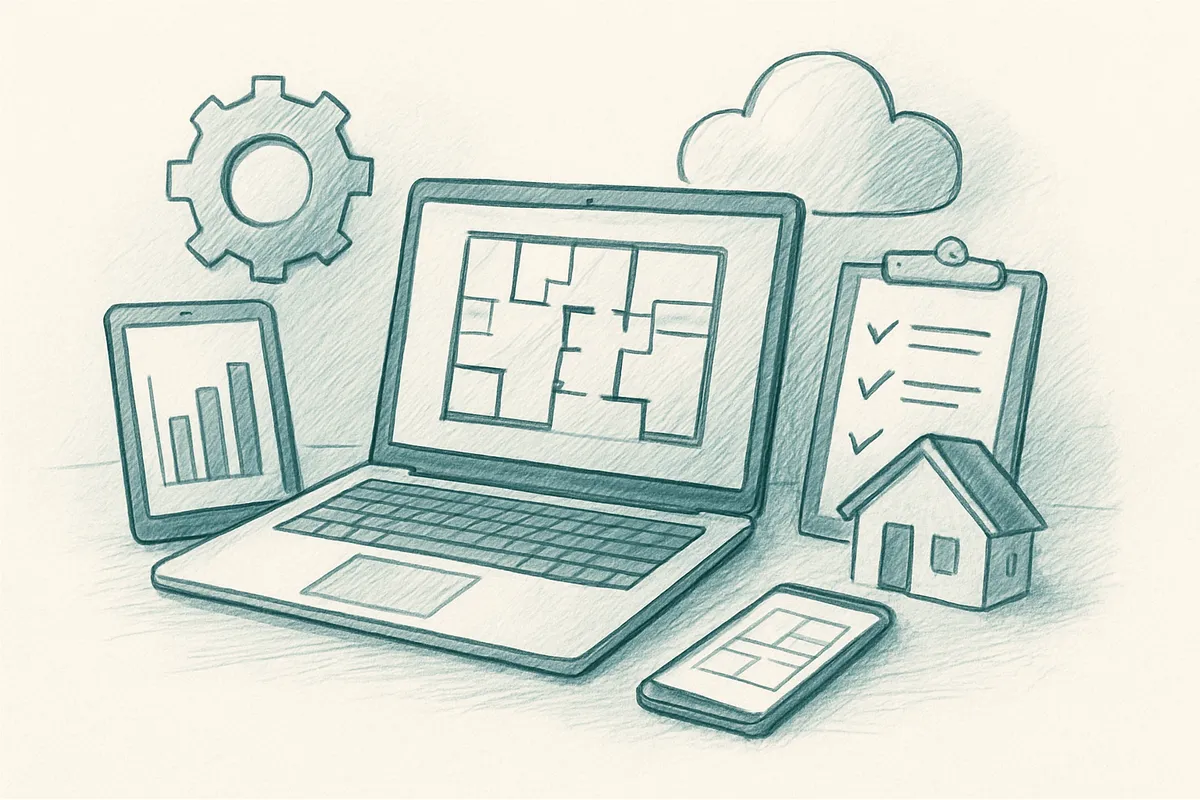
Workplace real estate agility runs on a three-layer technology stack: an IWMS or CAFM platform, an occupancy intelligence layer, and an on-demand workspace network.
Most IWMS platforms, Archibus, Planon, IBM TRIRIGA, are authoritative records for lease data, space inventory, and maintenance schedules. What they rarely do is connect to real-time occupancy sensors or on-demand booking systems. That gap means CRE teams make portfolio decisions on utilization data that can be weeks or months old.
The fix is bidirectional data flow. Agile tools must write actual utilization data back to the IWMS, not just pull from it. One-way data flows break the feedback loop entirely: the IWMS shows planned capacity, not real occupancy, and lease decisions get made on the wrong numbers.
An API layer, or a platform that natively bridges booking, sensor, and lease data, closes this gap. Without it, the three layers operate as silos and the agility benefit disappears.
The stack that produces measurable results has four components working together:
AI-driven attendance forecasting is the newest layer and the one with the highest impact on portfolio decisions. Forecast accuracy above 90% lets CRE teams plan for actual demand rather than peak headcount, the difference between a lease renewal that fits and one that locks in 30% more space than the business uses [2].
Workplace flexibility describes how and where employees work; workplace real estate agility describes how quickly a company can resize, repurpose, or exit its physical portfolio in response to demand changes. Flexibility is an HR and scheduling concept, remote work, hybrid schedules, flexible hours. Real estate agility is a portfolio management discipline: it governs lease structures, space allocation cycles, and the data systems that tell you when to act. The two are related, but agility operates at the asset and cost level, not the employee-experience level.
Companies that shift to agile real estate models typically report portfolio cost reductions of 30–40% [2]. The savings come from three sources: consolidating underused owned space, replacing long-term leases with shorter or flex-space commitments, and using utilization data to avoid renewing space that employees don't actually occupy. Results vary by portfolio size and starting utilization rate, a company running at 35% average occupancy has more to gain than one already at 70%.
Most organizations see measurable utilization data within 60–90 days of deploying a workplace management platform, but portfolio-level cost reductions typically take 12–24 months because lease exit timelines govern the pace. The fastest wins come from consolidating floors or buildings ahead of scheduled renewals. Companies that start with accurate attendance forecasting, rather than badge data or manual counts, compress that timeline because they can make consolidation decisions with confidence earlier.
Yes, though the tools and tactics differ from enterprise deployments. Smaller companies benefit most from avoiding long-term lease commitments in the first place, starting with shorter lease terms or coworking memberships rather than retrofitting a fixed portfolio. The core principle still applies: match space supply to actual demand using real occupancy data rather than headcount assumptions. The payoff per square foot can be proportionally larger for smaller companies because fixed overhead represents a higher share of operating costs.
Traditional corporate real estate management relies on long planning cycles, multi-year lease commitments, and headcount-based space formulas that are set annually and rarely revisited. An agile approach replaces those fixed cycles with quarterly reviews, live occupancy data, and lease structures designed for reversibility. The practical difference is speed: traditional CRE teams often take months to respond to a headcount change; agile teams can adjust space allocation within days by drawing on on-demand workspace networks and pre-negotiated flex agreements.
Workplace real estate agility is not a cost-cutting exercise, it is a structural shift in how your organization makes space decisions. The companies reducing portfolio spend by 30–40% [2] are doing three things consistently: measuring actual occupancy rather than assuming it, building lease flexibility into every renewal cycle, and treating attendance forecasting as a prerequisite for any consolidation decision.
If your next lease renewal is within 18 months, that deadline is your most actionable starting point. Pull your current utilization data, identify which floors or locations are running below 50% average occupancy, and use that evidence to open a renegotiation or exit conversation before the renewal window closes. That single move, timed to real data, is where an agile real estate strategy pays off fastest.
Explore more from our content library: