Share This Article
No items found.


Understanding hybrid work challenges solutions is essential. Cutting real estate costs in a hybrid model starts with matching your office footprint to actual attendance patterns, not headcount. Most companies overpay because they lease for a five-day workweek while employees show up two or three days a week, leaving desks empty most of the time. The fix is a repeatable process: measure real utilization, consolidate or right-size space based on that data, then use on-demand workspace access to cover overflow instead of permanent leases. Done well, this combination lowers fixed overhead while keeping flexibility intact.
Most wasted real estate spend traces back to a handful of operational gaps: poor attendance visibility, uncoordinated scheduling, and onboarding processes that assume a fixed desk for every hire. Finding hybrid work challenges solutions starts with naming these mechanisms precisely, not treating cost overruns as an unavoidable side effect of flexible work.
When no one can reliably say who is coming in on a given day, facilities teams default to leasing and staffing for the worst-case scenario, the one day a month when everyone shows up at once. That defensive posture inflates fixed costs year-round to cover a peak that rarely materializes. Office occupancy has lagged well behind headcount since the shift to hybrid, with nearly 20% of office space in major U.S. cities sitting unleased as of late 2023, the highest vacancy rate recorded since 1979 [2].
Fragmented scheduling compounds the problem. Marketing shows up Tuesday and Thursday, finance picks Monday and Wednesday, and engineering comes in whenever a sprint demands it, with no shared system to align these patterns, whole floors sit under-occupied even though rent, utilities, and cleaning costs run at full capacity. JLL's Global Occupancy Planning Benchmark Report found that 87% of companies have adopted hybrid work, yet most still lack the occupancy strategy needed to connect those schedules to real space decisions [3]. Traditional space planning assumed fixed seating and static headcounts; hybrid work broke both assumptions without replacing them with anything structured [3].
New hires who never experience a consistent in-office rhythm struggle to absorb team norms, find mentors, or build the informal relationships that happen around a desk, not over video calls. Managers sense this friction and respond the only way they know how: by holding onto more square footage than current attendance justifies, treating extra space as insurance against a culture problem rather than solving it with better coordination.
This is the core mechanism behind bloated real estate budgets. Unpredictable, low occupancy doesn't push facilities teams toward rightsizing, it pushes them toward caution, keeping space "just in case" instead of matching the footprint to what utilization data actually shows.
Occupancy rate, actual attendance measured against seat capacity, is the one number you need before touching a lease, a floor plan, or a budget line. Most hybrid work challenges solutions fail at this first step because teams guess at usage instead of measuring it, then right-size against a figure that's already wrong by the time the decision ships.
The mismatch is rarely subtle. Office vacancy in major U.S. markets hit almost 20% by the fourth quarter of 2023, the highest level recorded since at least 1979 [2]. That gap between leased square footage and people actually showing up is where real estate budgets quietly bleed. Without hour-by-hour occupancy data, corporate real estate teams are left negotiating lease renewals and consolidation plans on instinct rather than evidence.
The hybrid policy you choose directly shapes your occupancy curve, and that curve determines whether you can safely cut space. A fixed-days policy, where every employee comes in the same two or three days, produces sharp peaks and deep troughs, the office is packed Tuesday through Thursday and nearly empty Monday and Friday. A team-based anchor-day model smooths that curve somewhat by staggering which teams are in-office on which days, but still leaves uneven demand across floors. A fully flexible policy flattens the curve further but makes week-to-week forecasting harder without good data.
Each pattern implies a different right-sizing ceiling. Peaked occupancy under fixed-day policies means you need capacity for the busiest day, not the average day, a mistake many CRE teams make when they size for mean attendance instead of peak demand.
Run a straightforward audit before any portfolio decision. Pull badge-swipe, wifi-connection, or desk-booking data across at least eight to twelve weeks to smooth out holiday and seasonal noise. Segment the results by floor and by team, since one department's heavy Tuesday usage can mask another's near-empty week. Flag zones that stay under 30-40% utilized across the full period, these are your consolidation or sublease candidates, not the building average.
Cutting too aggressively before securing flexible capacity is where right-sizing backfires. If you shed a full floor based on average occupancy but haven't built in a way to cover peak attendance days, employees show up to a full office with nowhere to sit, the exact failure mode that kills return-to-office initiatives. This is where pairing owned-office data with access to an on-demand workspace network matters: Upflex's UnifyAI engine forecasts attendance at 97% accuracy and layers in access to third-party workspaces for overflow, so you can consolidate your core footprint without losing the capacity buffer peak days require. For more information, see Ai Seo Tools Small Business 12 Best Solutions For 2026.

Turning occupancy data into lower real estate costs takes four sequential moves: consolidate, rebook, forecast, and flex. Together these form the practical core of hybrid work challenges solutions for finance and real estate leaders trying to cut spend without hurting the in-office experience.
AI-driven forecasting predicts who's coming in, on what day, and to which location, so facilities teams can staff, clean, and provision space ahead of demand instead of reacting to it. Upflex's UnifyAI engine processes scheduling inputs and historical utilization data to forecast attendance with 97% accuracy, which turns a guessing exercise, how many desks, how much coffee, how many cleaning crews, into a planning exercise with a reliable number behind it. Teams using this kind of forecasting also track co-attendance against a goal, with a documented benchmark of 88% co-attendance achievement showing whether the office is actually delivering the in-person collaboration leadership is paying for. Without that visibility, space planning stays reactive, and CBRE's research across nearly 6,000 buildings and 350 million square feet found occupancy patterns are uneven enough that static planning consistently misses the mark [2].
On-demand workspace access lets you absorb overflow days and satellite-city needs without signing a new long-term lease for space you'll only half-use. Instead of committing to fixed square footage sized for peak demand, you size your owned portfolio for typical demand and route the overflow, a product launch week, a sales kickoff, a cluster of employees in a city without an office, through a flexible network. Upflex's on-demand network gives employees access to workspace options globally for exactly those moments, which is part of how organizations on the platform report 40%+ reductions in real estate spend. Tooling for this ranges from budget-friendly booking software for single-office consolidation up to enterprise orchestration platforms that combine forecasting, booking, and external network access in one dashboard, the right tier depends on how many locations and how much lease exposure you're managing.
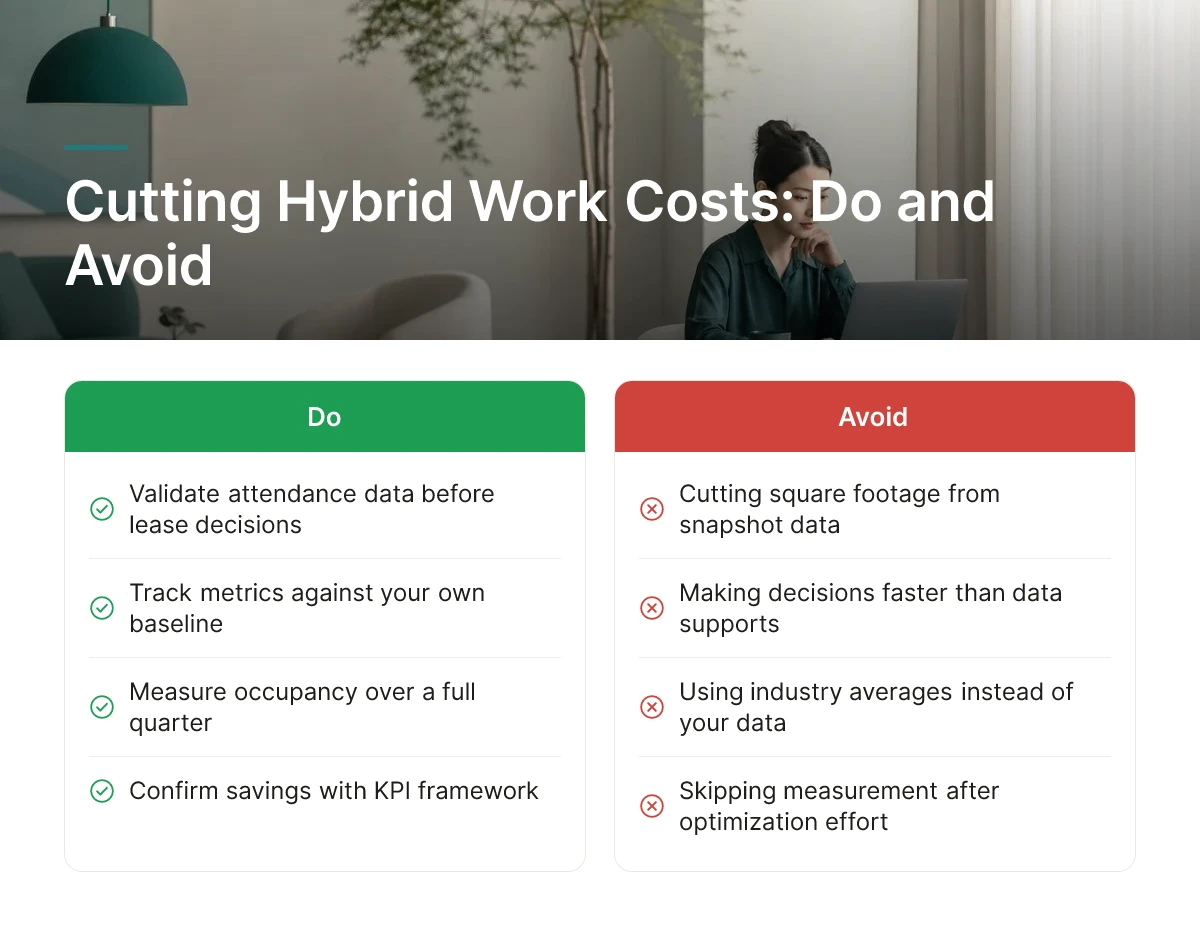
Confirm savings with four KPIs tracked against your own pre-change baseline, not industry averages, so the numbers reflect your real estate, not someone else's.
Any hybrid work challenges solutions effort that skips measurement risks reverting to guesswork within two quarters. Space decisions made on instinct tend to drift back toward over-provisioning once a few executives complain about not finding a desk. A simple KPI framework keeps the case for consolidation grounded in evidence rather than anecdote.
Four metrics give you a usable, lightweight framework without requiring a data science team.
Build your before/after comparison from your own audit. Pull the baseline occupancy and cost figures you captured before making changes, then re-measure the same metrics 90 days after implementation using identical methodology, same data source, same time window, same floor boundaries. Comparing your October badge data to your January badge data is valid; comparing your numbers to a published industry benchmark is not, because portfolio size, geography, and hybrid policy vary too much between organizations.
Co-attendance tracking adds a collaboration check on top of the cost numbers. If consolidation cut square footage but the same project teams are no longer showing up on overlapping days, you have saved money while damaging the reason people come in at all. Platforms built for hybrid coordination report co-attendance achievement alongside occupancy, so you can see whether the right people are present together, not just whether seats are filled.
Set a quarterly review cadence. Headcount changes, policy shifts, and lease events move faster than annual planning cycles can absorb, so revisit all four KPIs every quarter and adjust allocation before small mismatches become expensive ones.
Most failed cost-cutting efforts share the same root cause: real estate decisions get made faster than the data can support them. Knowing these four pitfalls in advance is part of finding workable hybrid work challenges solutions rather than repeating the same expensive cycle every budget year.
Terminating a lease or consolidating floors based on a few months of badge swipes invites trouble. Attendance in hybrid teams varies by week, season, and project cycle, and a single snapshot rarely captures peak days. Organizations that cut too early often find themselves overcrowded on Tuesdays and Wednesdays within a quarter, triggering the exact employee backlash the office was supposed to prevent. JLL's Global Occupancy Planning Benchmark Report found that 87% of companies have adopted hybrid work, yet many are still early in building the occupancy strategies needed to size space correctly [3]. Validate attendance patterns over multiple cycles before signing off on a smaller footprint.
A sales team that comes in four days a week and an engineering team that comes in one day a week have nothing in common operationally, yet many consolidation plans apply one blanket ratio across the whole company. That approach either starves high-attendance teams of desks or wastes space on teams that rarely show up. Segment by team-level attendance before deciding what to cut, not after.
A reservation calendar tells you who booked a desk. It does not tell you who will actually show up, which is the number that matters for real estate decisions. Teams that choose booking software without a forecasting and analytics layer end up back at the same guesswork six months later, re-running the same space debate with no better data than before.
Consolidating offices without a plan for new-hire onboarding or team culture quietly drives attrition even as the real estate line item improves. A smaller footprint that undermines in-person collaboration and connection among teams costs more in turnover than it saves in rent. Any credible hybrid work challenges solutions plan accounts for the people side of consolidation, not just the square footage.
Hybrid work is difficult to manage financially because attendance is unpredictable, so you end up paying full rent on space that sits 30-50% empty most days. Without forecasting, finance teams can't justify downsizing, and real estate ends up being budgeted against guesswork instead of actual usage patterns.
Flexible attendance policies lower and flatten daily occupancy, which is why nearly 20% of U.S. office space sat unleased as of late 2023 [2]. With 87% of companies now running some hybrid program [3], occupancy swings by day and team, making static seating plans obsolete.
The fastest path is pairing attendance forecasting with on-demand workspace access instead of renovating or relocating. Upflex's UnifyAI engine predicts attendance with 97% accuracy, letting you consolidate underused floors immediately while routing overflow or traveling staff to its on-demand workspace network, no construction, no new lease required.
Re-audit utilization quarterly at minimum, since hybrid attendance patterns shift with team composition and policy changes. Organizations tracking co-attendance goals should review monthly during the first two quarters after any major space change, then move to a quarterly cadence.
Cutting real estate costs in a hybrid model comes down to three moves: forecast attendance before you cut space, give employees on-demand access when your own offices don't fit their schedule, and re-audit utilization on a set cadence rather than guessing once a year. Upflex customers combine these moves to cut real estate spend by 40%+ while still hitting 88% co-attendance targets. Start by pulling your last 90 days of badge or booking data and mapping it against your current square footage, that gap is exactly what a forecasting tool like Upflex is built to close.
Explore more from our content library: