Share This Article
No items found.


Real estate agility is the capacity of a real estate team or portfolio to rapidly adapt space, processes, and resources in response to shifting demand, market conditions, or organizational needs, without sacrificing cost control. It replaces rigid, long-cycle planning with iterative decision-making, shorter lease commitments, and data-driven space adjustments. Companies that embed agility into their real estate operations consistently report 30–40% reductions in portfolio spend and faster response times when headcount or hybrid work patterns change.
Real estate agility is the structured ability to resize, repurpose, or reallocate space in iterative cycles, replacing multi-year fixed plans with shorter, data-driven decisions.
Traditional real estate management runs on 10-year leases and waterfall-style planning: commit to a floor plate, build out the space, and absorb the cost regardless of how headcount or work patterns shift. Agile real estate teams operate on quarterly cycles instead, adjusting space allocations, exiting underperforming locations, and adding capacity through on-demand options, all without waiting for a lease event to force the issue.
According to the Scrum Alliance's research on agility in the real estate industry, organizations that adopt agile principles in their real estate operations gain a measurable competitive advantage in responsiveness and cost management compared to those relying on traditional long-cycle planning models.
"The real estate industry is at an inflection point. Those who embrace iterative, data-driven portfolio management will outperform peers still locked into decade-long commitments that no longer reflect how people actually work." — Dr. Jeff Sutherland, Co-Creator of Scrum, Scrum Inc.
The contrast between agile and traditional real estate management is sharpest across three dimensions:
Post-2020 hybrid work normalization has made the traditional model a direct liability. Average office utilization in enterprise portfolios now sits at 40–60%, meaning organizations are routinely paying for space that sits empty more than half the time. A static 10-year lease signed against a pre-hybrid headcount assumption doesn't correct itself, it compounds.
Companies that apply agile real estate strategies report 30–40%+ reductions in occupancy costs compared to static portfolio holders, a benchmark Upflex customers have confirmed, with documented outcomes exceeding 40% in real estate spend reduction through AI-driven utilization data and portfolio consolidation decisions.
Agile real estate teams track five core KPIs to measure progress:
These KPIs give real estate and finance leaders a concrete scorecard, one that replaces gut-feel lease decisions with evidence that holds up in a CFO review.
Real estate agility breaks into five distinct types, strategic, operational, financial, spatial, and organizational, each governing a different layer of portfolio decision-making.
Strategic agility operates at the portfolio level: the ability to exit a market, consolidate offices across cities, or shift from owned assets to flex space when business conditions change, without being locked in for five years.
Operational agility governs day-to-day space allocation. It determines whether a floor can be reassigned from individual desks to team collaboration zones within days, not quarters.
Financial agility is about the lease liability mix. Shifting 20–30% of a portfolio from long-term leases to on-demand or flex space can reduce committed lease liability by $1,500–$3,000 per seat annually, based on average Class A office costs in major U.S. markets of $8,000–$12,000 per seat per year, with flex space running $5,000–$9,000 for the same seat on a rolling basis.
Organizational agility determines how fast the other four types can execute. When local facility managers hold reallocation authority, rather than waiting on a 6-month corporate approval chain, strategic decisions compress from quarters to weeks. Platforms like Upflex support this by giving facility managers real-time utilization data and desk booking controls at the site level, without requiring central IT sign-off on every change. Teams looking to explore agile real estate solutions can also review how Agility Capital approaches real estate investment and portfolio flexibility.
"Organizational agility in real estate is not about having flexible leases — it's about having the decision-making structures that let you act on flexibility before the market forces your hand." — Sara Sutton, Founder and CEO, FlexJobs
Spatial agility is most visible in repurposing decisions [2]: converting underutilized corporate floors into collaboration hubs, or subleasing surplus space on-demand rather than carrying dead cost through a lease tail.
One critical interdependency limits all five types: spatial agility without financial agility simply moves cost around. Reconfiguring a floor achieves nothing if the lease liability on that floor remains fixed. All five types must activate together, strategic direction, operational execution, financial flexibility, spatial reconfiguration, and organizational decision rights, for the compounding returns that define genuine real estate agility.
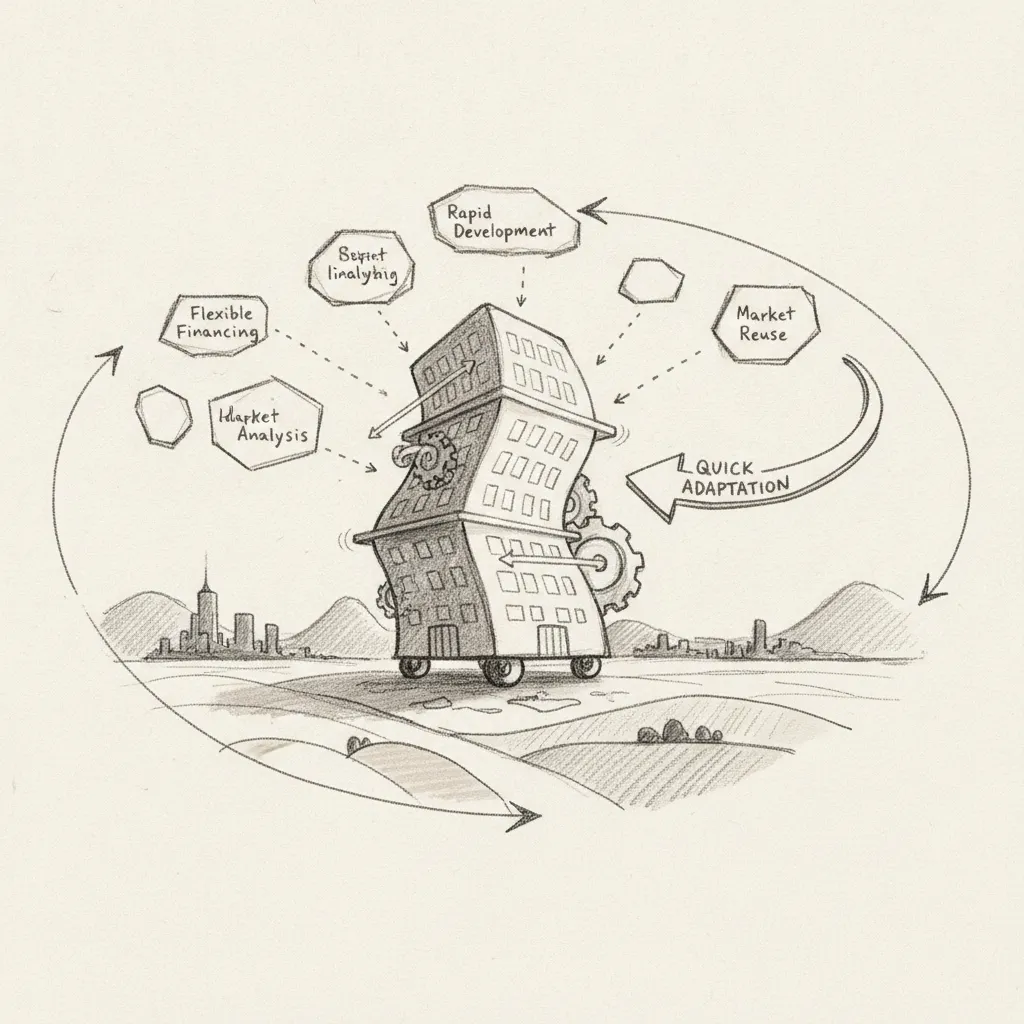
Scrum, Kanban, and Lean each map to a different type of real estate work, time-boxed projects, continuous operations, and cost-reduction programs, respectively. For more information, see how the universal realization of gender equality will help us tackle climate change.
Scrum fits projects with a defined start and end: a new office buildout, a lease renegotiation, or a portfolio review cycle. Instead of waiting 90 days for a quarterly all-hands to surface decisions, teams run 2-week sprints, each ending with a sprint review where blockers get resolved and the next cycle is scoped. A lease negotiation that previously stalled across three quarterly reviews can close in six sprint cycles, roughly 12 weeks.
Kanban suits continuous operations where work flows in rather than arriving in batches. Map a visual board to the stages of a space request: Submitted → Assessed → Approved → Provisioned → Occupied. Every card represents one request; bottlenecks become visible the moment a column backs up. One real estate operations team that adopted this approach cut average provisioning time from 3 weeks to 4 days by exposing a single approval handoff that was holding up every request.
The decision comes down to project shape. Use Scrum for time-boxed work with a clear deliverable. Use Kanban for desk booking workflows, maintenance tickets, and facilities requests that never fully stop. Use Lean for cost-reduction programs running across development pipelines, where the goal is eliminating waste rather than shipping a defined output.
For a deeper look at how Scrum principles translate specifically to real estate workflows, the Scrum Alliance's guide to real estate agility provides practitioner-level detail on applying sprint-based methods to lease and portfolio decisions.
| Framework | Best Fit | Real Estate Example |
|---|---|---|
| Scrum | Time-boxed projects | Lease renegotiation, office fit-out |
| Kanban | Continuous operations | Space requests, maintenance tickets |
| Lean | Cost-reduction programs | Construction pipeline, fit-out budgeting |
Lean identifies seven categories of waste, overproduction, waiting, transport, overprocessing, inventory, motion, and defects, and real estate agility programs that apply this lens consistently find the same two culprits at the top of the cost list.
Waiting is the single largest waste in construction and fit-out workflows. Permit approvals can hold a project idle for weeks; a team sitting on a completed fit-out design while awaiting a single sign-off burns holding costs daily. Overprocessing, over-specifying fit-outs with finishes, fixtures, or technology configurations that occupants never requested, is the second. Both wastes compound: an over-specified fit-out takes longer to approve, which extends the waiting period further.
A Lean audit of a fit-out program typically starts by mapping every handoff from design brief to certificate of occupancy, then flagging steps that add time without adding value to the end occupant. Removing those steps, not speeding them up, is where the real cost reduction happens.
Moving a traditional real estate team to an agile operating model takes five sequential steps, starting with a baseline audit and ending with a quarterly review cadence.
Step 1: Run a baseline audit. Before changing any process, measure three numbers: current space utilization rate, the percentage of leases with break clauses or sub-12-month terms (your lease flexibility ratio), and average decision cycle time from request to approval. You cannot sprint toward a target you have not set, and these three figures will become the cost data you use in every subsequent conversation with leadership.
Step 2: Pick one pilot project. Choose a single floor, one regional office, or one upcoming lease renewal and run a four-sprint agile cycle on it. This limits risk and generates the internal proof point leadership needs before asking them to change how the entire portfolio is managed.
Step 3: Restructure decision rights. Real estate agility fails when every space decision escalates to the CFO. Define clearly which decisions facility managers own outright, desk reconfigurations, short-term bookings, minor layout changes, and which require VP sign-off. Document it. Ambiguity kills sprint velocity faster than any technology gap.
Step 4: Address resistance directly. Two patterns surface most often, and both require the same antidote, the cost data from Step 1.
Step 5: Establish a quarterly portfolio review. Replace the annual review with a standing quarterly cadence. The agenda should cover three items: utilization versus forecast, lease events in the next 18 months, and one repurposing or exit decision per cycle.
The two most common resistance patterns are predictable. Legal and procurement teams default to long-term leases because that structure is familiar, reduces their workload, and aligns with the vendor relationships they have already built. Senior leaders, meanwhile, often equate flexibility with instability, reading shorter commitments as a sign that the business lacks direction rather than that it has gained optionality.
Counter both patterns with the numbers from your baseline audit. If your utilization rate sits at 40%, a figure common across post-pandemic enterprise portfolios, the cost of a long-term lease commitment becomes concrete and hard to defend. Platforms like Upflex make this case easier by surfacing utilization data and attendance forecasts in a single dashboard, giving corporate real estate leaders the evidence they need to bring procurement and senior leadership to the table with facts rather than projections.
Present the pilot results from Step 2 before asking for broader adoption. A single regional office that cut decision cycle time in half, or one lease renewal that avoided 18 months of surplus space, is more persuasive than any framework document. Real estate professionals and teams actively implementing agile methods can also connect with practitioners through the Agility Real Estate community on LinkedIn to share case studies and implementation strategies.
Three software categories form the minimum viable stack for real estate agility: space utilization analytics, on-demand workspace booking, and portfolio scenario modeling.
Miss any one of them and you get a blind spot. Without utilization analytics, you're guessing which floors to consolidate. Without on-demand workspace access, you can't flex capacity without signing a lease. Without scenario modeling, you can't pressure-test a portfolio reduction before committing to it.
Generic project management tools like Jira or Asana were built for software sprints, not lease decisions. Forcing them into real estate workflows creates custom integrations that need constant maintenance, and still don't produce the cost-per-seat or occupancy reports your CFO wants. Purpose-built platforms that combine booking, analytics, and portfolio management in one interface cut that overhead significantly.
On-demand workspace platforms are the financial agility lever in software form. Upflex's global on-demand workspace network lets teams provision workspace in hours rather than months, with no long-term commitment, the exact flex portfolio mix that makes a 30–40% real estate cost reduction achievable without stranding employees.
AI-powered demand forecasting is the highest-use capability in the stack. Upflex's UnifyAI engine predicts who is coming in, when, and in what team configuration, reaching 97% attendance forecast accuracy. That precision lets real estate leaders right-size space before occupancy patterns shift, not after a quarter of wasted square footage.
A tool that sits in isolation produces data no one acts on. Agile real estate platforms must connect to three systems: your HRIS for headcount signals, your calendar system (Microsoft 365 or Google Workspace) for attendance patterns, and your finance platform for cost-per-seat reporting.
Those integrations close the feedback loop, headcount changes in HR automatically update space demand forecasts, and booking data flows into finance dashboards without manual exports. That's the difference between a workplace tool and a real estate decision engine.
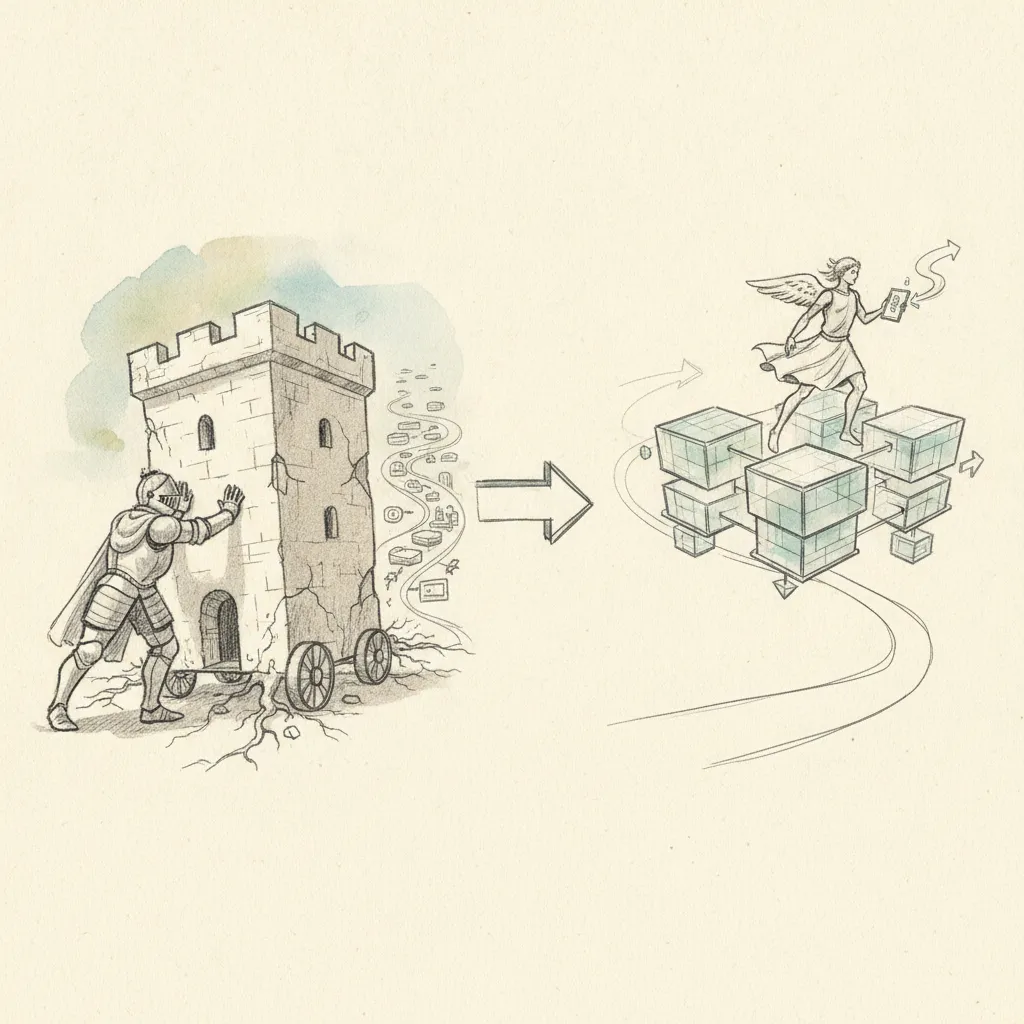
Agile real estate refers to the organizational capability to make fast, data-driven decisions about space, how it's allocated, measured, and adjusted over time. Flexible real estate describes the physical or contractual format of space itself, such as short-term leases or coworking memberships. The two concepts work together: flexible space gives you the options, but agile processes determine whether your team actually uses those options well. A company can hold flexible leases and still make slow, reactive portfolio decisions.
Most corporate real estate teams report measurable ROI within 6 to 12 months of adopting agile portfolio practices. Early wins typically come from eliminating underutilized space, often identified within the first quarter once attendance data is collected consistently. Larger savings, such as the 40%+ real estate cost reductions Upflex clients document, usually follow a lease event like a renewal or consolidation decision, which may take 12 to 24 months to materialize after the data work begins.
Small real estate teams can adopt agile methods, the core practices scale down without losing value. A team of three managing two office locations can run two-week planning cycles, track occupancy weekly, and make incremental space decisions just as effectively as a 50-person corporate real estate department. The main difference is tooling: smaller teams often start with lighter-weight solutions before graduating to enterprise platforms as portfolio complexity grows.
The four most useful metrics are: occupancy rate (actual attendance versus available desks), co-attendance rate (how often teammates are in the office on the same day), cost per occupied seat, and lease flexibility ratio (percentage of portfolio under short-term or flex arrangements). Tracking co-attendance specifically, Upflex benchmarks 88% co-attendance achievement as a target outcome, tells you whether your space decisions are actually supporting collaboration, not just cutting square footage.
Real estate agility directly supports environmental, social, and governance (ESG) objectives by reducing the amount of space organizations occupy and heat, cool, and power unnecessarily. When utilization data drives portfolio decisions, companies consolidate into fewer, better-used locations, cutting energy consumption and carbon emissions per employee. Shorter lease commitments also allow organizations to prioritize buildings with stronger green certifications at each renewal cycle, progressively improving the environmental profile of their portfolio without a single large capital commitment.
Real estate agility is not a philosophy, it's a set of practices that produce measurable outcomes: lower cost per seat, faster portfolio decisions, and office space that teams actually want to use. The organizations seeing the sharpest results share three habits: they collect attendance data continuously, they tie space decisions to short planning cycles rather than annual reviews, and they hold a mix of committed and flexible capacity so they can adjust without waiting on a lease event.
If you manage a hybrid portfolio and haven't yet mapped your actual occupancy against your committed lease obligations, that's the concrete first step, pull 90 days of badge or booking data, compare it to your current footprint, and you'll have the baseline every agile real estate decision depends on.
Explore more from our content library: