Share This Article
No items found.


Understanding office space in london is essential. London office space comes in three main formats, coworking desks, serviced offices, and traditional leases, with prices ranging from roughly £300/month per desk in outer zones to £1,500+/month in the City or West End. Serviced offices offer the most flexibility, typically on monthly or 12-month rolling contracts with all-inclusive pricing. Coworking suits teams under 10; traditional leases suit established companies wanting full control over a space for 3–10 years.
London offers three core office formats, coworking, serviced, and traditional leases, each suited to a different stage of business growth and risk tolerance.
A serviced office is a fully fitted, privately managed workspace where one monthly fee covers rent, utilities, internet, and facilities. Contracts run from one month to two years, and most operators can get you in within 48 hours. That speed is the defining advantage over the other two formats.
Coworking spaces offer shared desks or private pods with no long-term commitment. Pricing runs £300–£700 per desk per month in Zone 2 and £600–£1,200 in Zone 1. They suit individuals and small teams that need flexibility above all else.
Traditional leases hand the tenant an empty shell. You fit it out, you manage it, you pay for everything, but the per-sq-ft cost at scale is the lowest of the three. Terms typically run 3–10 years.
According to workspace analysts, each format carries distinct trade-offs that become more pronounced as team size grows:
"The biggest mistake growing businesses make is choosing an office format based on where they are today, not where they'll be in 18 months. Flexibility has a price, but so does being locked into the wrong space." — Sarah Corden, Commercial Property Advisor, London Business Property Forum
Coworking costs in London range from £150 to £1,500 per desk per month depending on desk type and location, a spread wide enough to suit a freelancer or a 50-person team.
Hot desks run £150–£400/month. Dedicated desks, your own assigned seat, cost £350–£800/month. Private coworking suites for teams reach £600–£1,500 per desk per month in central locations.
Serviced offices in Zone 1 (City of London, West End, Canary Wharf) average £650–£1,200 per desk per month [2]. Zone 2 locations, Shoreditch, Clerkenwell, Hammersmith, bring that down to £400–£750. You can browse current availability and compare pricing across London districts on platforms such as Hubble's London office space listings.
Traditional leases price by square foot per year. Prime West End commands £45–£110 per sq ft. The City runs £35–£65. Fringe zones drop to £20–£40.
Three factors move price more than any other. First, floor level and natural light: upper floors with good daylight carry a measurable premium over basement or ground-floor space. Second, proximity to Elizabeth line stations, buildings within a five-minute walk of Farringdon, Liverpool Street, or Paddington attract higher rents because of the commuter draw. Third, BREEAM sustainability ratings: buildings rated "Excellent" or "Outstanding" command a premium because occupiers face increasing ESG reporting obligations and tenants competing for talent use building credentials as a recruitment signal.
"London's office rental market has bifurcated sharply. Tenants are willing to pay a significant premium for best-in-class, sustainable buildings, while secondary stock faces growing vacancy pressure." — Mark Richardson, Head of London Offices Research, British Property Federation
The City, Shoreditch, Canary Wharf, the West End, and three emerging districts each serve a distinct business profile, choosing the wrong one costs you on rent, talent, or both.
City of London remains the anchor for financial and legal firms. Elizabeth line access at Liverpool Street and Farringdon makes it one of the best-connected office districts in Europe. Pricing is premium, but deal-flow density and client proximity justify it for professional services.
Shoreditch and Old Street is the default for tech and creative businesses. Rents run 20–30% below City rates, and the talent pipeline from nearby universities, including UCL, City University, and Queen Mary, is strong. The trade-off is smaller average floorplates.
Canary Wharf offers the best value per sq ft for large floorplates in London. Finance and professional services dominate, but post-pandemic investment in retail and residential is changing the area's reputation as a ghost town after 6pm.
West End (Mayfair, Soho, Fitzrovia) carries a prestige address premium of 15–25% over City rates [2]. Client-facing businesses, media companies, and luxury brands pay it for the address and the foot traffic.
Three emerging districts deserve attention for teams willing to move off the established grid. King's Cross has become a media and tech hub anchored by Google's UK headquarters. Battersea Power Station attracts design and creative firms, with Northern line access added in 2021. White City is building a life sciences cluster around Imperial College London, all three offer sub-City pricing with Zone 1 or near-Zone 1 transport access.
According to the Greater London Authority's business and economy guidance, strategic investment in transport infrastructure across outer zones is actively driving commercial property development and making previously overlooked districts increasingly viable for businesses of all sizes.
A serviced office in London bundles rent, rates, utilities, internet, and facilities into one monthly fee, making it the fastest and lowest-friction way to occupy private office space.
All-inclusive pricing typically covers business rates, service charge, utilities, broadband, reception staff, cleaning, and a monthly allocation of meeting room credits. There are no fit-out costs and no dilapidations liability at exit.
The major operators each bring a distinct offer. IWG (Regus and Spaces) has the widest London footprint. WeWork concentrates on larger, design-led buildings. Landmark and Fora target premium occupiers who want boutique interiors. Uncommon focuses on sustainability credentials and B-Corp positioning.
Serviced offices work best for three profiles: Series A–C startups scaling headcount faster than a traditional lease allows, international companies entering the UK market who need a London address without a five-year commitment, and established teams that want a prestigious postcode without the capital expenditure of a fit-out.
One advantage the standard listings miss: serviced offices allow a business to hold multiple smaller offices across different London zones simultaneously. For distributed teams, this removes the single-commute-hub problem, a finance team in the City and a product team in Shoreditch can each have a dedicated base under one operator agreement, rather than forcing everyone onto the same commute.
Coworking gives individuals and teams flexible, pay-as-you-use access to professional workspace, from a £25 day pass to a private team suite billed monthly.
Memberships range from hot-desk day passes at £25–£50/day to dedicated desk plans at £350–£800/month, up to private team suites priced per desk. Most major London coworking buildings also offer meeting room hire on top.
The format suits freelancers, early-stage startups under 10 people, and hybrid teams that need drop-in access across multiple locations rather than a fixed desk five days a week.
On-demand coworking networks extend that flexibility further. Upflex, for example, gives employees access to 700+ London venues on a single plan, so a team member in Hammersmith and one in Bethnal Green can both book professional workspace near home without the company holding multiple individual memberships.
One shift the top search results don't cover: coworking in London is increasingly sold on "flex enterprise" plans, where companies pay per actual usage rather than per assigned seat. For hybrid teams with variable attendance, where 40% of desks sit empty on any given Tuesday, this model eliminates the fixed-cost waste of a standard per-seat membership and aligns spend directly with how often people actually show up.
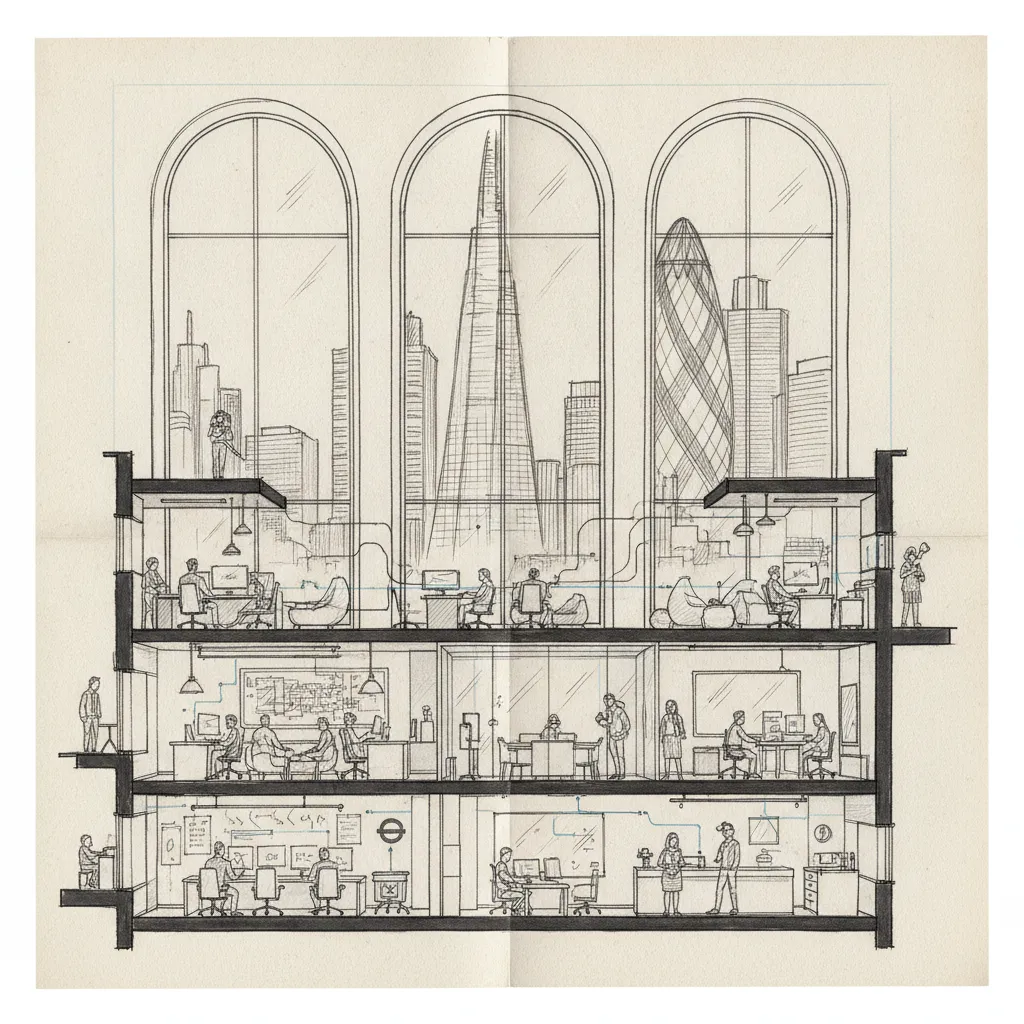
Traditional leases suit established businesses that need full brand control and can commit to 3, 5, or 10 years in exchange for lower per-sq-ft costs.
Standard lease terms run 3, 5, or 10 years, with rent reviews every 5 years. Break clauses, typically at year 3 or year 5, are negotiable but rarely offered without being asked for directly. Push for a rolling break rather than a fixed-date-only option if your growth trajectory is uncertain.
Tenant responsibilities extend well beyond rent. Business rates typically add 49–51p per £1 of rateable value to your annual occupancy cost. A mid-spec Cat B fit-out in London runs £60–£120 per sq ft, and you'll face dilapidations liability at lease end to restore the space to its original condition.
Traditional leases work best for businesses with 50+ headcount, stable growth projections, and a genuine need to control how the space looks and functions. One underused option: grey space subletting. Companies holding existing leases increasingly sublet surplus floors on 1–3 year terms at below-market rates, a practical middle path between serviced offices and a full direct lease commitment.
For guidance on tenant rights and lease obligations, the Landlord and Tenant Act 1954 remains the foundational legislation governing commercial leases in England and Wales, and understanding its provisions can significantly strengthen your negotiating position.
The gap between a quoted office price and your actual monthly outgoing in London routinely runs 30–50%, these are the line items that create it.
Business rates are the most frequently missed item. Coworking and serviced office quotes often exclude them entirely, verify explicitly before signing. If your rateable value falls under £12,000, small business rates relief may eliminate this cost, but you must apply for it; it isn't automatic. The UK Government's official business rates guidance explains how rateable values are calculated and how to apply for available reliefs.
On traditional leases, service charges add £8–£20 per sq ft per year, covering building maintenance, security, and common area upkeep. That's an additional £16,000–£40,000 annually on a 2,000 sq ft floor, a figure that rarely appears in a headline quote.
Serviced office plans typically include 4–8 hours of meeting room time per month [2]. Additional hours are billed at £30–£80 per hour, which adds up quickly for client-facing teams. Dilapidations on a traditional lease should be budgeted at £15–£40 per sq ft to cover restoring the space at exit.
Parking, storage, and additional phone lines are almost never included in base quotes. Always request a full schedule of charges, not just the per-desk or per-sq-ft headline, before comparing options.
Standard London offices cover the basics reliably; premium tiers add wellness and sustainability features that carry a measurable rent premium but also deliver cost offsets.
Most serviced offices and coworking spaces include high-speed Wi-Fi, a shared kitchen, printing, 24/7 access, and bike storage [2]. These are table stakes, their absence at any reputable operator should prompt questions about building management quality.
Premium operators and Grade A buildings go further. The following amenities are increasingly standard at the top tier:
BREEAM-rated buildings command a 10–15% rent premium, but they reduce energy costs and directly support ESG reporting obligations for tenants, a material consideration for businesses with public sustainability commitments.
One angle most office searches miss: amenity packages are negotiable, particularly on terms of 12 months or longer. Operators will add meeting room credits, furniture upgrades, or IT infrastructure buildout at no extra cost to close a deal. Ask for it in writing as part of heads of terms, not as a verbal promise after signing.
"Tenants are no longer just renting square footage — they're selecting a workplace experience. Operators who understand this are winning deals on amenity quality, not just price." — James Pellatt, Director of Workplace, Grosvenor Britain & Ireland
The most consistent pattern across London office decisions is that businesses underestimate total cost and overestimate how stable their headcount will be.
The most common mistake is choosing on headline rent alone. Businesses routinely find their actual occupancy cost runs 30–50% above the quoted price once rates, service charges, and meeting room overages are factored in. Building a total occupancy cost model before shortlisting, not after, eliminates this problem.
The second most common error is underestimating growth. A team that signs a 12-month serviced office for 10 desks and needs 20 within 6 months faces expensive mid-term renegotiation or a disruptive move. Any agreement without a documented expansion clause is a risk for a business growing faster than 20% annually.
Businesses that choose well share one habit: they visit shortlisted spaces between 9–10am on Tuesday, Wednesday, or Thursday, peak occupancy hours, rather than accepting a staged tour at 2pm on a Friday. Noise levels, desk availability, and lift wait times look very different at genuine peak load.
Hybrid teams increasingly report that the right office space in London isn't a single fixed address. A network of locations matched to where employees actually live cuts average commute time and measurably improves attendance, a finding that should directly inform location decisions before any lease is signed. You can explore current availability across London's key districts on Rightmove's London offices listings.
Match your office type and contract to headcount trajectory, total occupancy cost, and where your employees actually live, in that order.
Step 1: Anchor on headcount trajectory, not current size. If you expect 30%+ growth in the next 12 months, remove any option that lacks a documented expansion clause. Renegotiating mid-term costs more in time and money than choosing a slightly larger space upfront.
Step 2: Calculate total occupancy cost. Add rent, business rates, service charges, fit-out amortization, and meeting room overages. The headline per-desk figure is a starting point, not a budget number.
Step 3: Map employee home postcodes before choosing a location. A Canary Wharf office is the wrong answer if 70% of your team lives in North or West London. Commute friction is one of the primary reasons employees skip in-office days.
Step 4: Evaluate fixed versus networked. For hybrid teams, a single fixed office may deliver lower utilization and higher per-desk cost than an on-demand workspace network covering multiple London zones. Platforms like Upflex combine AI-powered attendance forecasting, predicting who's coming in with 97% accuracy, with access to a global on-demand workspace network, so you can right-size your London footprint based on actual usage data rather than assumptions.
Step 5: Negotiate. Operators expect it. Standard asks on terms of 12 months or longer include 1–3 months rent-free, additional meeting room credits, and a furnished fit-out. Get every concession into the heads of terms document before instructing solicitors.
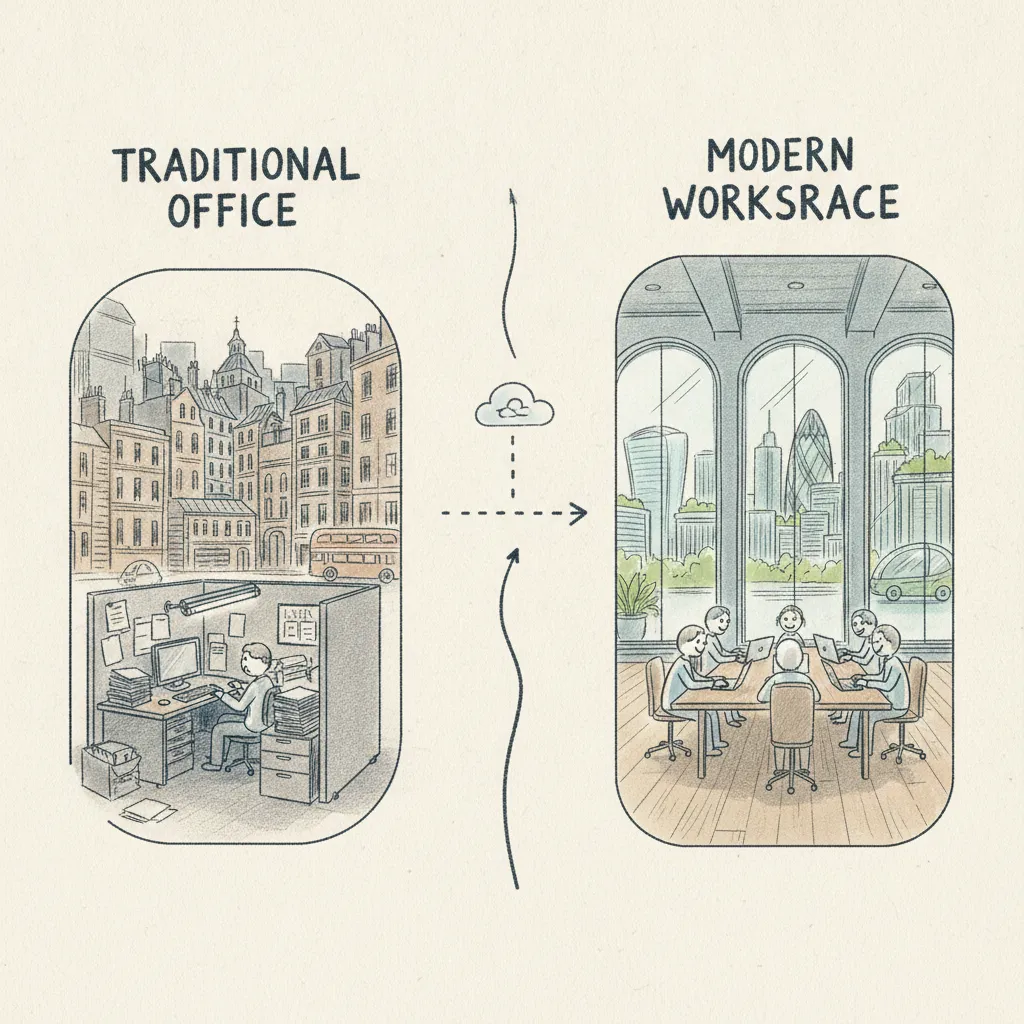
Hot-desking at a coworking space is the most affordable entry point, with day passes in areas like Shoreditch starting around £25–£40 per day. Shared offices and coworking memberships typically run £150–£350 per person per month, significantly less than a private leased office. For distributed teams that only need occasional London presence, on-demand workspace access through a platform like Upflex lets you pay per use rather than committing to a fixed monthly desk cost.
Yes, serviced offices and managed workspaces across London commonly offer rolling monthly contracts with no long-term lease commitment. Providers in areas like the City, Canary Wharf, and Southwark list flexible terms starting at one month [2]. This flexibility suits fast-growing teams, project-based work, or companies testing a new London location before signing a longer lease.
London's largest available office blocks regularly exceed 100,000 sq ft, concentrated in the City of London, Canary Wharf, and the South Bank. Canary Wharf in particular hosts several buildings with floorplates above 50,000 sq ft per floor. Availability at this scale changes frequently, commercial property platforms list current large-format options in real time [1].
Business rates are a property tax levied by the local council, calculated by multiplying the office's rateable value (set by the Valuation Office Agency) by the government's annual multiplier. For 2024–25, the standard multiplier is 54.6p per pound of rateable value. Tenants in serviced or managed offices typically have business rates bundled into their monthly fee, while traditional leasehold tenants pay them separately on top of rent.
For serviced offices, a search lead time of four to eight weeks is typically sufficient, as operators can often accommodate moves within 48 hours of signing. For traditional leases, allow six to twelve months: legal due diligence, fit-out works, and lease negotiations each take time. Businesses that rush a traditional lease search frequently accept unfavourable terms or miss better-value options that require slightly longer to secure.
London's office market offers more flexibility than at any point in the last decade, but that flexibility only pays off if your space strategy matches how your team actually works. Three things worth acting on: first, match your lease type to your growth horizon (serviced for speed, leased for cost efficiency at scale); second, use utilization data before committing to square footage, not after; third, treat the City, Canary Wharf, and emerging zones like Stratford as genuinely different cost and talent propositions, not interchangeable options.
If your team operates a hybrid model, audit your current attendance patterns before your next lease decision. Upflex's UnifyAI forecasting, 97% attendance accuracy, gives you the data to right-size your London footprint with confidence rather than guesswork. Request a demo at upflex.com to see what your actual office utilization looks like today.
Explore more from our content library: