Share This Article
No items found.


Hybrid workplace infrastructure is the combination of real estate strategy and workplace technology that lets distributed teams work productively across home, office, and on-demand locations. Instead of treating space and software as separate budgets, it links them: workspace booking data informs how much office square footage you actually need, and real estate decisions determine which technology has to be deployed where. The goal is a smaller, smarter footprint plus an employee experience that makes any location workable, not a bigger IT stack alone. Research from the Stanford Institute for Economic Policy Research confirms that hybrid arrangements are becoming a durable feature of how organizations operate, not a temporary adjustment.
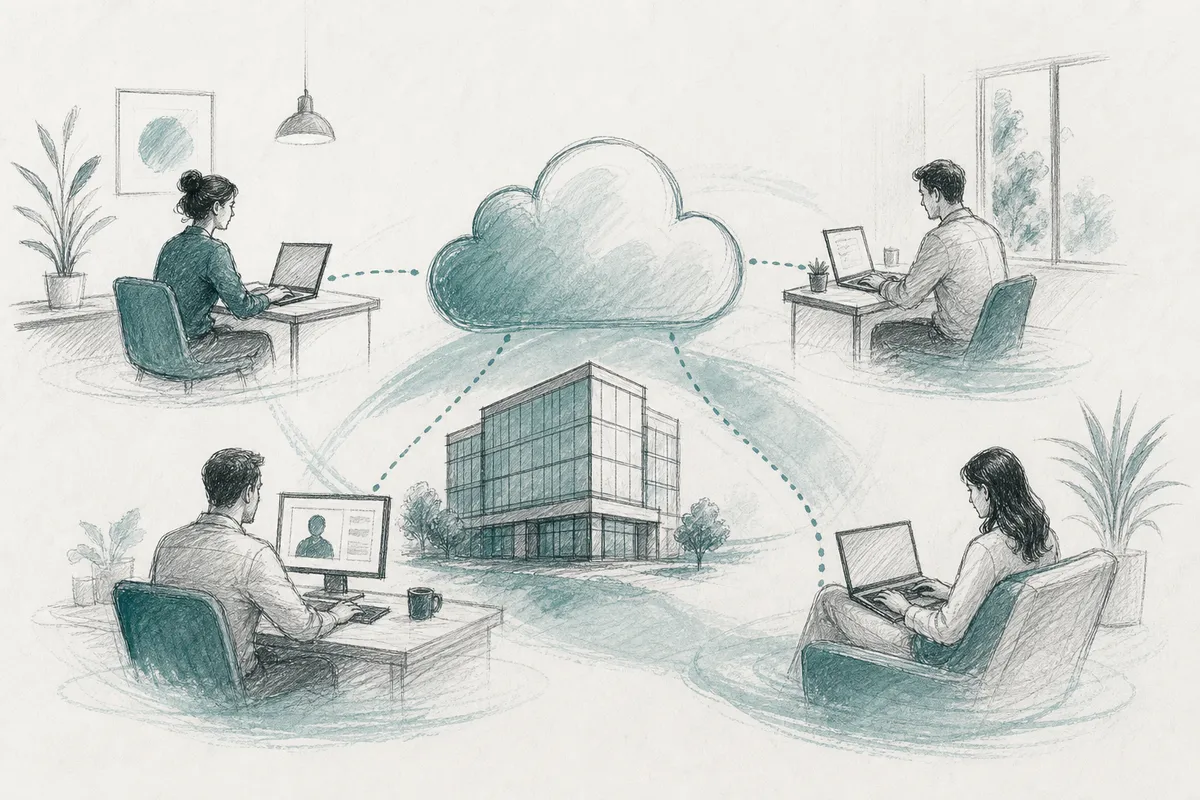
Hybrid workplace infrastructure joins two decisions companies used to make separately: how much office space to lease, and what technology employees use to work in and around it.
Most conversations about hybrid work start and end with software, Zoom for meetings, Slack for chat, a VPN for security. Those tools matter, but they solve a communication problem, not a real estate problem. A company can have flawless video conferencing and still be paying for three floors that sit half-empty on Tuesdays and overflow on Wednesdays. A well-planned IT infrastructure strategy has to account for this mismatch between tools and space, not just add more software.
Remote work tools help people talk to each other from anywhere; workplace infrastructure decides where "anywhere" actually is and what it costs. A messaging app doesn't tell a corporate real estate leader whether to renew a lease, downsize a floor, or open access to workspace outside the owned portfolio. That's a footprint and utilization question, and it requires attendance data, booking systems, and space planning, not another communication channel.
The two run in a loop, not a straight line. Attendance patterns and desk-booking data reveal which days and locations are actually in demand, and that evidence shapes decisions about which offices to keep, shrink, or exit. Those real estate decisions then dictate what technology has to be deployed, and where.
Consider a company cutting leased square footage by a third after a lease renewal review. That cut only works if employees still have somewhere to work on the days the reduced office can't hold everyone, which means on-demand workspace access and a functioning desk and room booking system have to go live before, not after, the space shrinks. Upflex is built around exactly this loop, pairing its UnifyAI attendance forecasting with desk booking and an on-demand workspace network so real estate cuts and technology rollout happen in sync rather than in sequence.
Space is expensive and slow to change; a lease is a multi-year commitment, not a monthly subscription. Technology is comparatively cheap and fast to adjust. The real infrastructure question is how much flexibility you can push into the technology layer so the real estate layer can shrink without breaking the employee experience.
Start with attendance data, not headcount, plan hybrid workplace infrastructure around who actually comes in, how often, and from where they travel.
Most real estate decisions still start from a static number: total employees times an assumed occupancy ratio. That approach breaks down in hybrid environments, where attendance varies by team, by day of the week, and by season. A finance team meeting every Tuesday and Thursday has a completely different space signature than a sales team that clusters around quarterly kickoffs. Real, observed attendance and location patterns, not a headcount spreadsheet, are the correct input to space planning.
The central trade-off is fixed cost versus variable cost. A signed lease charges the same amount whether desks sit empty or full, while on-demand workspace access only bills for the days someone actually uses a seat. That shift, from a fixed real estate obligation to a variable, demand-driven one, is the financial logic behind most portfolio consolidation decisions today.
Key factors that determine whether a hybrid workplace plan actually works include:
Organizational readiness matters just as much as square footage. Team-by-team attendance policies, manager buy-in on in-office days, and clear change management around what's changing and why all determine whether a smaller footprint actually works. A beautifully sized office plan fails if managers keep defaulting to five-day expectations that the space was never built to hold.
The practical model is "core plus flex": a smaller anchor office sized for team-dependent, collaborative work, supplemented by on-demand access near where employees actually live. Upflex supports this model directly, UnifyAI forecasts attendance to size the core office correctly, while its on-demand network covers overflow and distributed employees without a second lease. Guidance on hybrid workplace technology points to the same principle: technology and space decisions need to move together, not in isolation.
Watch the pace of the cut. Reducing committed space before on-demand coverage is proven in the markets where employees actually live creates gaps people notice on day one, no desk, no nearby option, no confidence in the plan. For more information, see Marketing Manager.
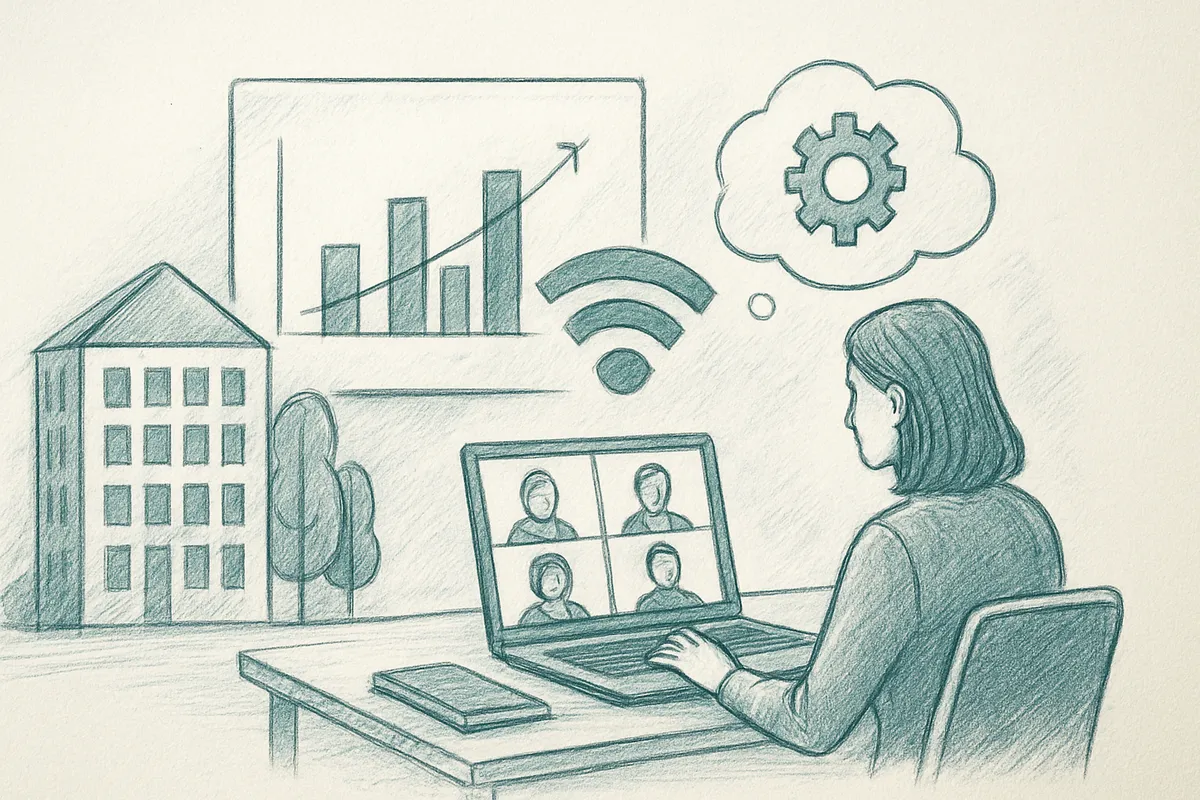
Four layers make up a working hybrid workplace infrastructure: booking systems, occupancy sensors, on-demand workspace access, and team coordination tools. Each layer feeds the next, and none of them work in isolation.
The core components of a functioning hybrid infrastructure stack typically include:
These layers close a loop. Utilization data shapes booking policy, for example, capping bookings on underused floors or nudging teams toward shared anchor days. Booking policy, in turn, generates the usage evidence that real estate leaders need to justify consolidating a floor or exiting a lease. Upflex's UnifyAI engine is built around this loop directly, forecasting attendance at 97% accuracy and feeding that forecast into both desk booking and portfolio decisions, so the coordination layer and the real estate layer stay connected instead of running on separate spreadsheets.
Most companies already run an HR system, a calendar platform, and a badge or access-control system, new infrastructure needs to plug into those, not replace them. A booking tool that ignores your existing calendar creates double entry and gets abandoned within months.
Cost tiers matter here. Budget-friendly point solutions can solve one problem, like desk booking, cheaply. Enterprise platforms that unify booking, network access, and analytics cost more but avoid the integration tax of stitching together five vendors. Security deserves equal weight: any setup involving third-party workspace access needs clear access-control and data-handling rules before rollout, not after.
ROI on hybrid workplace infrastructure comes from tying real estate cost to actual usage instead of peak headcount, then tracking cost per occupied seat over time.
A traditional lease is sized for the day everyone might show up, which means the space sits mostly empty the other four or five days of the week. On-demand access flips that model: you pay for space when someone actually uses it, rather than carrying fixed square footage against a headcount number that hasn't reflected reality since 2020.
Track three things to make this concrete:
Avoid comparing raw square-footage cost alone. The real comparison is total cost per employee served, including the technology layer, forecasting, booking, and on-demand network access all carry a cost, and a cheaper lease that leaves employees without a desk isn't actually cheaper once you count the productivity loss.
Track whether employees near a closed or downsized office still have a viable place to work, then correlate that access with retention and engagement survey trends over several quarters. If a regional office closes and nearby employees lose any real workspace option, attrition and disengagement tend to show up before the real estate savings do.
Separate one-time transition costs from ongoing costs when building the business case. Technology rollout and change management are one-time line items; subscriptions and on-demand workspace access are recurring. Mixing them into a single number makes payback periods look worse than they are and confuses the CFO conversation with the CHRO one. Upflex's utilization data supports exactly this kind of tracking, giving real estate and HR leaders a shared view of occupied seats, cost per seat, and co-attendance trends instead of two disconnected spreadsheets.
A successful rollout starts small, proves value with one team or region, and expands only after utilization and satisfaction data justify it.
Enterprises that get this right resist the urge to flip a switch company-wide. Instead, they pilot with a single department or office location for six to eight weeks, track how desks and rooms actually get used against how they're booked, and collect direct feedback from that group before writing the next phase of the rollout plan. This sequencing catches configuration problems, wrong desk ratios, missing room types, confusing booking flows, while the blast radius is still small enough to fix cheaply.
Watch for three signals: utilization rates that stabilize rather than swing week to week, a drop in complaints about desk or room availability, and real estate decisions that reference occupancy data instead of gut feel. A Head of Corporate Real Estate evaluating a lease renewal should be able to pull utilization history and co-attendance patterns rather than guessing at how full the building gets. Upflex customers use this kind of data, generated by UnifyAI's attendance forecasting, to support portfolio consolidation decisions, with documented outcomes of 40%+ reduction in real estate spend once the numbers back the case.
Access control, data residency, and IT alignment are the three requirements that determine whether a deployment passes security review. Shared and third-party workspaces need the same access provisioning rigor as owned offices, badge or app-based entry tied to employee identity, not shared credentials. Booking and occupancy data often crosses borders when teams are distributed globally, so data residency terms need to match existing data protection obligations. The workspace access policy should live inside the existing IT security policy, reviewed by the same team that governs network and device access, not run as a parallel track owned solely by facilities.
Warning signs that a rollout isn't working: utilization stays stubbornly low months in, employees quietly revert to email threads and spreadsheets to coordinate in-office days, or real estate costs hold flat despite the technology spend.

No, most companies keep a core owned or leased footprint and supplement it, rather than replacing it outright. The typical approach right-sizes existing offices based on real utilization data, then adds on-demand workspace access for employees outside commuting range or on travel days, avoiding a costly, disruptive full relocation.
Most organizations see a working model within one to two quarters, though full portfolio optimization takes longer. Early phases, attendance forecasting, desk booking rollout, policy alignment with HR and finance, can launch in weeks; lease decisions and consolidation follow once utilization data builds a reliable pattern.
Cutting real estate before understanding actual attendance patterns, then scrambling when teams can't find desks on their in-office days. Decisions based on badge swipes or guesswork instead of forecasting data tend to trigger employee backlash and force costly reversals within a year.
Smaller companies benefit too, particularly those with distributed teams across a few cities. The core problem, paying for space nobody reliably uses, hits mid-market firms just as hard as global enterprises, just at a smaller dollar scale.
Ownership typically sits jointly between corporate real estate, IT, and HR, since no single department controls all the levers involved. Real estate manages the footprint, IT manages the booking and access technology, and HR manages the policies and change management that determine whether employees actually adopt the new model.
Real estate spend and employee experience aren't competing priorities, they're the same problem viewed from two angles, and solving one without data on the other leads to bad decisions. The path forward starts with accurate attendance forecasting, extends to right-sized owned space, and includes on-demand access for the days and locations your own footprint can't cover.
Before your next lease renewal, pull your actual utilization data for the past two quarters and compare it against what you're currently paying to keep every seat available. That gap is your starting point.
Explore more from our content library: