Share This Article
No items found.

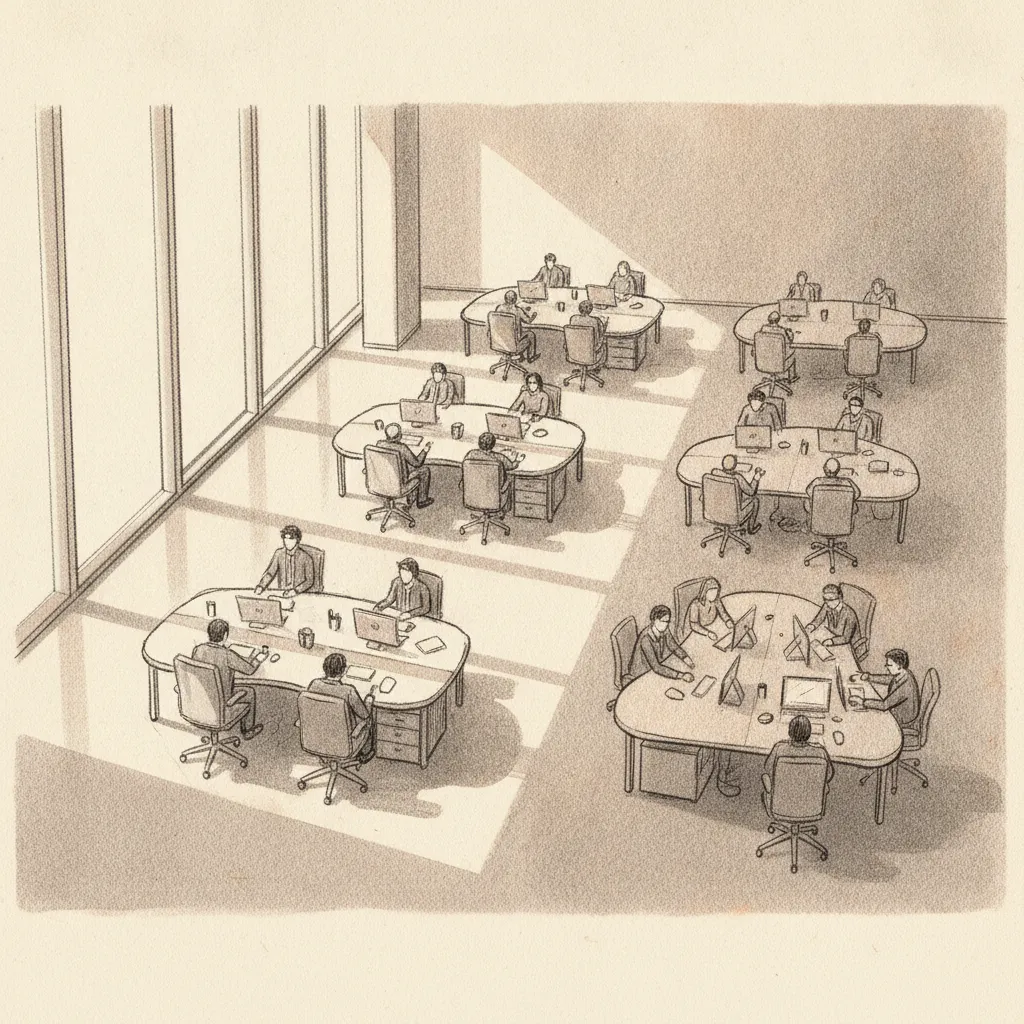
The most effective way to improve workplace productivity is to align your people, your space, and your tools around how work actually happens — not how it was planned on paper. Research from Northeastern University confirms that structured routines, clear goal-setting, and intentional workspace design consistently outperform ad-hoc effort [1]. Knowing how to improve workplace productivity means addressing all three layers at once: individual habits, team coordination, and the physical environment that either supports or undermines both.
This article covers 12 actionable strategies grounded in organizational research and real-world enterprise practice. Whether you're a Corporate Real Estate leader watching occupancy rates, an HR leader trying to get hybrid teams collaborating effectively, or a finance executive scrutinizing every dollar in the portfolio, these approaches are designed to deliver measurable outcomes. This is particularly relevant for how to improve workplace productivity.
Productivity without direction is just activity. Teams that operate against clearly defined, measurable objectives consistently outperform those working from vague mandates.
According to Robert Half, setting clear goals and expectations is one of the top six drivers of workplace productivity [2]. When employees understand exactly what success looks like, they prioritize accordingly. Ambiguity, on the other hand, generates the kind of low-value busywork that fills calendars without moving anything forward.
The OKR framework (Objectives and Key Results), popularized by Intel and Google, offers a practical structure for this. Each objective is paired with two to four measurable key results, creating an unambiguous line of sight between daily effort and organizational outcomes. Teams using OKRs report faster alignment and fewer redundant workstreams.
A common mistake is setting goals at the individual level only, without cascading them to team or department targets. In practice, individual productivity gains evaporate if the team's shared objectives aren't aligned. SHRM research reinforces this point: clear expectations are the single most direct lever managers have over team performance [3].
Pro Tip: Don't just set goals — publish them. When team objectives are visible to everyone, peer accountability replaces the need for constant managerial check-ins, freeing up leadership time for higher-value decisions.
Poorly structured meetings are one of the most significant drains on workplace productivity, consuming time that could be spent on focused, high-value work.
Research cited by Corporate Rebels suggests that eliminating up to 50% of recurring meetings has a measurable positive impact on individual output and team morale [4]. The problem isn't meetings themselves — it's meetings without a clear decision to be made or a specific outcome required. When considering how to improve workplace productivity, this point stands out.
Asynchronous communication tools have matured significantly in recent years, and as of 2026, most enterprise teams have access to platforms that make real-time meetings optional for status updates, information sharing, and routine approvals. Reserving synchronous time for decisions, creative work, and relationship-building changes the nature of every meeting that remains on the calendar.
From experience, the teams that resist these changes most strongly are often the ones with the most to gain. When working with organizations transitioning to hybrid models, the first productivity win almost always comes from cutting meeting volume, not adding new tools.
The workspace itself directly affects how much productive work gets done — poor space design, unpredictable occupancy, and misaligned hybrid schedules all suppress output in ways that no amount of personal discipline can fully overcome.
The World Green Building Council has documented that factors including air quality, natural light, thermal comfort, and noise levels have a direct, measurable impact on cognitive performance and employee output [5]. Buildings designed to maximize daylight reduce energy costs while simultaneously improving the working conditions that drive productivity.
But physical design is only half the equation in 2026. The bigger challenge for most enterprises is hybrid work coordination — specifically, ensuring that employees who come into the office actually find their teammates there. An empty floor on a Tuesday that still costs the same as a full one is a productivity problem and a real estate problem simultaneously.
This is where workplace optimization platforms deliver outsized value. At Upflex, we've found that the core issue isn't space availability — it's attendance predictability. When employees can't reliably know who will be in the office on a given day, the commute stops feeling worth it, co-attendance drops, and collaboration suffers. For those exploring how to improve workplace productivity, this matters.
AI that forecasts who's coming in, when, and where — that's what Upflex's UnifyAI engine does — delivers 97% attendance forecast accuracy, enabling teams to coordinate in-office days with confidence and achieve 88% co-attendance rates. That level of coordination doesn't happen by asking employees to update a spreadsheet. It requires intelligent orchestration that runs in the background and surfaces the right information at the right time.

Pro Tip: Before investing in new office furniture or redesigning floor plans, audit your actual occupancy data for 90 days. Most enterprises discover that their space utilization problem is a scheduling problem — and scheduling problems are solved with data, not construction.
Fragmented communication is a silent productivity killer. When information lives across email threads, chat platforms, project tools, and informal conversations, employees spend more time locating context than acting on it.
According to Slack's research on business productivity, streamlining communication channels is the top strategy for improving team output [6]. The principle is straightforward: reduce the number of places where decisions are made and documented, and you reduce the cognitive overhead required to stay aligned.
In practice, this means choosing a primary channel for each type of communication and enforcing it consistently. Urgent decisions go in one place. Project updates go in another. Casual conversation stays separate from operational threads. The taxonomy doesn't need to be complicated — it needs to be consistent.
Hays US notes that reorganizing processes to eliminate time-consuming communication bottlenecks is one of the highest-leverage changes organizations can make [7]. The key is identifying which bottlenecks are structural (baked into how information flows) versus behavioral (habits that can be changed with clear norms).
Just as healthcare organizations recognize that culture and clear communication create the foundation for excellence — as explored in this piece on grateful hearts growing families what it means to be named the best pediatrics practice of 2025 — enterprises that invest in communication clarity see it compound into measurable performance gains over time. This directly impacts how to improve workplace productivity outcomes.
Every hour an employee spends on low-value administrative work is an hour not spent on the work that actually drives business outcomes. Automation is the most direct way to reclaim that time at scale.
Intuit's workplace productivity research identifies efficient workflows as a core driver of true productivity — not just doing more, but eliminating the friction that prevents people from doing meaningful work [8]. As of 2026, the automation tools available to enterprise teams cover a wide range of administrative tasks that previously required manual effort.
| Task Category | Manual Approach | Automated Approach | Time Saved (Est.) |
|---|---|---|---|
| Desk booking | Email/spreadsheet coordination | AI-driven desk booking platform | 2-4 hrs/week per team |
| Attendance tracking | Badge swipe reports, manual review | AI attendance forecasting | 3-5 hrs/week per manager |
| Meeting scheduling | Back-and-forth email chains | Automated scheduling tools | 1-2 hrs/week per person |
| Status reporting | Weekly manual report compilation | Automated dashboard updates | 1-3 hrs/week per manager |
| Expense processing | Manual receipt submission | Automated expense capture | 30-60 min/week per person |
Not every task is worth automating. Use this three-part filter before investing in any automation tool:
One pitfall to watch for: automating a broken process just produces broken results faster. Before deploying any automation, map the current workflow and identify whether the process itself needs redesigning first.
Sustained, uninterrupted focus is one of the scarcest resources in modern workplaces. Building organizational habits that protect it is one of the highest-leverage investments a leader can make in productivity.
Cal Newport's deep work framework defines cognitively demanding, distraction-free work as the activity that produces the most value per hour in knowledge-work environments. The challenge in hybrid settings is that the default conditions — open-plan offices, constant notifications, fragmented schedules — actively undermine the conditions deep work requires. This is particularly relevant for how to improve workplace productivity.
Research from the Employee Wellness Training Foundation highlights that handling tasks decisively and minimizing context-switching are core habits of high-performing individuals [9]. Context-switching (the cognitive cost of shifting between tasks) has been shown to reduce effective IQ by up to 10 points per switch — a staggering cost for knowledge workers who switch tasks dozens of times per day.
Industry analysts at Executive Academy note that goal-setting and structured work intervals are among the most evidence-backed strategies for boosting individual and team output in knowledge-work environments [11]. The organizations that implement these practices at a cultural level — not just as individual tips — see the most durable results.
Pro Tip: When your team is in the office together, protect that time for collaborative work — brainstorming, decision-making, relationship-building. Reserve deep individual focus work for home or quiet workspace days. Hybrid done right means matching the work type to the environment, not just filling seats.
Gut instinct is not a productivity strategy. Organizations that use real utilization data to make workplace decisions consistently outperform those operating on assumptions about how their space and people are being used.
Most enterprises are sitting on more workplace data than they realize — badge access records, desk booking logs, calendar data, and employee surveys all tell part of the story. The problem is that this data lives in silos and rarely gets synthesized into actionable decisions. For Corporate Real Estate leaders watching every dollar in the portfolio, this is a significant missed opportunity.
Real estate portfolio optimization (the process of right-sizing office footprint based on actual utilization patterns) requires accurate, continuous data. One-off surveys and annual utilization studies are too slow and too infrequent to support the kind of dynamic decisions hybrid work demands. Organizations that have cut real estate spend by 40% or more didn't do it by guessing — they did it by measuring.
| Metric | What It Measures | Why It Matters |
|---|---|---|
| Space utilization rate | % of desks/rooms in active use | Identifies over/under-provisioned space |
| Co-attendance rate | % of team members in office on same days | Measures collaboration enablement |
| Attendance forecast accuracy | Predicted vs. actual office attendance | Enables reliable space planning |
| Cost per occupied seat | Real estate cost / average daily occupancy | Drives consolidation decisions |
| Employee satisfaction score | Survey-based workplace experience rating | Balances cost cuts with culture health |
Our team at Upflex recommends establishing a baseline on all five of these metrics before making any significant real estate or workplace policy decisions. You can't optimize what you haven't measured. When considering how to improve workplace productivity, this point stands out.
Not every strategy on this list will deliver equal value for every organization. The right starting point depends on your team's size, hybrid work maturity, and the specific bottlenecks suppressing output right now.
Use this four-step framework to identify where to focus first:
For organizations with distributed hybrid teams, the highest-leverage investments typically sit at the intersection of space management and team coordination — specifically, ensuring that in-office days are worth the commute. For organizations with primarily co-located teams, communication architecture and meeting culture reforms tend to deliver faster returns.
One limitation to acknowledge: productivity improvement is not a one-time project. It's an ongoing discipline that requires regular review, honest measurement, and willingness to change approaches that stop working. The organizations that sustain productivity gains are those that build continuous improvement into their operating rhythm, not those that launch a single initiative and move on.
Workplace productivity measures how effectively an organization converts time, talent, and resources into valuable output. It matters because low productivity directly increases operating costs, slows growth, and reduces employee satisfaction. For enterprise leaders, improving workplace productivity is one of the highest-leverage levers available for both financial performance and talent retention.
Effective measurement depends on the type of work involved. For knowledge workers, useful proxies include project completion rates, goal achievement against OKRs, and employee-reported focus time. For space and real estate teams, metrics like space utilization rate, cost per occupied seat, and co-attendance rates provide a more accurate picture of how the workplace is supporting (or hindering) productive work. For those exploring how to improve workplace productivity, this matters.
Hybrid work can significantly improve productivity when it's well-coordinated — employees gain autonomy, reduce commute fatigue, and can match work type to environment. But poorly managed hybrid models create coordination failures, empty offices, and missed collaboration opportunities. The key to improving workplace productivity in a hybrid setting is predictable attendance coordination, which requires data and intelligent scheduling tools rather than ad-hoc scheduling.
Office design has a direct, documented impact on cognitive performance. Natural light, thermal comfort, air quality, and acoustic control all affect how well people concentrate and collaborate. Research from the World Green Building Council confirms these physical factors are not peripheral — they're core productivity drivers. That said, design improvements deliver the most value when paired with smart space management that ensures the right people are in the right spaces on the right days.
AI improves workplace productivity in two primary ways: by automating repetitive administrative tasks that consume skilled workers' time, and by providing predictive intelligence that improves decision-making. In hybrid work contexts, AI-powered attendance forecasting (like Upflex's UnifyAI engine, which delivers 97% forecast accuracy) enables teams to coordinate in-office days reliably, ensuring that the office is worth the commute and that real estate spend is justified by actual utilization.
The most common culprits include excessive meetings, unclear goals, fragmented communication tools, poor space design, and lack of focus time protection. In hybrid environments, unpredictable attendance and misaligned team schedules add additional friction. Addressing these structural issues delivers more durable productivity gains than motivational programs or individual productivity coaching alone.
Results vary depending on the initiative and organizational context. Communication reforms and meeting culture changes often show measurable impact within 30-60 days. Automation investments typically deliver returns within one quarter once deployed. Workplace space optimization and real estate consolidation decisions take longer — typically 6-18 months to fully realize financial savings — but the data-driven decisions that enable them can be made much faster with the right analytics tools in place.
Improving workplace productivity without adding headcount requires eliminating waste before adding capacity. Start by auditing where time is being lost to low-value meetings, administrative tasks, and coordination friction. Then apply automation to repetitive processes, restructure communication to reduce context-switching, and optimize the physical and hybrid environment to support focused work. Organizations that do this systematically consistently find significant untapped capacity within their existing teams.
Improving workplace productivity isn't a single initiative — it's a system. The organizations seeing the most significant gains in 2026 are those that address goal clarity, meeting culture, communication architecture, automation, focus time, and space management as an integrated set of levers, not isolated projects.
For hybrid enterprises specifically, the workplace environment itself has become a productivity variable in ways it never was before. When employees can't predict whether their teammates will be in the office, the commute loses its value proposition. When real estate spend doesn't reflect actual utilization, finance leaders are funding space that isn't working. Both problems are solvable — but they require data, intelligent forecasting, and a platform built for the realities of hybrid work.
Upflex combines AI-powered office orchestration with access to the world's largest on-demand workspace network, giving Corporate Real Estate, Finance, and HR leaders the tools to cut real estate spend by 40%+ while delivering the co-attendance and collaboration outcomes their teams need. If you're serious about improving workplace productivity across your hybrid organization, the data-driven approach is the only one that scales.
Explore more from our content library: