Share This Article
No items found.

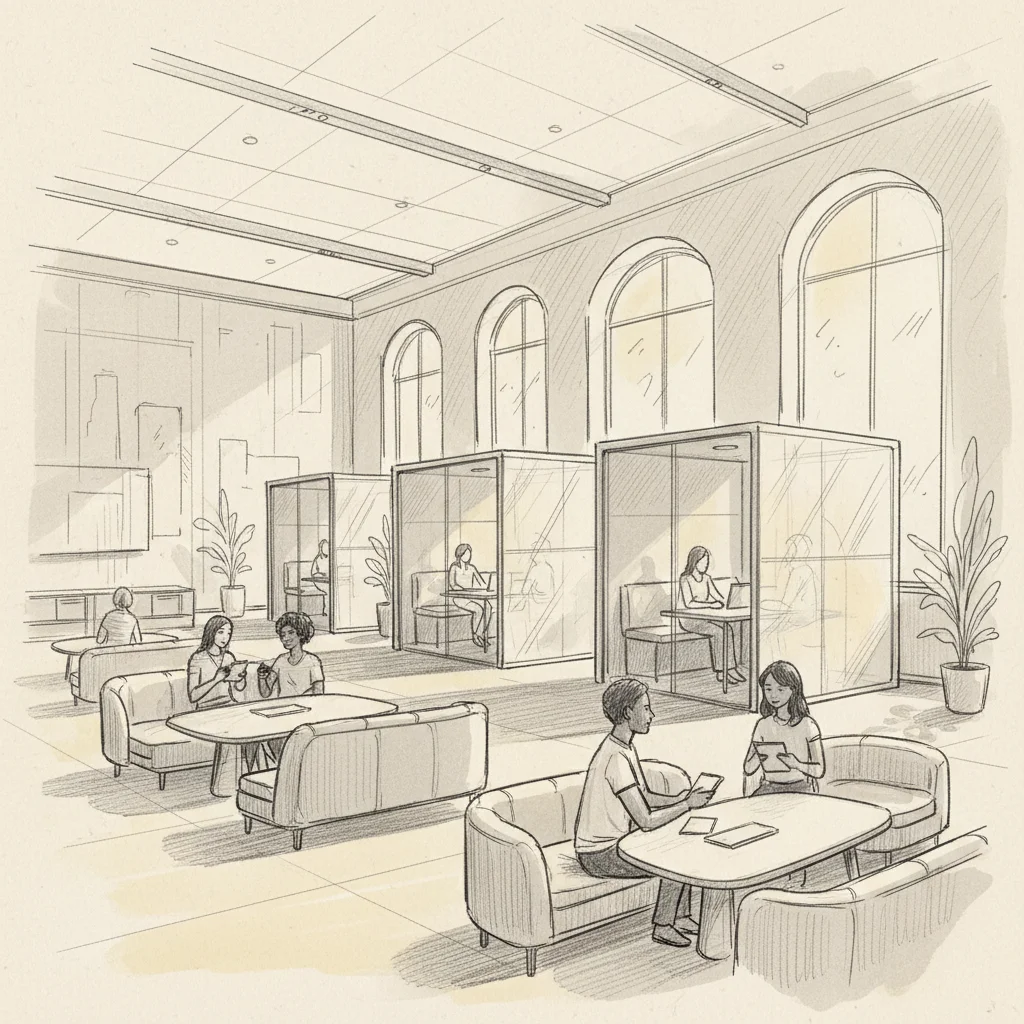
A hybrid work office space is a physical workplace configured to support employees who split their time between remote and in-person work. Done right, it reduces real estate costs, improves team collaboration, and gives your workforce the flexibility they expect in 2026. Research from the University of Chicago Booth School of Business found that office-space demand fell by roughly 41% between 2019 and 2023 for companies with low in-office expectations [1]. That number signals both the challenge and the opportunity: most enterprises are still carrying real estate footprints built for a pre-hybrid world.
This guide walks you through everything you need to plan, design, and optimize a hybrid work office space strategy in 2026. You'll learn how to assess your current footprint, design for flexibility, deploy the right technology, and measure outcomes that matter to finance, HR, and real estate leaders alike. Expect to spend roughly two to four weeks implementing a full strategy, depending on your portfolio size.
Before redesigning your hybrid work office space, you need accurate utilization data, a clear picture of your lease obligations, and alignment across corporate real estate, HR, and finance. Without these three inputs, any redesign risks being built on assumptions rather than evidence.
Start by gathering the following before any space planning begins:
You'll also need the right people and tools in place:
| Prerequisite | Why It Matters | Who Owns It |
|---|---|---|
| 90-day occupancy data | Reveals true utilization patterns, not assumptions | Corporate Real Estate / Facilities |
| Lease schedule | Identifies consolidation windows and break clauses | Corporate Real Estate / Legal |
| Employee survey data | Grounds design in actual work habits | HR / Workplace Experience |
| Booking platform | Enables ongoing measurement and coordination | IT / Workplace Technology |
| Executive sponsorship | Unlocks budget and change management authority | CFO / CHRO |
Pro Tip: Don't rely on badge swipe data alone. Tailgating, forgotten badges, and remote-heavy days all distort the numbers. Cross-reference badge data with calendar booking data and desk reservations to get an accurate baseline before you make any space decisions.
Auditing your current utilization means measuring how many desks, meeting rooms, and collaborative zones are actually used versus how many you're paying for. This single step is where most real estate savings are found.
Research published in the Journal of Environmental Psychology confirms that employee preferences for office attributes in hybrid working vary significantly by role type and team structure [4]. A one-size-fits-all floor plan misses this entirely.
A practical example: a global financial services firm recently discovered through a 90-day audit that two of its six floors ran below 25% utilization on every day except Tuesday. That single insight justified a lease consolidation that reduced their real estate footprint by 33% at the next renewal window.
Pro Tip: Run your audit across at least three months to capture seasonal variation. A single month of data, especially one that includes a major holiday or all-hands event, will skew your baseline and lead to poor space decisions.
Your hybrid work office space design principles are the strategic rules that govern how space is allocated, what types of zones you build, and how employees interact with the environment. Setting these principles before touching floor plans prevents costly redesigns later.
Two frameworks dominate enterprise hybrid office design as of 2026:
Harvard Business Review's landmark piece on designing the hybrid office argues that the most effective hybrid spaces function as "culture spaces" rather than mere workstations [5]. The implication is clear: if employees can do focused work at home, the office needs to offer something they can't replicate remotely, primarily spontaneous collaboration, mentorship, and social connection.
A well-designed hybrid office typically allocates space across these categories:
The University of Minnesota's Hybrid Workplace Strategic Space Initiative provides a useful institutional model, coordinating space design with HR policy to ensure alignment between flexible work expectations and physical environments [6].
According to Humanscale's five rules of hybrid office design, ergonomic flexibility is as important as spatial flexibility [7]. Employees who hot-desk need adjustable furniture and adequate technology at every station, not just at assigned desks.
Technology is what converts a well-designed hybrid work office space from a static environment into a dynamic, data-driven workplace. The right platform stack handles desk booking, attendance forecasting, and real-time utilization in one integrated view.
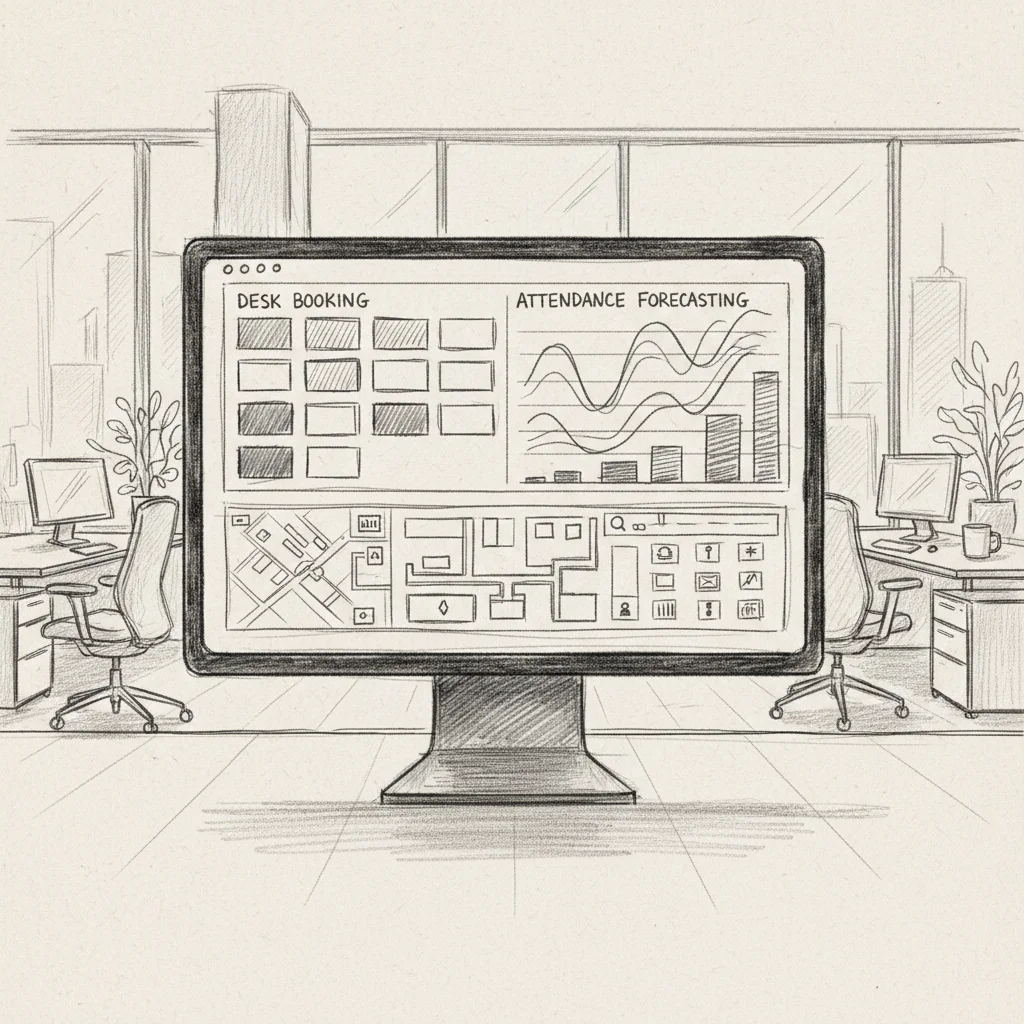
Most enterprise hybrid programs need these four technology layers:
Most desk booking tools tell you where people sat yesterday. That's useful for reporting, but it doesn't help you coordinate team co-attendance or right-size your space for tomorrow. Attendance forecasting (the ability to predict, not just record, who's coming in) is the capability that separates reactive space management from proactive workplace optimization.
At Upflex, we've found that organizations relying on historical badge data alone consistently underestimate Tuesday and Wednesday peaks while overestimating Monday and Friday demand. This mismatch leads to both overcrowding on peak days and wasted space on slow ones.
Upflex's UnifyAI engine forecasts attendance with 97% accuracy, automating workplace coordination so teams arrive on the same days without requiring manual scheduling. The result: customers achieve 88% co-attendance rates, meaning the right people are in the office together when it matters. For teams managing complex, multi-location Workflow processes across hybrid environments, that coordination layer is the difference between a productive office day and a frustrating one.
Industry analysts consistently note that the biggest failure mode in hybrid office programs isn't space design — it's coordination. Employees come in on different days, miss their teammates, and conclude the office isn't worth the commute. The right technology eliminates that failure mode before it takes hold.
Right-sizing your real estate portfolio means aligning your office footprint to actual and forecasted demand, rather than historical headcount. This is where hybrid work office space strategy translates directly into cost savings.
The NAIOP Research Foundation's report on hybrid work and the future of office confirms that demand for office space has fundamentally shifted, with enterprises reassessing long-term lease commitments in light of sustained hybrid adoption [2]. Your CFO already knows this. Your job is to show them the data that justifies the consolidation decision.
Build your business case using these steps:
| Metric | Pre-Hybrid Benchmark | Hybrid Benchmark (2026) |
|---|---|---|
| Desk-to-employee ratio | 1:1 | 0.6:1 to 0.8:1 |
| Average daily utilization | 70-85% | 40-60% |
| Real estate cost reduction (optimized) | N/A | 30-40%+ |
| Co-attendance achievement (target) | N/A | 85-90% |
| Meeting room utilization (target) | 50-60% | 55-70% |
Upflex customers consistently achieve 40%+ reductions in real estate spend by combining utilization data from UnifyAI with strategic lease consolidation. One limitation worth noting: results vary significantly based on lease structure, geography, and the maturity of your hybrid program. Organizations in early-stage hybrid adoption typically see smaller initial savings, with larger reductions coming at the second or third lease renewal cycle.
Pro Tip: Don't wait for a lease expiration to start optimizing. Begin collecting utilization data 18-24 months before any major renewal. That data becomes your negotiating leverage with landlords and your justification for consolidation with the CFO.
Measuring your hybrid work office space performance on an ongoing basis is what separates a one-time redesign from a continuously optimized workplace strategy. Space needs change as teams evolve, headcount shifts, and work patterns mature.
Track these metrics monthly, with quarterly reviews tied to your real estate planning cycle:
The most effective hybrid workplace programs operate on a 90-day review cycle. Every quarter, review your KPIs, identify the two or three biggest gaps, and make targeted adjustments. This might mean reconfiguring an underused floor, adjusting your desk-to-room ratio, or expanding on-demand workspace access for a team that travels frequently.
According to TIMIFY's analysis of hybrid work trends, businesses that treat office space as a dynamic asset rather than a fixed cost consistently outperform peers on both employee satisfaction and real estate efficiency [8]. The key is building measurement into the operational rhythm, not treating it as an annual exercise.
From experience working with global enterprises, the teams that struggle most with hybrid office optimization are those that redesign their space once and then stop measuring. The office environment needs the same iterative discipline as a product roadmap.
The most common mistakes in this method planning are predictable, and most of them are avoidable with the right data and governance in place.
A this strategy is a physical workplace designed to accommodate employees who split their time between working remotely and working on-site. Unlike traditional offices built for full-time occupancy, hybrid office spaces typically feature flexible seating (hot-desking or hoteling), a mix of collaboration zones and focus areas, and technology infrastructure that supports both in-person and remote participants simultaneously. The goal is to make the office worth the commute on the days employees choose to come in.
this approach typically costs 25-40% less than a traditional full-occupancy office when properly optimized. The savings come from reducing your desk-to-employee ratio (from 1:1 to roughly 0.6:1 to 0.8:1), consolidating underutilized locations, and supplementing owned space with on-demand workspace access for employees who occasionally need a workspace outside the primary office. Results vary based on lease structure, geography, and the maturity of your hybrid program.
A hybrid office refers to your company's own workspace configured to support split remote and in-person work. A flexible office (or flex office) typically refers to a third-party managed workspace, such as a coworking space or serviced office, that you access on-demand without a long-term lease. Many enterprises use both: a hybrid-configured headquarters plus access to a flexible workspace network for employees in other cities or those who need overflow capacity.
Desk booking in a the practice is managed through a workplace management platform that lets employees reserve desks, meeting rooms, and collaboration zones in advance. Effective systems also capture no-show data (booked but unused desks), provide real-time availability, and integrate with calendar tools like Microsoft 365 or Google Workspace. The best platforms go beyond booking to forecast attendance, so space can be prepared and teams can coordinate in-office days proactively rather than reactively.
As of 2026, most hybrid employees work from the office two to three days per week, with Tuesday, Wednesday, and Thursday being the most popular in-office days across industries. This creates a significant midweek peak and a Monday/Friday trough that directly impacts space planning. Designing for average occupancy rather than peak occupancy is one of the most common and costly mistakes in hybrid office planning.
A this practice needs four core technology layers: desk booking and space management software, attendance forecasting (to predict who's coming in and when), utilization analytics for real estate decisions, and video-conferencing infrastructure in every meeting room that supports both in-person and remote participants equally. Organizations with distributed teams also benefit from access to an on-demand workspace network, giving employees a professional workspace option wherever they are without requiring additional long-term leases.
Success in this method management is measured through a combination of operational and financial metrics: average daily occupancy rate, peak utilization, co-attendance rate (the percentage of team in-office days where the majority of the team actually shows up together), cost per occupied desk, and employee satisfaction with the office experience. The most effective programs review these metrics quarterly and make iterative adjustments rather than waiting for annual planning cycles.
Yes, but only if the reduction is paired with better coordination and a higher-quality in-office experience. Enterprises that simply cut square footage without improving the office environment or coordinating team attendance typically see employee satisfaction drop. The companies that successfully reduce their real estate footprint by 30-40% while maintaining strong culture are those that invest in collaboration-rich space design, deploy attendance coordination technology, and supplement owned space with on-demand workspace access for employees who need flexibility beyond the primary office.
A well-executed this strategy strategy delivers two things at once: a lower real estate cost structure and a better employee experience. The steps are clear. Audit your utilization. Define your design principles. Deploy technology that forecasts and coordinates, not just records. Right-size your portfolio at the next lease event. And measure continuously so you can improve every quarter.
The organizations that get this right don't guess at attendance or design space based on pre-pandemic headcount. They use data. They use forecasting. And they treat the office as a dynamic asset that earns its cost, rather than a fixed overhead line that just gets paid.
Upflex combines AI-powered attendance forecasting (97% accuracy through UnifyAI) with desk booking, space management, and access to the world's largest on-demand workspace network. That means your team can right-size owned space with confidence, coordinate co-attendance without manual effort, and give employees a professional workspace wherever they need one. The result: 40%+ reductions in real estate spend and 88% co-attendance achievement, backed by real data from real deployments.
If your real estate portfolio is still sized for 2019 and your this approach strategy is still built on spreadsheets and badge swipes, now is the time to change that.
Explore more from our content library: