Share This Article
No items found.

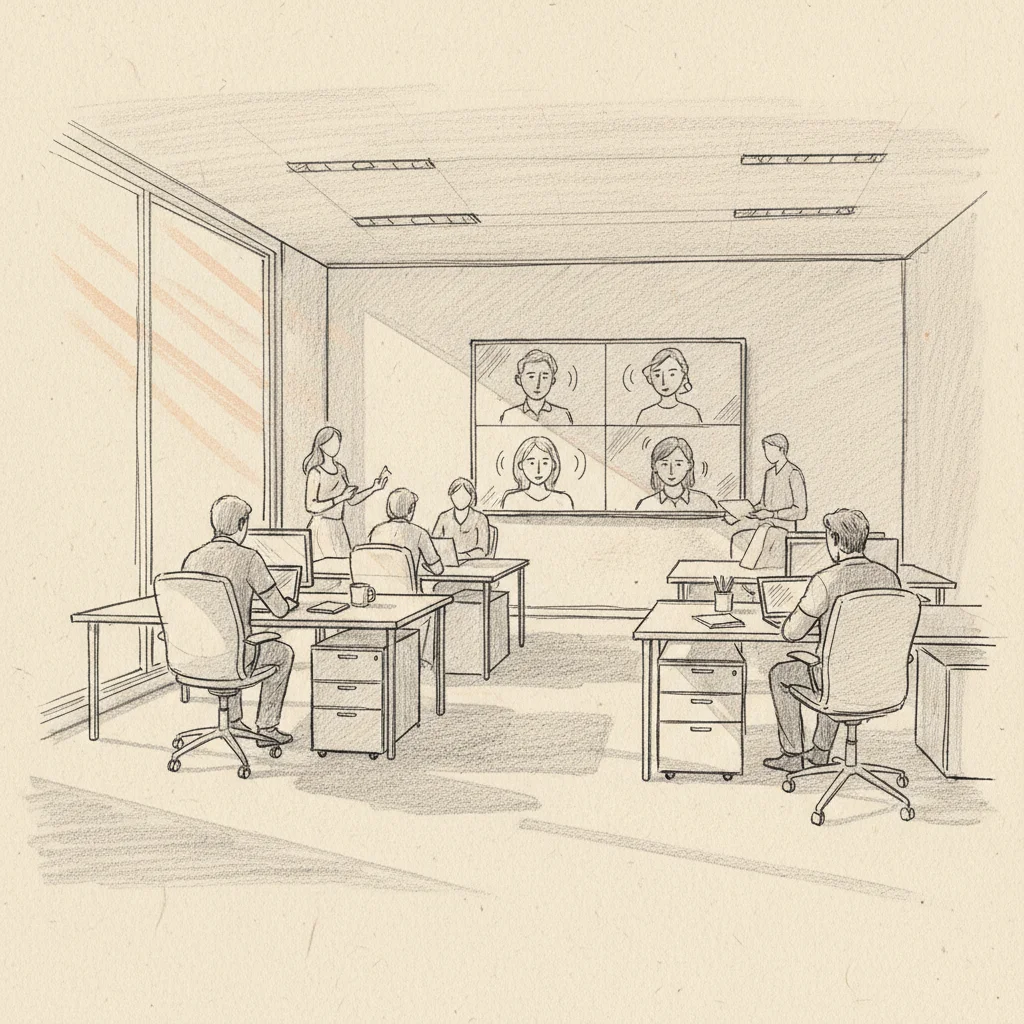
Knowing how to manage hybrid teams is one of the defining leadership challenges of 2026. Most managers inherited playbooks built for either fully remote or fully in-office work, and neither fits the messy reality of hybrid. Employees split their weeks across home offices, company headquarters, and on-demand workspaces. Attendance is unpredictable. Collaboration suffers when the wrong people show up on the wrong days. And real estate budgets keep burning through dollars on space that sits empty half the week. This guide gives you a concrete, step-by-step framework to fix all three problems, drawing on research from MIT, Stanford, Gallup, and Harvard Business Review, plus the operational data Upflex has gathered from enterprises managing hybrid teams at scale.
A hybrid work policy is the written agreement that defines which days employees work on-site, how attendance is tracked, and what flexibility employees can expect week to week. Without one, managers default to informal arrangements that create inequity and confusion. This is particularly relevant for how to manage hybrid teams.
Research from LumApps identifies a clear hybrid workplace policy as the first and most critical step in managing hybrid teams effectively [1]. A policy that gets used has four components:
A common mistake is writing a policy that describes the ideal scenario but says nothing about enforcement or tooling. Employees read the ambiguity as permission to ignore the in-office requirement entirely. Another pitfall: setting anchor days without checking which days employees are already self-selecting. If 70% of your team comes in on Tuesdays and Thursdays anyway, anchor those days and you'll hit your co-attendance targets with minimal friction.
Pro Tip: Before publishing your hybrid policy, run a two-week attendance analysis using desk booking or badge data. The days your team already prefers in-person are your natural anchor days. Build the policy around behavior that already exists rather than trying to change it from scratch.
Stanford's Cardinal at Work program recommends that managers focus on results rather than physical presence as the primary performance indicator, which means your policy should specify outcomes expected on remote days, not just location requirements [2].
Attendance forecasting is the practice of predicting which employees will be on-site on a given day so managers can align team schedules, allocate space efficiently, and avoid the "empty office" problem that drives real estate waste.
Most enterprises still rely on calendar invites and informal check-ins to gauge who will be in the office. This produces attendance data that is wildly inaccurate, often by 30-40%, according to workplace utilization studies. The result: companies pay for floors they don't use, and employees arrive to find their team isn't there, which erodes the entire rationale for coming in.
At Upflex, we've found that the core problem isn't employee resistance to hybrid work. It's the coordination failure that makes in-office days feel pointless. When employees show up and their teammates aren't there, they stop showing up. The cycle feeds itself. When considering how to manage hybrid teams, this point stands out.
Upflex's UnifyAI engine solves this by forecasting office attendance with 97% accuracy, processing scheduling inputs, historical badge data, and team calendar signals to predict who will be on-site and when. That forecast then triggers automated coordination workflows: employees get nudges to align their schedules with their team's planned in-office days, and space is allocated accordingly. Enterprises using UnifyAI have achieved 88% co-attendance rates, meaning the right teammates are actually in the building together on the days that matter.
Inclusive communication means designing every meeting, decision, and information-sharing moment so that remote participants have equal access to context, voice, and visibility as those physically present in the room.
Gallup research consistently shows that remote and hybrid employees report lower feelings of connection and are at higher risk of being overlooked for high-visibility projects and promotions [3]. This isn't a motivation problem. It's a structural one. When managers hold hallway conversations that produce decisions, remote employees are excluded by default.
According to Harvard Business Review, the most effective hybrid managers treat every meeting as if all participants are remote, even when half the room is physically present [4]. That means:
LifeLabs Learning identifies clear communication and inclusion as two of the five essential skills for managing hybrid teams effectively [5]. Schedule weekly 1:1s with every direct report regardless of their location. Use a consistent agenda: wins from the past week, blockers, and one question about how the hybrid arrangement is working for them. This surfaces friction early, before it becomes a retention problem.
Pro Tip: Record all-hands and team meetings and post the recording with a written summary within two hours of the session ending. Employees in different time zones or who had conflicting commitments stay informed without having to chase down colleagues for context.
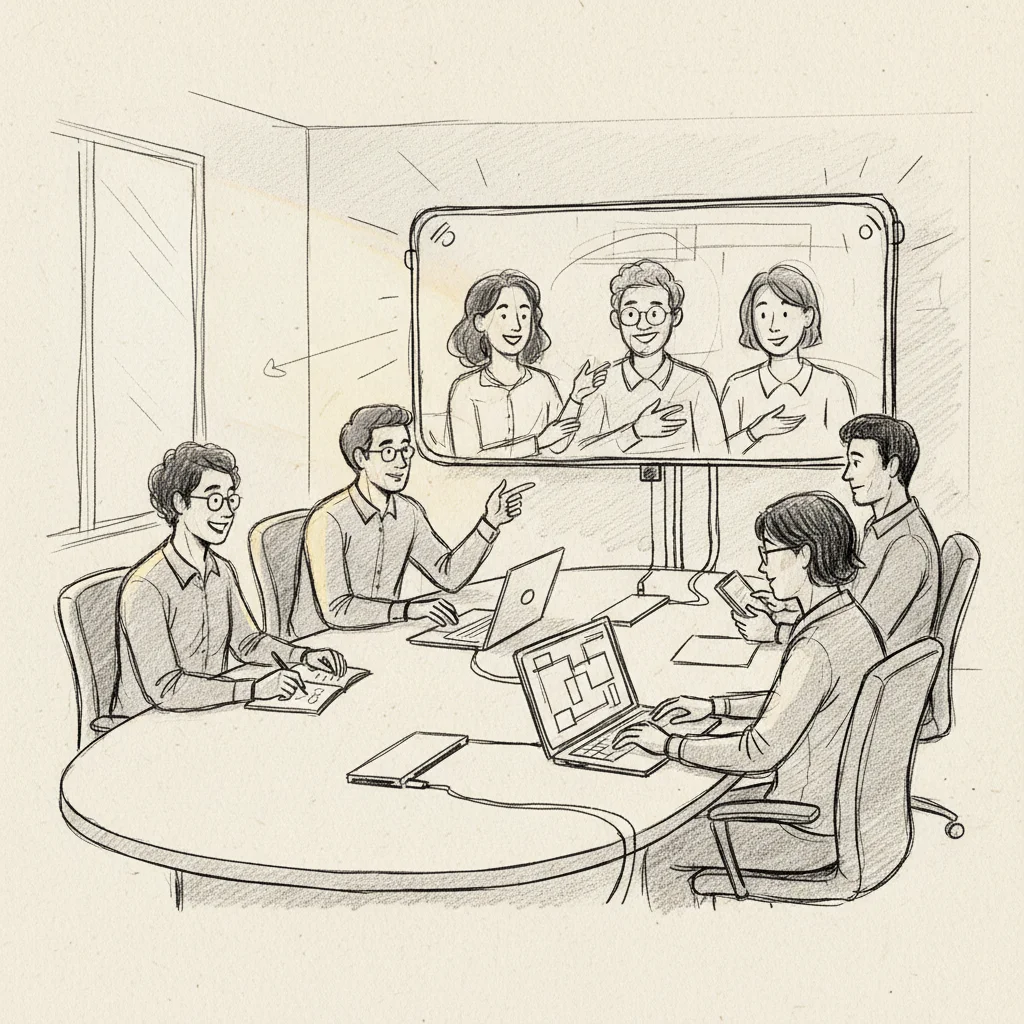
Real estate portfolio optimization for hybrid teams means right-sizing your office footprint based on actual and forecasted utilization data, rather than pre-pandemic headcount assumptions. For those exploring how to manage hybrid teams, this matters.
For most global enterprises, real estate is the second or third largest operating expense. As of 2026, the average office utilization rate in hybrid environments sits below 50% on most days, according to workplace analytics benchmarks. Companies are paying full-price leases for space that is functionally half-empty five days a week.
MIT Sloan research recommends that managers and real estate leaders look at outcomes and be strategic about how teamwork is structured across locations, rather than assuming physical presence equals productivity [6]. That reframing is the foundation of smart portfolio decisions.
Upflex customers following this framework have achieved 40%+ reductions in real estate spend, with the savings validated by utilization data that finance teams can present directly to the CFO. The platform's on-demand workspace network covers locations globally, so employees in cities without a company office can still access professional workspace without requiring a new lease.
| Utilization Rate | Recommended Action | Potential Outcome |
|---|---|---|
| Below 40% | Exit or sublease; redirect budget to on-demand workspace access | 30-50% cost reduction on that footprint |
| 40-60% | Consolidate floors; implement hot-desking with desk booking software | 15-30% cost reduction; improved employee experience |
| 60-80% | Optimize layout; ensure anchor days don't exceed capacity | Improved space efficiency; reduced friction on peak days |
| Above 80% | Add flex capacity via on-demand workspace network; review anchor day spread | Prevents overcrowding; maintains employee satisfaction |
Measuring hybrid team performance means evaluating output, collaboration quality, and goal achievement rather than physical presence or hours logged at a desk.
The instinct to monitor location is understandable but counterproductive. Rutgers University's HR guidance explicitly advises managers to provide clear visibility into work arrangements and focus on what people produce rather than where they produce it [7]. The OKR (Objectives and Key Results) framework, widely used in enterprise environments, is particularly well-suited to hybrid teams because it anchors performance conversations to measurable outcomes rather than observable behaviors.
For each team member, define:
A common mistake in hybrid performance management is applying different standards to remote and in-office employees without realizing it. Managers unconsciously rate in-office employees higher because they see their effort directly. Forbes research on hybrid team management recommends building structured calibration sessions into the performance review cycle specifically to correct for this bias [8].
| Strategy | Best For | Key Metric | Tool Type Needed |
|---|---|---|---|
| OKR tracking | All hybrid team members | Key result completion rate | Goal management software |
| Attendance forecasting | Real estate and HR leaders | Co-attendance rate | AI workplace platform |
| Desk utilization analytics | Corporate real estate teams | Utilization rate by floor/day | Desk booking + sensor data |
| Pulse surveys | HR and people managers | Engagement score; inclusion index | Employee listening platform |
| Collaboration health metrics | Team leads and project managers | Meeting participation; async response rate | Microsoft 365 / Google Workspace analytics |
Hybrid team culture is built through repeated, intentional rituals, not spontaneous in-office moments. Without deliberate design, culture defaults to the experience of whoever is physically in the room most often.
MIT Sloan's research on hybrid work emphasizes being deliberate about interactions and creating structured opportunities for social connection that don't depend on geography [6]. Effective rituals include:
Forbes notes that managing hybrid teams effectively starts with the manager modeling the behaviors they want to see, including transparency about their own schedule, location, and availability [8]. If you're in the office three days a week, say so publicly. If you're working remotely on Fridays, put it in your calendar. Visibility from the top normalizes the hybrid model for everyone below it.
Pro Tip: Schedule your quarterly in-person gatherings at least two months in advance and anchor them to a business event, like a planning cycle or product launch. Teams that have a clear reason to be together show up. Teams invited to "just connect" often don't prioritize the travel.
Hybrid team management requires a technology stack that covers three distinct needs: communication and collaboration, desk booking and space management, and access to workspace outside the main office.
Most enterprises invest heavily in layers one and two but ignore layer three. The result: employees in secondary cities or traveling for work have no professional workspace option and either work from cafes or expense ad hoc coworking memberships without any central visibility. Upflex's on-demand workspace network gives those employees access to professional spaces globally while giving real estate leaders consolidated utilization data across every workspace their employees use, whether it's a company office or a third-party venue. This directly impacts how to manage hybrid teams outcomes.
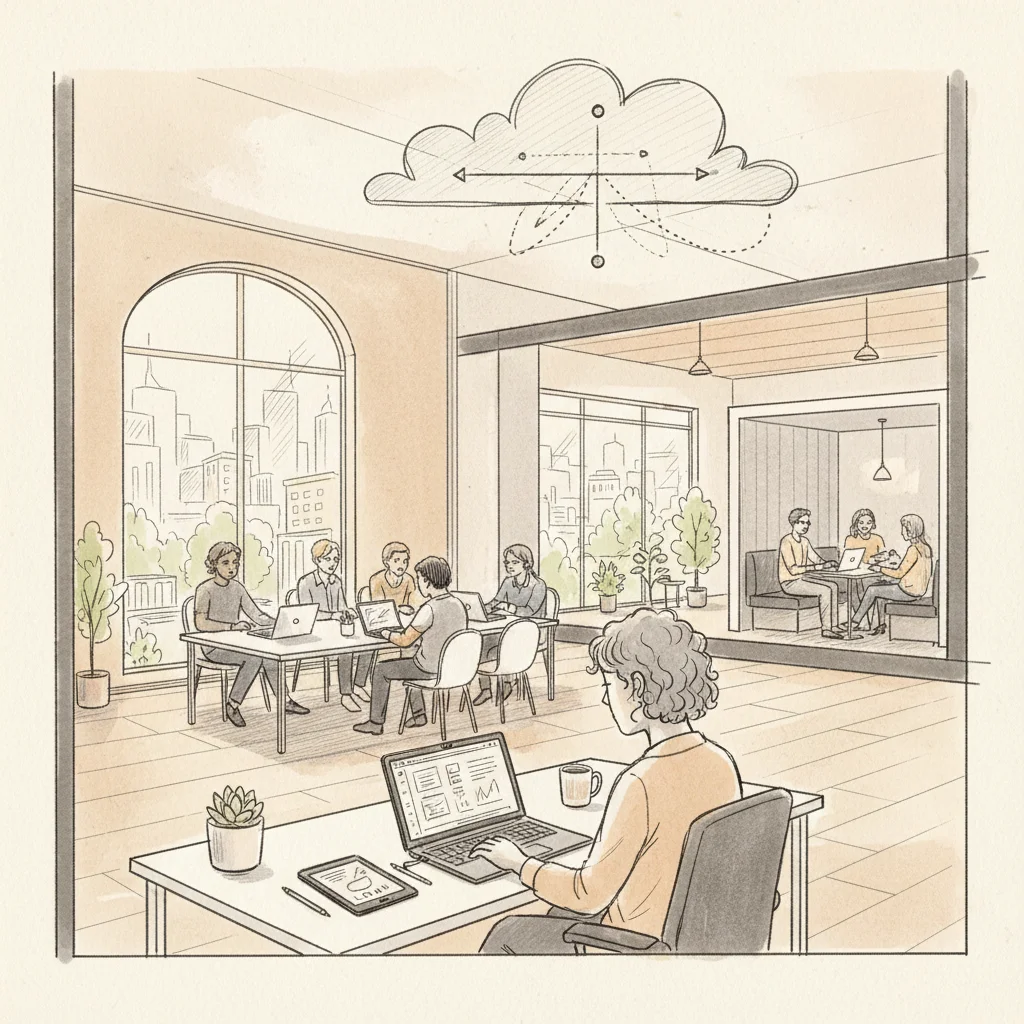
The right hybrid management strategy depends on your team size, geographic distribution, real estate situation, and the maturity of your existing tooling. Use this framework to prioritize where to start.
In practice, most enterprises have multiple problems simultaneously. Prioritize the one that is most visible to senior leadership or most directly tied to a cost or retention risk. Quick wins in one area build the organizational credibility to tackle the others.
The biggest challenge is coordination: getting the right people in the same place at the same time without mandating rigid schedules. When attendance is unpredictable, co-attendance suffers, in-office days feel pointless, and employees stop coming in. Solving this requires attendance forecasting and automated scheduling nudges, not just a policy document.
Fairness in hybrid teams requires two things: equal access to information (no hallway decisions that exclude remote employees) and equal standards for performance evaluation (OKR-based assessment rather than presence-based judgment). Build structured calibration sessions into your review cycle to catch proximity bias before it affects promotions or project assignments.
As of 2026, most global enterprises have settled on two to three anchor days per week, with the remainder as employee-choice remote days. The right number depends on the nature of the work: roles requiring deep collaboration or client-facing interaction benefit from more on-site time, while heads-down individual contributors often perform better with more remote flexibility. Results may vary by team and industry.
Measure output, not location. Use the OKR framework to set quarterly objectives with measurable key results for every team member. Supplement with collaboration health metrics (meeting participation, async response rates, document contribution) and regular pulse surveys to catch disengagement early. Avoid using badge data or desk booking frequency as a proxy for performance. This is particularly relevant for how to manage hybrid teams.
You need three categories of tools: a communication and async collaboration platform (Microsoft Teams, Slack, or Google Workspace), a desk booking and attendance coordination system with AI forecasting capability, and access to an on-demand workspace network for employees outside commuting range of a company office. A platform like Upflex combines the second and third layers into one system, giving real estate and HR leaders consolidated visibility across all workspace types.
Culture in hybrid teams is built through repeated, intentional rituals rather than spontaneous in-office moments. Weekly team standups, quarterly in-person gatherings, async recognition channels, and virtual coffee pairings all contribute. The manager's own behavior matters most: publicly sharing your schedule, modeling transparency, and treating remote and in-office employees identically sets the cultural standard for the whole team.
Start with 90 days of utilization data to identify floors or buildings consistently below 60% occupancy. Model your peak anchor day demand using attendance forecasting, then consolidate or exit underused space. Fill geographic gaps with on-demand workspace access rather than new leases. This approach to how to manage hybrid teams from a real estate perspective has enabled Upflex customers to cut real estate spend by 40%+ while maintaining or improving the employee experience.
Co-attendance (the rate at which team members are physically present in the office on the same days) is the metric that determines whether in-person work actually delivers its intended collaboration benefit. Individual attendance rates tell you how often people come in; co-attendance tells you whether the right people are there together. Enterprises using Upflex's UnifyAI coordination workflows achieve 88% co-attendance rates, compared to the industry average of well below 60% without structured coordination.
Knowing how to manage hybrid teams in 2026 means going beyond flexible scheduling and into the operational infrastructure that makes flexibility work: forecasted attendance, coordinated in-person days, inclusive communication, and a real estate portfolio sized to actual demand rather than pre-pandemic headcount. The managers and real estate leaders who get this right aren't just improving employee satisfaction. They're generating measurable cost savings and building the data foundation to make every future workplace decision with confidence.
Upflex brings together AI-powered office orchestration and access to the world's largest on-demand workspace network to address every layer of this challenge. From 97% accurate attendance forecasting that eliminates coordination failures, to utilization analytics that give CFOs the data they need to right-size the portfolio, to global workspace access that serves employees wherever they work, the platform is built for the operational reality of hybrid work at enterprise scale. If your team is still guessing who will be in the office next Tuesday, that's the first problem worth solving.
Explore more from our content library: