Share This Article
No items found.

Office space in Dubai ranges from AED 500–1,200 per sq ft annually in premium districts like DIFC and Downtown, down to AED 80–300 per sq ft in emerging zones like Business Bay or JLT. Coworking desks start around AED 1,500/month, making them a cost-effective entry point. Your choice of location, lease type, and legal setup directly determines visa quota, overhead, and scalability, so the decision carries more weight than the rent figure alone.
Your industry, headcount, and growth stage should drive your Dubai office decision, location and legal structure determine cost, visa quota, and market access.
DIFC is the default address for finance, legal, and professional services firms. Grade A offices run AED 250–350 per sq ft annually, and the district operates under its own common-law jurisdiction, meaning contracts, dispute resolution, and court proceedings follow English-law principles rather than UAE civil law. For a financial services firm signing client agreements across borders, that distinction is material.
Tech startups and agencies typically don't need that infrastructure. Business Bay and Jumeirah Lakes Towers (JLT) offer workspace at AED 80–160 per sq ft per year [3], cutting occupancy costs by 50–70% compared to DIFC while still providing metro access and modern fit-outs. Both districts attract SMEs and scale-ups that prioritize flexibility over a prestige postcode. According to Property Finder UAE, Business Bay and JLT consistently rank among the most searched commercial districts in Dubai, reflecting strong demand from growing businesses.
Dubai Internet City (DIC) and Dubai Media City (DMC) serve a different need entirely. These free zones are purpose-built for tech and media companies, and tenants receive 100% foreign ownership alongside zero corporate tax on qualifying income. If your business model depends on IP, software licensing, or content production, the regulatory environment in DIC or DMC is structured specifically around those activities.
"Location is not just a cost decision — it's a strategic one. The right Dubai district signals credibility to clients, attracts the right talent pool, and determines which regulatory framework governs your contracts." — Sarah Al Mansoori, Commercial Real Estate Consultant, Dubai Chamber of Commerce
Mainland offices give you broader UAE market access and higher visa quotas per sq ft than equivalent free zone setups, a critical advantage if you're hiring aggressively or servicing clients directly across the Emirates without a local distributor.
Free zones trade that access for tax and ownership benefits. The right call depends on your revenue model: if you sell primarily outside the UAE or within a single free zone ecosystem, the ownership structure justifies the trade-off. If you're building a local sales operation, mainland licensing typically costs less in the long run than the workarounds free zone companies use to reach UAE-based clients.
Match the office format to your headcount trajectory before signing anything. A five-person team locked into a three-year traditional lease will overpay by 30–50% versus a coworking or serviced office arrangement that scales month to month. Platforms like Upflex give distributed teams on-demand access to workspace across Dubai and globally, so you can right-size your committed footprint without stranding employees who need a desk on short notice.
When comparing locations, it helps to browse active listings to understand real-time pricing and availability. Resources like Bayut's Dubai office rentals and Dubizzle's commercial office listings provide up-to-date market data across all major districts, helping you benchmark asking rents before entering negotiations.
Base rent covers only 60–70% of what you'll actually pay, the remaining 30–40% sits in fees, deposits, and operational costs most budgets miss.
Service charges in premium towers add AED 20–40 per sq ft per year on top of your headline rent. For a 2,000 sq ft floor in a Business Bay tower, that's AED 40,000–80,000 annually before you've switched on a single light.
Fit-out is the largest upfront variable. A blank shell space costs AED 150–300 per sq ft to build out, a 2,000 sq ft office runs AED 300,000–600,000 in capital expenditure before your team moves in. Serviced offices and coworking spaces eliminate this entirely, which matters when you're managing cash flow.
Parking is routinely underestimated. A bay in DIFC or Downtown Dubai runs AED 800–1,500 per month. A 10-person team with cars adds AED 96,000–180,000 per year, before a single desk is paid for.
Three mandatory line items catch first-time tenants off guard: a DEWA security deposit (typically AED 2,000–10,000 depending on load), a municipality fee of 5% of annual rent, and ejari registration. Together, these are routinely underestimated by 15–20% in initial budgets.
Here is a summary of the key cost components to include in your Dubai office budget:
"Many businesses underestimate their total occupancy cost by 25–30% because they focus only on headline rent. Service charges, fit-out amortization, and parking can fundamentally change the economics of a location." — James Whitfield, Head of Commercial Leasing, JLL Middle East
The break-even point between coworking and a private lease sits at roughly 8–12 dedicated desks. Below that threshold, coworking wins on total cost; above it, a conventional lease typically becomes cheaper per seat.
Coworking desks in Dubai range from AED 1,500–3,500 per month per person. A comparable private office lease runs AED 80,000–200,000+ per year for equivalent space, but that figure excludes fit-out, service charges, and parking. For teams evaluating commercial workspace on a tight timeline, platforms like Upflex provide on-demand access to a global workspace network, letting you pay per use rather than committing to a long-term lease while your headcount stabilizes.
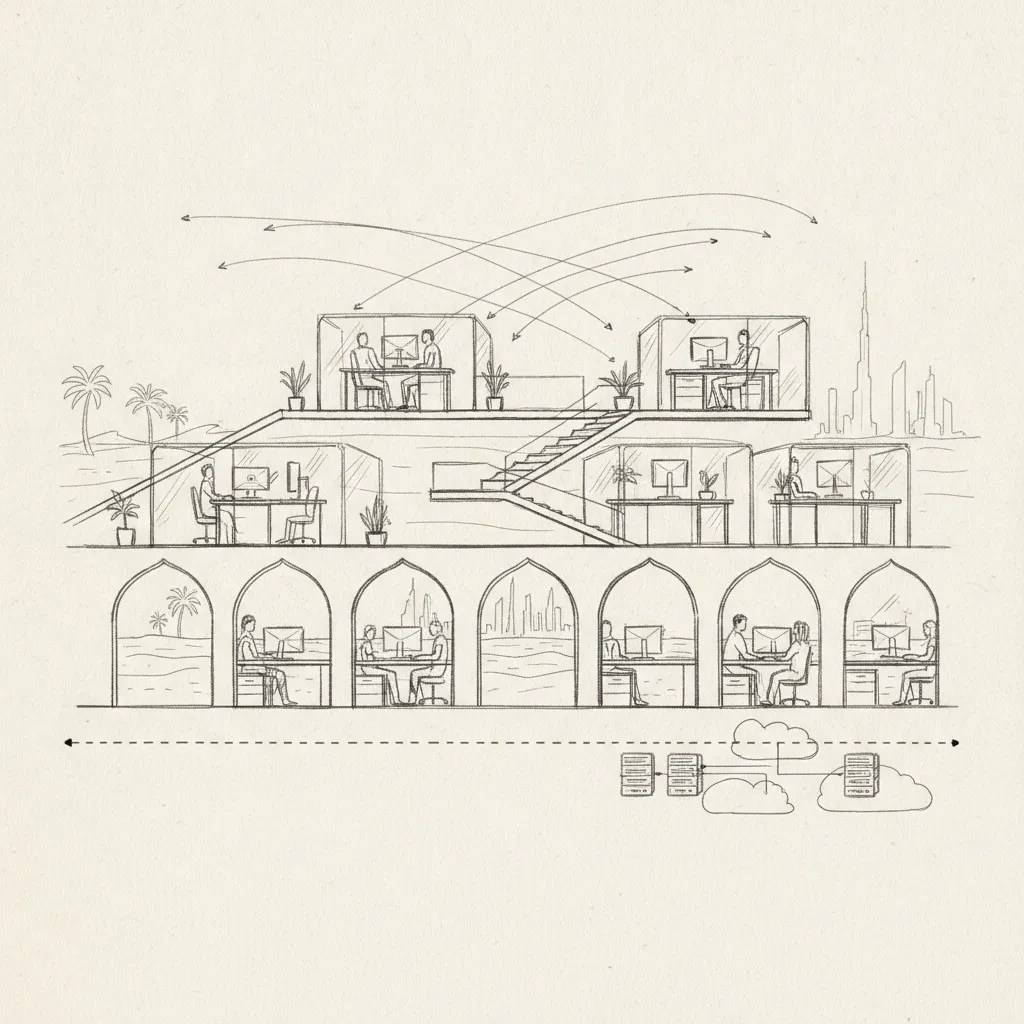
Every business renting commercial premises in Dubai must hold a valid trade license, and the office address is a mandatory field on that application.
The license issuing authority depends on your entity structure. Mainland companies register with the Department of Economic Development (DED); free zone companies register with their respective free zone authority, such as DIFC, DMCC, or Dubai South. Both routes require a physical or registered office address before the license can be issued. According to the Dubai Department of Economy and Tourism, businesses must maintain a valid, registered office address throughout the life of their trade license to remain compliant.
Once you have a signed lease, you must register it through Ejari, the Real Estate Regulatory Agency's official tenancy contract system. Ejari registration costs approximately AED 220 and is a legal requirement. Without a valid Ejari certificate, you cannot process employee residence visas, open a corporate bank account, or renew your trade license.
Free zone entities carry one significant constraint: they cannot trade directly on the UAE mainland without appointing a local distributor or obtaining a separate mainland license. For sales-heavy businesses that need direct access to UAE customers, this is a material limitation worth resolving before signing a lease.
Your licensed entity sponsors employee residence visas, and the number of visas you can sponsor is tied directly to your office size.
On the mainland, DED typically allocates one visa per 9 square meters of leased space. A 90 sq m office, for example, supports up to ten employee visas. Free zones operate differently: many offer fixed-quota packages, such as three or six visas per flexi-desk arrangement, regardless of square footage.
To sponsor a visa, the entity needs a physical office address, a valid Ejari registration, and proof of tenancy. Coworking providers in Dubai increasingly offer compliant packages, bundling a registered address, Ejari documentation, and a trade license address into a single monthly fee, which satisfies these requirements without committing to a full private office lease.
If your headcount is growing faster than your current space allows, tracking your visa quota against your actual floor area is worth doing before you hit the ceiling. Platforms like Upflex, which consolidate workspace utilization data across a company's portfolio, can help corporate real estate teams model whether a larger dedicated office or a flexible workspace arrangement better supports both headcount targets and cost goals.
The costliest errors companies make when renting commercial space in Dubai fall into five predictable categories, all avoidable with the right due diligence before signing.
Dubai's post-2024 office market has seen a 22% rise in demand for flexible lease terms, driven by hybrid work reducing average daily occupancy to 55–65% of peak capacity. Committing to a three-year lease before you know your actual headcount locks you into fixed costs that your utilization data may never justify. Validate attendance patterns for at least one quarter before signing anything longer than 12 months.
Free zones offer lower setup costs, but if your business model requires selling directly to UAE mainland clients or partnering with local distributors, a free zone license forces you into workarounds, typically a mainland distributor agreement, that can cost more than the rent savings deliver. Confirm your licensing requirements with a UAE commercial lawyer before selecting a jurisdiction.
RERA ties visa quotas to square footage. Companies that grow from 10 to 30 staff mid-lease frequently find their space no longer supports the visa count they need, forcing a costly early exit or sublease negotiation. Build a 12-month hiring forecast into your space calculation from day one.
Demand for coworking and serviced offices in Dubai grew 35%+ year-on-year through 2024–2025. Locking into a traditional lease without flex provisions, break clauses, expansion rights, or access to on-demand workspace for distributed team members, is a structural risk as occupancy patterns continue shifting. Platforms like Upflex give corporate real estate teams access to a global on-demand workspace network alongside their owned offices, so overflow capacity doesn't require a new lease.
Dubai's standard practice of paying annual rent in one or two post-dated cheques catches many SMEs off guard. A full year's rent clearing in January creates acute Q1 liquidity pressure. Negotiate for four or more cheques where possible, and model the cash flow impact before you agree to any payment schedule.
"The cheque-based rent system in Dubai is one of the most common cash flow traps for new market entrants. Always negotiate payment terms before you negotiate the rent figure itself." — Rania Khalil, Partner, Al Tamimi & Company Commercial Real Estate Practice

Demand for commercial workspace in Dubai has stayed strong post-2024, bucking the remote-work contraction seen in many Western markets. Dubai's free zone expansion, a surge in financial services and tech firm relocations, and government-backed economic diversification have kept absorption rates high. Many multinationals entering the Gulf region treat Dubai as their regional headquarters, driving demand for both traditional leased space and flexible, on-demand options that accommodate distributed hybrid teams without long-term lease commitments.
Fitted and fully furnished offices in Business Bay, DIFC, and Dubai Internet City are the most sought-after options post-2024 [3]. Grade A fitted space appeals to financial and professional services firms that need to be operational quickly. Flexible coworking memberships and serviced offices are growing fast among scale-ups and multinationals testing the market before committing to a direct lease.
Yes, foreign companies can rent office space in Dubai's free zones without a local partner or sponsor. Free zones such as DIFC, DMCC, and Dubai Internet City allow 100% foreign ownership and provide their own licensing authority. Outside free zones, on the Dubai mainland, foreign companies historically needed a local sponsor holding 51% ownership, though recent UAE Commercial Companies Law reforms have expanded sectors where full foreign ownership is permitted.
The minimum office size for a Dubai mainland trade license is typically 200 square feet, though the exact requirement varies by business activity and the relevant licensing authority. Free zones set their own thresholds, some accept a flexi-desk arrangement with no dedicated square footage, so check directly with the free zone authority or the Dubai Department of Economy and Tourism before signing a lease.
When comparing listings, look beyond the headline rent figure. Evaluate the lease term flexibility, included service charges, parking allocation, fit-out condition (shell-and-core versus fitted), and proximity to metro stations. Also confirm whether the building supports the visa quota your headcount requires. Browsing active listings on platforms such as Property Finder UAE gives you a real-time benchmark for asking rents across districts before you enter landlord negotiations.
Finding the right office space in Dubai comes down to three decisions: choosing the correct jurisdiction (mainland versus free zone), matching the space type to your actual headcount and growth timeline, and building cost controls into the lease before you sign. Grade A fitted offices in Business Bay or DIFC command a premium for good reason, location and specification directly affect talent attraction and client perception.
If your team operates on a hybrid model, factor in utilization from day one. Platforms like Upflex let you pair a right-sized Dubai office with on-demand workspace access across the region, so you pay for space your team actually uses rather than square footage that sits empty three days a week.
Your concrete next step: pull your current headcount data and projected 12-month growth, then request a fit-out cost breakdown from at least two landlords in your shortlisted district before your next budget cycle closes.
Explore more from our content library: