Share This Article
No items found.

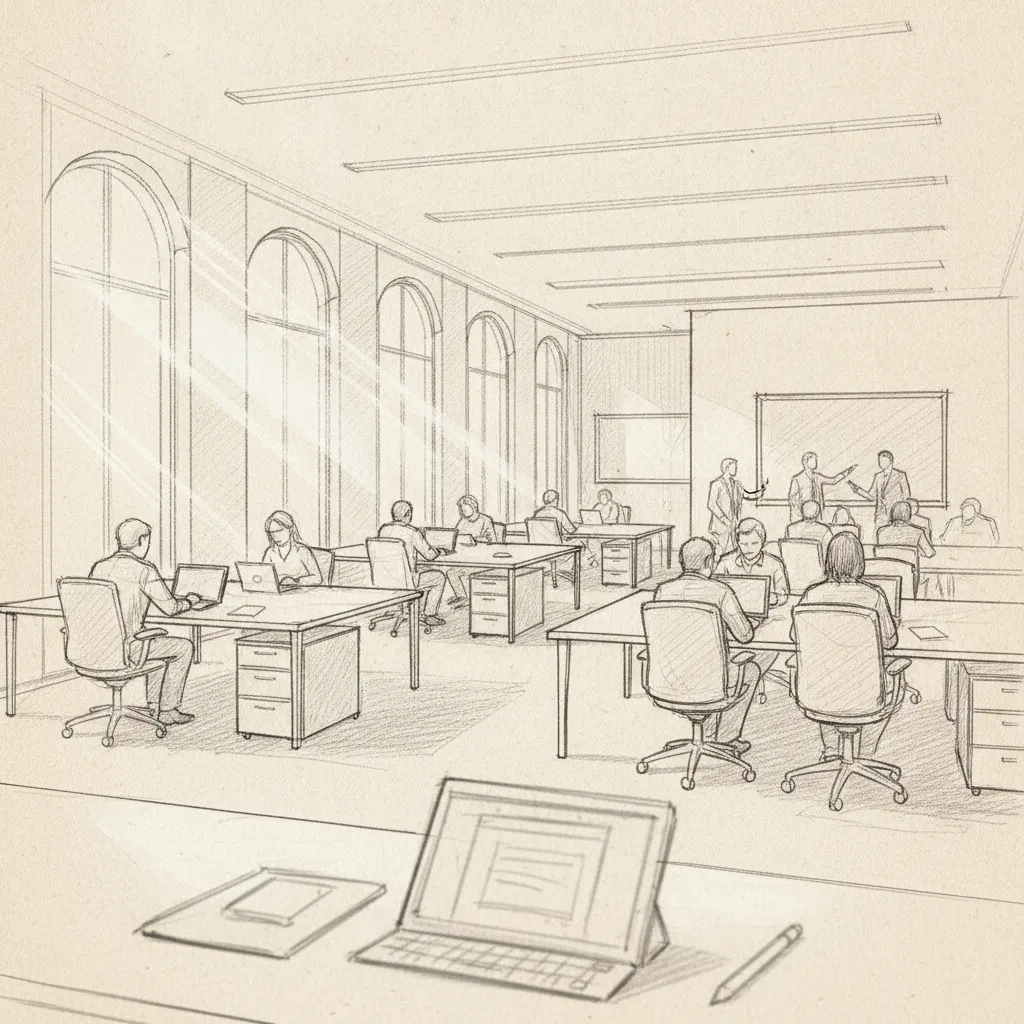
Corporate workspace solutions are the integrated strategies, technologies, and physical environments that organizations use to manage where and how their employees work. They span everything from traditional leased offices to AI-powered hybrid work platforms that forecast attendance, coordinate teams, and optimize real estate portfolios. For enterprises managing hybrid teams across multiple locations, choosing the right corporate workspace solutions is one of the highest-leverage decisions a real estate or HR leader can make in 2026.
Real estate remains one of the top three operating costs for most large enterprises. Yet average office utilization rates hover between 30% and 50% globally, according to workplace analytics research cited by CBRE's Workplace Solutions practice [1]. That gap between what companies pay for and what employees actually use is the core problem that modern corporate workspace solutions are built to close.
Corporate workspace solutions are the full range of tools, platforms, physical spaces, and management strategies that enterprises deploy to optimize how employees work, where they work, and at what cost. They address both the physical environment and the technology layer required to manage it effectively in a hybrid world.
The term covers more ground than most people initially expect. A complete corporate workspace solution typically includes several interconnected layers:
Industry analysts describe this convergence as "workplace orchestration," a discipline that blends real estate strategy with technology and human behavior. The Business and Institutional Furniture Manufacturers Association (BIFMA) recognizes workspace solutions as a distinct professional category, with certified vendors like Pyrotech Workspace Solutions operating within established standards for ergonomics and workspace design [3].
Corporate workspace solutions differ from general office space in scale, governance, and integration. They're designed for organizations managing hundreds or thousands of employees across multiple locations, often in multiple countries. That scale demands data-driven decision-making, not just a floor plan and a lease.
For example, a regional business might rent a single coworking membership through a provider like WeWork [4] and call it done. A global enterprise, by contrast, needs a unified platform that manages its owned offices, provides overflow access to external workspaces, and delivers utilization analytics that finance teams can actually act on. That's the distinction that separates a point solution from a true corporate workspace solution.
| Workspace Type | Best For | Key Limitation |
|---|---|---|
| Traditional leased office | Stable, high-density teams | Fixed cost regardless of utilization |
| Coworking membership | Distributed or remote-first teams | Limited control, no forecasting |
| On-demand workspace network | Traveling employees, overflow capacity | Requires platform integration to scale |
| AI-powered workplace platform | Global hybrid enterprises | Requires change management to adopt |
Modern corporate workspace solutions operate through a layered system: data collection feeds forecasting models, which drive automated coordination, which in turn shapes how physical space gets allocated and priced. The process is more dynamic than most traditional real estate thinking allows for.
The most basic technology layer is desk booking software, which lets employees reserve a workspace before they arrive. That's table stakes in 2026. What separates advanced corporate workspace solutions from basic booking tools is what happens before the employee makes that reservation.
AI-powered platforms like Upflex use attendance forecasting to predict who will come in, when, and where, with accuracy that reaches 97% through Upflex's proprietary UnifyAI engine. That forecast doesn't just tell you what happened last week based on badge swipe data. It tells you what will happen next Tuesday, so your space management team can configure floors, adjust HVAC, and ensure the right number of desks are available without manual intervention.
The workflow typically follows this sequence:
Pro Tip: Don't evaluate a corporate workspace platform solely on its booking interface. The real value is in the forecasting and coordination layer. A platform that predicts attendance accurately can prevent both overcrowding and ghost-floor scenarios — the two most expensive outcomes in hybrid real estate management.
Technology only works if the physical environment can respond to what the data reveals. That's why leading corporate workspace solutions combine platform intelligence with access to flexible physical inventory.
Organizations like Corporate Suites in New York City [5] offer private offices and shared workspaces that enterprises can access without long-term commitments. CBRE's workplace solutions practice emphasizes that the most effective corporate real estate strategies now blend owned space with flexible third-party access, creating a "core and flex" model that scales with actual demand rather than projected headcount [1].
In practice, this means a company might maintain a headquarters for its densest team days while routing remote employees and travelers to on-demand workspaces within a global network. That network access eliminates the dead zones between lease locations without requiring a single new long-term lease.

The right corporate workspace solutions deliver measurable financial, operational, and cultural outcomes. The most compelling results show up directly on the balance sheet and in employee engagement data.
The headline number is hard to ignore. Enterprises using AI-powered workplace optimization platforms report reductions in real estate spend exceeding 40%. At Upflex, we've found that this isn't achieved by cutting space arbitrarily. It's achieved by understanding actual utilization through accurate forecasting, then right-sizing the portfolio with confidence rather than guesswork.
The financial case breaks down across several dimensions:
Research from CBRE's workplace practice confirms that enterprises adopting flexible workspace strategies alongside portfolio consolidation consistently outperform those relying on traditional fixed-lease models in cost-per-employee metrics [1].
Cost reduction is the CFO's priority. But HR and workplace experience leaders care just as much about co-attendance, the ability to get teams physically together on the same days for collaboration and culture-building.
Platforms with automated coordination achieve 88% co-attendance rates, meaning nearly nine in ten targeted team meetings actually happen in person as planned. That's not a soft metric. It directly affects innovation velocity, onboarding quality, and the return on investment for the office space you're paying for.
Pro Tip: Present co-attendance data alongside cost savings when building the business case for a workspace platform. Finance leaders respond to the cost numbers, but HR and the CEO respond to the culture and collaboration metrics. Showing both in the same dashboard accelerates internal approval.
Deploying corporate workspace solutions at enterprise scale surfaces predictable failure modes. Understanding them before you start saves significant time, budget, and organizational goodwill.
A common mistake is investing in a desk booking tool and declaring the hybrid work problem solved. Desk booking tells you where people sat yesterday. It doesn't tell you who's coming tomorrow, whether teams will overlap, or whether the space you're paying for is earning its keep.
From experience, organizations that stop at booking tools end up with ghost floors on Mondays and Fridays and overcrowded offices on Tuesdays and Wednesdays, with no mechanism to balance the load. The forecasting and coordination layer is what prevents that imbalance.
One pitfall to watch for: vendors who describe their booking software as "AI-powered" because it uses a recommendation algorithm. True AI-powered office orchestration involves predictive modeling of team behavior, not just surfacing available desks. Ask specifically about forecast accuracy metrics before committing.
Even the best platform fails without adoption. Employees accustomed to assigned desks or fully remote schedules don't automatically embrace new coordination tools. Organizations that skip the change management phase see utilization rates for their workspace platforms drop to under 40% within six months of launch, according to workplace technology implementation research.
Effective deployment of corporate workspace solutions requires:
Flexible workspace providers like VenturePoint's corporate membership model [6] demonstrate that flexibility in workspace configuration, combined with clear communication about how employees can use the space, dramatically improves adoption rates. The same principle applies to enterprise platforms.
The enterprises seeing the strongest results from their corporate workspace solutions share a set of consistent practices. These aren't theoretical best practices. They're patterns observed across organizations that have successfully cut real estate costs while maintaining or improving employee experience.
Before redesigning your office or signing new leases, establish a baseline of actual utilization. Badge data, calendar data, and booking patterns all feed into a picture of when your space is used, by whom, and for what purpose.
Our team at Upflex recommends running a utilization audit for at least 60 days before making any portfolio decisions. The data almost always surprises leadership. Most enterprises discover that their highest-utilization days are Tuesday through Thursday, with Friday utilization running 60-70% below Tuesday peaks. That pattern alone justifies a significant rethink of how much fixed space is actually needed.
Key steps in a data-first workspace strategy:
The "core and flex" model is the dominant framework for enterprise workspace strategy in 2026. Organizations maintain a core of owned or long-leased space for their highest-density use cases, then supplement with flexible on-demand access for distributed teams, travelers, and overflow demand.
This approach is endorsed by major commercial real estate advisors including CBRE's Workplace Solutions practice, which notes that the most cost-effective enterprise portfolios blend fixed and flexible inventory in roughly a 70/30 to 60/40 ratio depending on workforce distribution [1].
| Best Practice | What It Achieves | Common Pitfall to Avoid |
|---|---|---|
| 60-day utilization audit | Data-driven portfolio decisions | Relying on badge swipes alone |
| AI attendance forecasting | Predictable space demand | Confusing booking tools with forecasting |
| Core and flex portfolio model | 40%+ reduction in real estate spend | Over-committing to fixed leases |
| Co-attendance coordination | 88% team meeting achievement | Leaving scheduling to chance |
| Phased platform rollout | High adoption rates | Company-wide launch without champions |
Pro Tip: When evaluating corporate workspace solutions, ask vendors for documented customer outcomes, not just feature lists. Specific metrics like "40% reduction in real estate spend" or "97% attendance forecast accuracy" are the signals that distinguish platforms with proven operational depth from those with polished demos and shallow results.
Workspace design also plays a supporting role. Research from Spacestor's workplace insights [7] indicates that modular, adaptable furniture configurations significantly improve how employees experience the office on high-attendance days, directly affecting whether hybrid workers choose to come in voluntarily. Physical environment and technology platform reinforce each other. Neither works as well in isolation.
Providers like TX Workspace Solutions [8] and Workspace Solutions, Inc. [9] demonstrate that even the physical furniture and design layer has become specialized for corporate environments, with services covering everything from space planning to installation and ongoing reconfiguration. For global enterprises, that physical flexibility needs to be mirrored in the technology layer.

A corporate workspace is a professionally managed work environment, either owned, leased, or accessed on demand, that an organization provides for its employees to perform their jobs. Unlike general office space, corporate workspaces are governed by organizational policies, integrated with enterprise technology systems, and designed to support specific work modes including focused individual work, team collaboration, and client-facing activities. In hybrid work models, the corporate workspace extends beyond a single building to include on-demand network locations that employees can access globally.
Charlie Green joined Workspace, the UK-based flexible office provider, as Chief Executive Officer in February 2026. Workspace Group PLC is a London-listed real estate investment trust specializing in flexible office and studio space for businesses across London. It's worth noting that "Workspace" as a brand name is used by several distinct companies in the workspace solutions industry, so context matters when researching leadership across this category.
Workspace solutions are the integrated combination of physical environments, technology platforms, and management strategies that organizations use to optimize where and how employees work. They go well beyond office furniture and floor plans to include desk booking software, attendance forecasting tools, flexible workspace network access, and real estate portfolio analytics. For enterprises managing hybrid teams, the most effective corporate workspace solutions combine AI-powered office orchestration with on-demand physical space access to reduce real estate costs while maintaining team collaboration and employee experience.
Traditional office management relies on static floor plans, assigned desks, and historical badge data to make space decisions. AI-powered this strategy use predictive modeling to forecast attendance before it happens, automate team coordination so employees show up on the same days, and generate real-time utilization data that supports portfolio consolidation decisions. The practical difference is significant: traditional management reacts to what happened last quarter, while AI-powered platforms like Upflex predict what will happen next week with up to 97% accuracy, enabling proactive space optimization rather than reactive cost-cutting.
The core and flex model is a real estate portfolio strategy in which an organization maintains a fixed "core" of owned or long-leased office space for its highest-density use cases, while supplementing with "flex" access to on-demand workspaces for distributed employees, travelers, and overflow demand. This approach, endorsed by major commercial real estate advisors including CBRE, allows enterprises to right-size their fixed cost base while still providing employees with high-quality workspace wherever they need it. As of 2026, the most effective implementations blend fixed and flexible inventory in a roughly 60/40 to 70/30 ratio.
Enterprises deploying AI-powered workplace optimization platforms report reductions in real estate spend of 40% or more. Results vary depending on current utilization rates, lease structures, and workforce distribution, but the mechanism is consistent: accurate attendance forecasting reveals how much space is genuinely needed, portfolio consolidation decisions follow from that data, and on-demand network access replaces expensive fixed commitments for variable demand. Organizations that combine internal space optimization with global on-demand workspace access tend to achieve the highest savings, since they can exit underperforming leases without leaving employees without a place to work.
this approach have moved far beyond office furniture and floor plans. The enterprises cutting real estate costs by 40% or more in 2026 aren't doing it by shrinking headcount or forcing rigid attendance mandates. They're doing it by understanding exactly how their space is used, forecasting demand accurately, and building portfolios that match actual employee behavior rather than theoretical capacity.
The technology layer is now the decisive factor. AI-powered office orchestration, attendance forecasting, and on-demand workspace network access have transformed what's possible for corporate real estate and HR leaders who are willing to move beyond legacy desk booking tools.
Upflex combines all of these capabilities in a single platform: UnifyAI delivers 97% attendance forecast accuracy, automated coordination achieves 88% co-attendance rates, and global on-demand workspace access eliminates the gaps between lease locations without adding long-term cost. If your organization is approaching a lease renewal, managing underutilized space, or trying to make hybrid work actually work for your teams, Upflex is built for exactly that challenge.
Explore more from our content library: