Share This Article
No items found.


Understanding real estate expense tracking software is essential. Enterprise finance and real estate leaders optimize real estate spending by pairing expense tracking software with workspace utilization data, so every dollar spent on offices, desks, and hybrid work gets matched against actual occupancy. The right platform consolidates spend across locations into one dashboard, flags underused space before renewal, and feeds clean numbers into existing accounting systems. This differs sharply from landlord or agent-focused expense apps, which track rental income and tax deductions for single properties rather than portfolio-wide workspace cost against usage.
Enterprise-grade real estate expense tracking software consolidates lease costs, workspace subscriptions, and occupancy data across dozens or hundreds of locations into one view.
That scope is what separates this category from the landlord and property-manager tools that dominate most search results. A single-property owner needs to categorize rental income and expenses for a tax return. A corporate real estate director needs to compare spend against actual usage across an entire portfolio, office by office, market by market, to decide where square footage is earning its cost and where it isn't [4].
The payoff is timing. Real-time visibility into spend-to-usage ratios lets finance act before a lease renewal auto-locks another year of underused space, rather than discovering the waste in a quarterly review after the window to renegotiate has closed.
This list is for CFOs, corporate real estate directors, and workplace operations leaders who own multi-site budgets and need portfolio-level answers, not individual investors tracking a handful of rental properties [5].
Upflex ties real estate expense data to forecasted employee attendance, so spend decisions reflect actual office usage instead of static lease line items.
The mechanism is UnifyAI, Upflex's forecasting engine, which predicts office attendance with 97% accuracy and pairs that forecast with real estate portfolio data. Instead of reviewing a spreadsheet of lease costs in isolation, a corporate real estate team sees which offices are running at a fraction of capacity and which ones are approaching the point where demand will outstrip the space available.
That visibility surfaces underused fixed offices as consolidation candidates while simultaneously giving employees access to Upflex's on-demand workspace network in cities where attendance is growing but a long-term lease isn't justified yet. Teams using this approach have documented 40%+ reductions in real estate spend alongside 88% co-attendance achievement, proof that cutting cost and keeping teams in the office together aren't mutually exclusive.
Upflex is built for enterprise workplace and real estate teams managing hybrid policy across multiple cities or countries, where the question isn't just "what are we spending" but "are we spending it on space people are actually using." The differentiator against single-purpose expense trackers like Stessa, Realtyzam, or Expensify: those tools categorize receipts and lease payments after the fact, while Upflex connects spend to a forward-looking attendance forecast before the decision gets made.

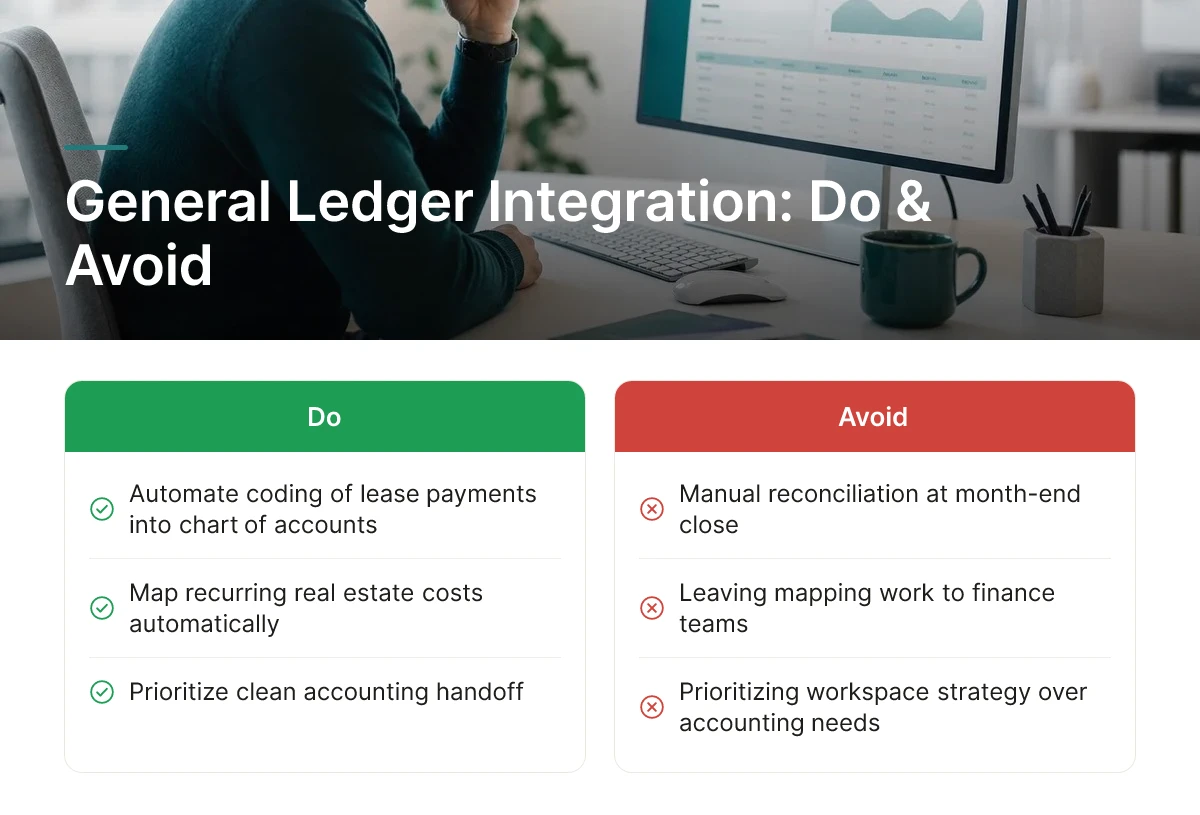
This category automates the coding of lease payments, utilities, and facilities costs directly into an enterprise's existing chart of accounts.
These platforms focus on the handoff between facilities spend and corporate finance reporting, automatically mapping recurring real estate costs to the right account codes rather than leaving that reconciliation to a finance team's manual process at month-end. For a company running multiple entities and cost centers, that mapping work can otherwise consume real staff hours every close cycle.
This category fits finance teams whose top priority is a clean accounting handoff rather than workspace strategy decisions, they're less concerned with whether an office is overbuilt and more concerned with whether the general ledger closes on time. The differentiator is depth of general ledger mapping and multi-entity consolidation, a layer of accounting rigor that lighter, landlord-focused expense apps aren't built to attempt [4].
Lease abstraction software extracts key dates, clauses, and obligations from lease documents so finance teams never miss a critical deadline.
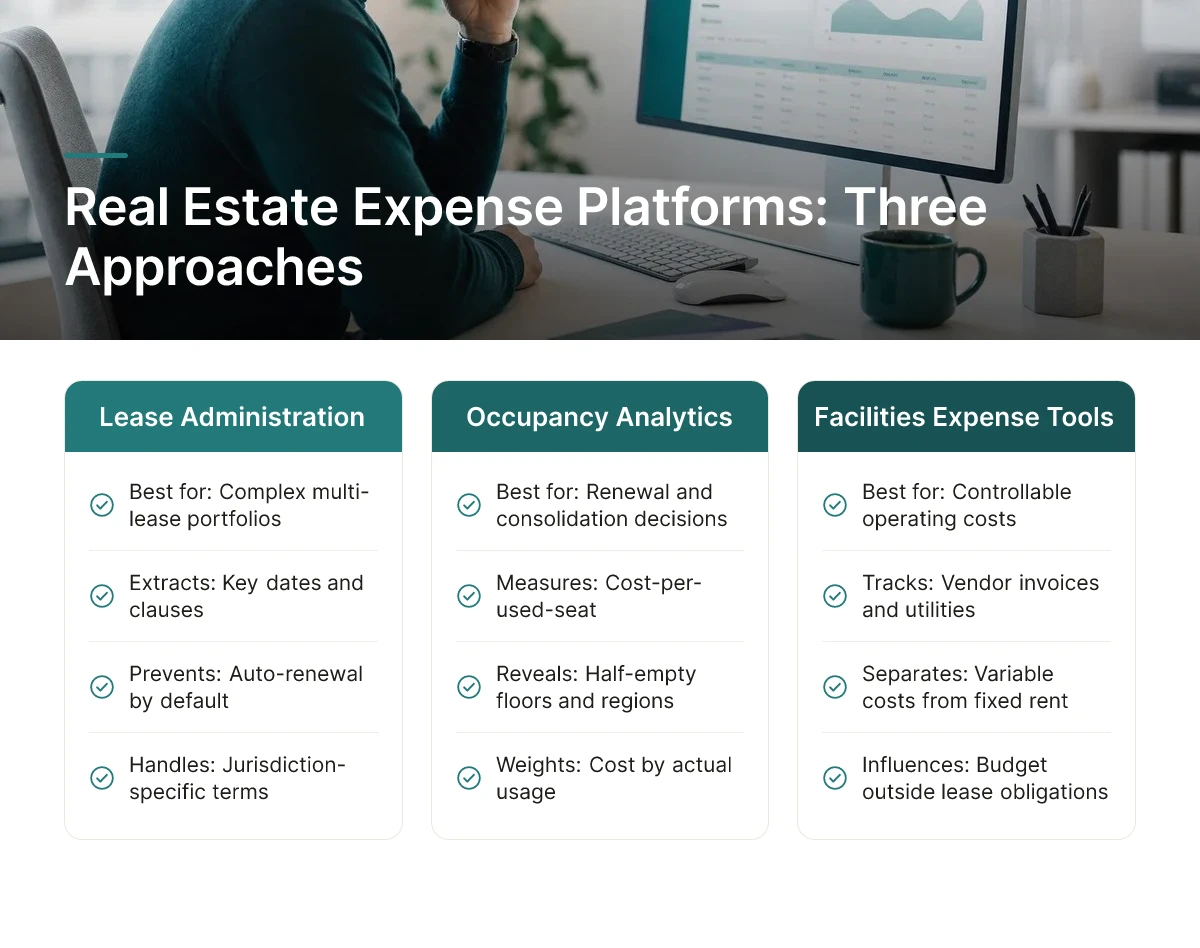
The mechanism is automated extraction: the software pulls renewal triggers, escalation clauses, and termination windows out of lease contracts and surfaces them on a calendar finance can actually monitor, instead of leaving those terms buried in PDFs across a shared drive. For a portfolio spanning dozens of leases with different terms by region, that structure is what prevents a lease from auto-renewing by default.
This matters most for enterprise teams managing many leases with complex, jurisdiction-specific terms, where a missed 90-day notice window can lock in another multi-year commitment on space the company no longer needs [3]. The differentiator here is a structured, lease-level audit trail, every clause, date, and obligation documented and searchable, a different unit of record than the receipt-level tracking landlord apps are built around.

Spend management platforms categorize facilities, coworking, and travel-to-office purchases in real time at the transaction level.
These tools track variable workspace costs, a day pass at a coworking space, a one-off meeting room rental, travel expenses tied to an in-office day, that don't fit neatly into a fixed lease line item but still add up across a distributed workforce. Card-level categorization gives finance a view into spending that would otherwise show up as a vague "miscellaneous" bucket.
This category is best for distributed teams with frequent, smaller purchases tied to flexible workspace use rather than a handful of large, predictable lease payments. The differentiator is transaction-level granularity: it complements portfolio-level lease and occupancy tracking rather than replacing it, giving finance the variable-cost detail that lease abstraction and ledger-mapping tools aren't designed to capture.
These platforms turn badge swipes, sensor readings, and booking records into a cost-per-used-seat figure finance can act on directly.
The mechanism is straightforward: badge data, occupancy sensors, or desk-booking logs reveal which floors, buildings, or regions sit half-empty relative to what the organization pays to lease them. Instead of reporting raw square footage or a flat lease rate, the platform weights cost by actual usage, a 200-desk floor running at 40% occupancy costs far more per used seat than the lease summary suggests.
This matters most for teams deciding whether to renew, downsize, or consolidate a specific office location ahead of a lease event. Upflex's UnifyAI engine forecasts attendance with 97% accuracy, which lets real estate leaders model utilization before a renewal date arrives rather than reacting to a quarter of disappointing badge data [2].
The differentiator here is usage-weighted cost analysis, not static square-footage or lease-cost reporting. A portfolio summary tells finance what a building costs; a usage-weighted view tells finance what each seat people actually sit in costs, a materially different number for consolidation decisions.
This category tracks recurring vendor invoices, maintenance contracts, and utility bills by location, separate from lease and occupancy platforms.
Where lease administration software handles fixed rent obligations, facilities expense tools track the variable costs layered on top: HVAC servicing, janitorial contracts, security vendors, and utility spend tied to a specific building or floor. The benefit is separating controllable operating costs from fixed lease obligations, giving facilities teams a budget they can actually influence instead of one dominated by a rent figure locked in years earlier.
Facilities and operations teams managing cost accountability building-by-building, or even floor-by-floor, are the best fit. A regional facilities manager responsible for three offices needs to know which one is burning through maintenance budget faster than the others, a portfolio-wide summary hides that signal.
The differentiator is operational cost granularity by location rather than a portfolio-wide financial rollup. Most lease and occupancy tools stop at the building level; maintenance expense tools go a layer deeper, into the vendor contracts and recurring invoices that make up day-to-day operating spend.
These dashboard tools pull lease, occupancy, and spend data from separate systems into one executive-facing report for finance leadership.
The mechanism is aggregation: a BI layer connects to lease administration software, occupancy platforms, and expense systems, then blends the outputs into custom dashboards built for board or CFO-level review. Rather than reconciling exports from four systems by hand each quarter, finance leaders get one view that already accounts for how lease cost, utilization, and operating spend interact.
The benefit is a single source of truth replacing spreadsheet reconciliation across disconnected systems, a common bottleneck as a skills shortage now outpaces budget constraints as the top barrier enterprises face in real estate transformation work [3]. Only 15% of business and corporate real estate leaders say they've moved past early-stage AI deployment into active optimization of their operations [3], and fragmented reporting is part of why.
Large enterprises with real estate spend scattered across many underlying tools are the best fit for this layer. The differentiator is cross-system aggregation, not single-purpose tracking, any one of the underlying tools can report on its own data well; only a BI layer makes them agree with each other.
Match the platform to portfolio complexity, hybrid work maturity, and audit requirements, not to whichever tool has the longest feature list.
Start by weighing integration depth against convenience. A tool that syncs to the general ledger and supports multi-entity reporting takes longer to implement but saves finance teams from manual reconciliation every closing cycle; a standalone reporting tool is faster to stand up but creates a second system of record finance has to maintain by hand.
Prioritize general ledger sync, multi-entity support, and exportable transaction-level detail, these determine whether finance trusts the numbers without re-checking them. A tool that can't map spend back to cost centers in the existing chart of accounts adds work instead of removing it.
Track cost-per-used-seat before and after adoption, not just subscription fees against lease savings on paper. Upflex customers use utilization data from the platform to document real estate spend reductions of 40%+ while maintaining 88% co-attendance achievement, giving finance and HR a shared metric instead of competing ones.
Match tool choice to hybrid work maturity, organizations still consolidating offices need occupancy-linked platforms, not flat cost trackers, since the decision in front of them is which building to keep, not just which invoice to approve. Assess audit requirements next: look for exportable records, approval chains, and change logs that hold up when auditors ask who approved what and when. Weigh qualitative cost tier, budget-friendly, mid-range, or enterprise, against actual portfolio complexity rather than defaulting to the cheapest option, since undersized tools get replaced within a year. Finally, plan for adoption: a platform with low onboarding friction across multiple office locations beats a more capable one that teams avoid using. For real estate expense tracking software to earn its keep, it has to get used consistently across every office in the portfolio, not just the flagship one.

Costs get fragmented across badge systems, booking tools, spreadsheets, and lease records that don't share data. Utilization rates sit at 30-50% in many portfolios, but without a unified view, finance teams can't connect that underuse to specific square footage or lease decisions, leaving real estate as a cost line nobody can fully explain.
It turns lease renewal decisions into math instead of guesswork, showing which locations are underused and which need capacity. When attendance forecasting pairs with cost data, real estate leaders can consolidate underperforming offices and reallocate budget toward on-demand workspace where distributed teams actually need it.
AI removes the manual work of matching badge swipes, booking logs, and invoices to specific cost centers by location. Instead of finance staff reconciling spreadsheets each month, forecasting engines like Upflex's UnifyAI generate attendance and utilization patterns automatically, feeding cleaner data straight into expense reports.
Audit protection comes from a documented, timestamped trail connecting bookings, attendance, and cost allocation by location and team. Centralized dashboards that log who used which space and when give finance leaders defensible records instead of reconstructing usage history from disconnected systems during audit season.
A single platform eliminates the reconciliation gap between desk booking, forecasting, and external workspace spend that separate tools create. Upflex combines internal space management with access to its on-demand workspace network in one view, so real estate and finance leaders see total occupancy cost without stitching together exports from multiple systems.
Tracking real estate spend across hybrid teams only works when attendance data, booking records, and lease costs live in one system instead of three. Leaders who consolidate that view can identify underused square footage with evidence, not estimates, and justify consolidation decisions to both the CFO and CHRO. The platforms that pair forecasting with flexible workspace access, like Upflex, which combines 97% accurate attendance prediction with its on-demand network, give finance teams the documentation to act, not just observe. Start by auditing how many separate tools currently touch your real estate cost data, then map where that fragmentation is costing you the most this quarter.
Explore more from our content library: