Share This Article
No items found.


Understanding flexible work arrangement benefits is essential. Flexible work arrangements cut real estate costs and protect productivity when companies right-size office space to actual attendance patterns rather than headcount, then reinvest part of the savings into tools and spaces that keep hybrid teams engaged. The real lever is data: utilization tracking, desk-sharing ratios, and attendance forecasting let a company shrink its footprint without shrinking collaboration quality. Done well, this trades fixed lease costs for a flexible, usage-matched real estate model while maintaining or improving employee engagement scores. As more organizations formalize these programs, understanding the full range of flexible work arrangement benefits has become a core part of workplace strategy rather than an afterthought.
The clearest of all flexible work arrangement benefits is direct: fewer desks per employee means less leased square footage and lower fixed occupancy cost.
The mechanism isn't a scheduling trick, it's a conversion of cost structure. Instead of leasing enough space for 100% of headcount to sit down at once, companies set desk ratios based on actual attendance patterns, then fill the gap with shared desks and on-demand workspace that scales with real usage. Fixed lease cost becomes variable cost tied to how much space people actually occupy. For a deeper look at how companies are rethinking occupancy models, EY's analysis of corporate real estate strategies for a hybrid workforce outlines several approaches worth considering.
Companies carrying full lease overhead on offices running below 50% average occupancy stand to gain the most, a position EY's 2022 Future Workplace Index found increasingly common, with over 70% of employees working from home two to three days a week [1]. That's a lot of paid-for space sitting empty most days.
The mistake most companies make is cutting space first and measuring later, which leads to overcrowding on peak collaboration days. Upflex addresses this by pairing attendance forecasting, accurate to 97%, with real estate decisions, so space reductions target the right square footage rather than an arbitrary percentage. Portfolio cuts backed by this kind of data have produced reductions in real estate spend exceeding 40%, while preserving the team-day density that actually drives in-office collaboration.
Activity-based working replaces assigned desks with space designed around tasks, letting companies shrink footprint while matching layouts to how people actually work.
Instead of a desk per employee, the office offers a mix of focus booths, collaboration zones, phone rooms, and open bench seating. Employees pick a space based on the task at hand rather than returning to a fixed spot.
Activity-based working is the physical design layer underneath a flexible schedule policy. A hybrid attendance policy says who comes in and when; activity-based working determines what that space looks like once they arrive. Desk-sharing ratios are set from utilization data rather than guesswork, if badge and booking data show 60% peak occupancy, the office is designed around that number, not around total headcount. A definitive guide to the hybrid workplace breaks down how space types and utilization data connect in practice.
Badge swipes, wifi connections, and desk-booking records show which space types get used, on which days, and for how long, a far more reliable input than a one-time survey that goes stale within a quarter. This model suits knowledge workers with variable daily tasks and teams whose in-office days are staggered rather than synchronized.
The risk: sharing desks too aggressively without enough variety of space types leaves employees competing for the same handful of quiet rooms, which erodes the experience gains the model is supposed to deliver.
Anchor days concentrate in-office attendance on set days each week, so shared space gets used efficiently without requiring daily occupancy.
The mechanism is synchronization: when a team agrees that Tuesday and Thursday are in-office days, facilities can plan staffing, cleaning, and catering around those two days instead of over-provisioning every day of the week. This model suits teams that need in-person collaboration but not daily co-location, product and sales teams running regular syncs and pipeline reviews are typical examples.
The differentiator is predictive attendance forecasting. Rather than guessing how many people will show up on an anchor day, forecasting tools let facilities teams size catering orders, cleaning schedules, and front-desk staffing to the expected count, cutting waste on slow days and avoiding shortages on busy ones.
Unstructured hybrid, where employees choose their own in-office days with no coordination, produces the opposite outcome: unpredictable attendance that swings between overcrowded Tuesdays and empty Fridays, wasting both space and staffing budget. Guidance on optimizing hybrid work environments covers practical ways to avoid this kind of mismatch between schedules and space.
Fully remote arrangements eliminate the office entirely, cutting lease, utilities, and facilities costs to zero rather than reducing them incrementally.
The mechanism is straightforward: no fixed office means no rent, no utility bills, and no facilities staff tied to that location. This model suits distributed teams, support functions, and roles that require minimal physical collaboration, customer support, back-office operations, and many engineering teams fit this profile.
The differentiator companies often miss is budgeting for occasional in-person need instead of assuming real estate spend drops to nothing. Teams still need space for quarterly offsites, client meetings, or onboarding sessions, and on-demand meeting space or coworking access covers that without reinstating a lease.
The tradeoff is cultural rather than financial. Full remote work can weaken informal mentorship and onboarding, the hallway conversations and shoulder-taps that happen naturally in an office, unless a company deliberately builds structured substitutes like scheduled pairing sessions or periodic in-person gatherings.
Compressed workweeks concentrate full-time hours into fewer days, which changes which days see peak office occupancy rather than cutting total space needed.
The mechanism is scheduling, not square footage: when employees work four 10-hour days instead of five 8-hour days, attendance smooths out differently across the week, and facilities can shift cleaning and staffing resources to match. This model suits operational and shift-based teams where coverage windows, not daily presence, determine staffing needs, such as manufacturing support or field-service coordination teams.
The limit to keep in mind: compressed weeks reduce the number of commute days an employee makes, but they don't automatically reduce the square footage a company needs, since the same number of people still need a desk on the days they're in. Companies that confuse the two end up disappointed when real estate costs don't move despite a popular schedule change.

Job sharing splits one full-time role between two people, which doubles the scheduling options available for a single desk without adding headcount cost to real estate.
The mechanism is straightforward: if two employees each work part of the week in the same role, one workstation now serves two people instead of one, and the desk sits occupied more days than a single full-timer would fill it. This model suits roles with clear handoff points, think account management, editorial production, or project coordination, along with positions facing part-time demand or senior employees who want reduced hours without leaving the company. Retention-sensitive situations, like a tenured manager easing toward retirement, are a common use case.
The differentiator here is deliberate desk pairing: assign job-sharing partners to the same workstation type and location rather than letting each person book separately across the floor. That keeps the arrangement from quietly creating net new space demand.
The coordination cost is real. Handoff documentation, shared inboxes, and overlapping hours for knowledge transfer all need explicit process design, or the arrangement creates more confusion than flexibility.
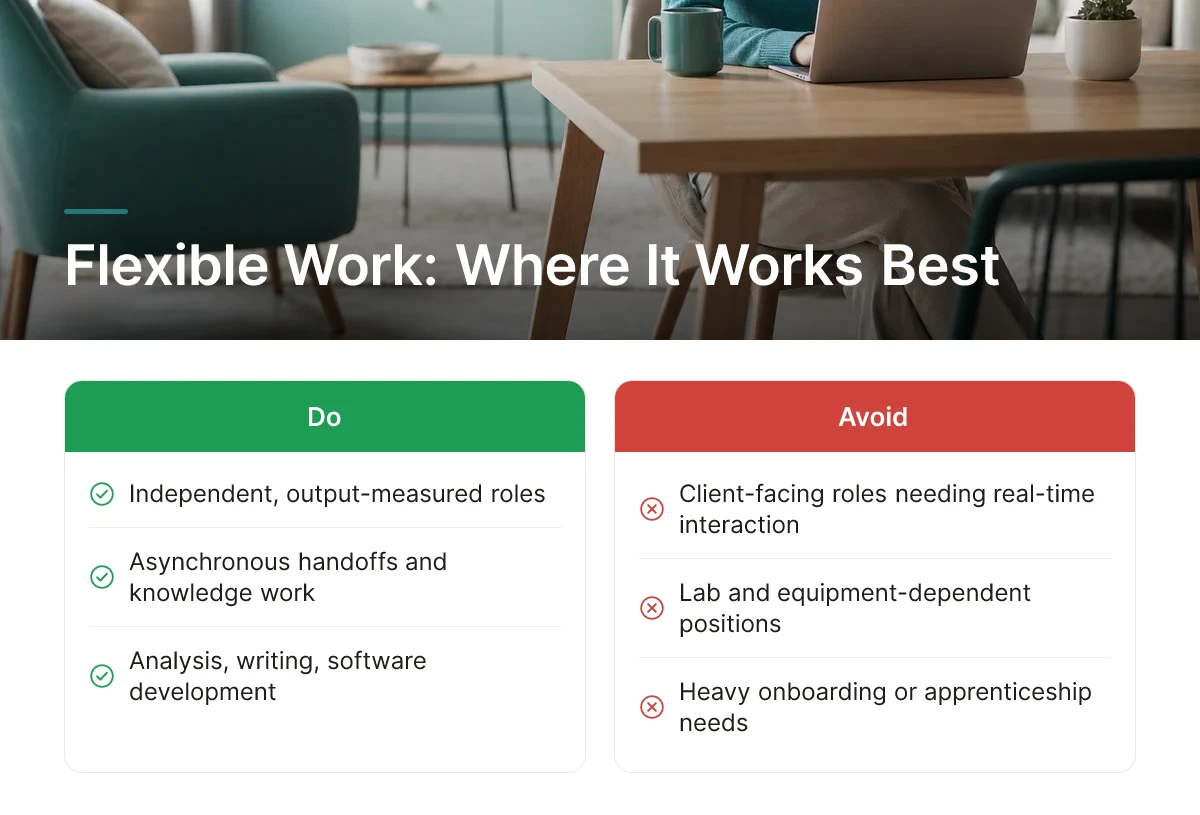
Flexible work arrangement benefits concentrate in independent, output-measured roles and shrink fast in jobs that depend on consistent physical presence or equipment.
Knowledge work with asynchronous handoffs, analysis, writing, software development, strategic planning, tolerates flexible schedules well because output is measurable regardless of when or where the work happens. Client-facing roles, lab and equipment-dependent positions, and jobs with heavy onboarding or apprenticeship needs hold up worse under flexibility because they rely on real-time physical interaction.
Yes. Finance, technology, and professional services roles with clear deliverables adapt readily, while manufacturing, healthcare delivery, and retail functions tied to physical equipment or customer presence adapt far less.
Score roles on two axes: task interdependence (how much the work depends on real-time collaboration with others) and output measurability (how clearly success can be judged without observing hours worked). Seniority is a weak proxy for flexibility fit, a junior analyst with low interdependence may flex more easily than a senior manager running daily floor operations.
The differentiator: plan real estate by department attendance pattern rather than one blanket policy. A sales department with high client-meeting frequency needs different desk ratios than an engineering team working mostly asynchronously. Research summarized in coverage of why employers offer flexible work arrangements reinforces that work-life balance and retention remain top drivers across departments, not just a single function.
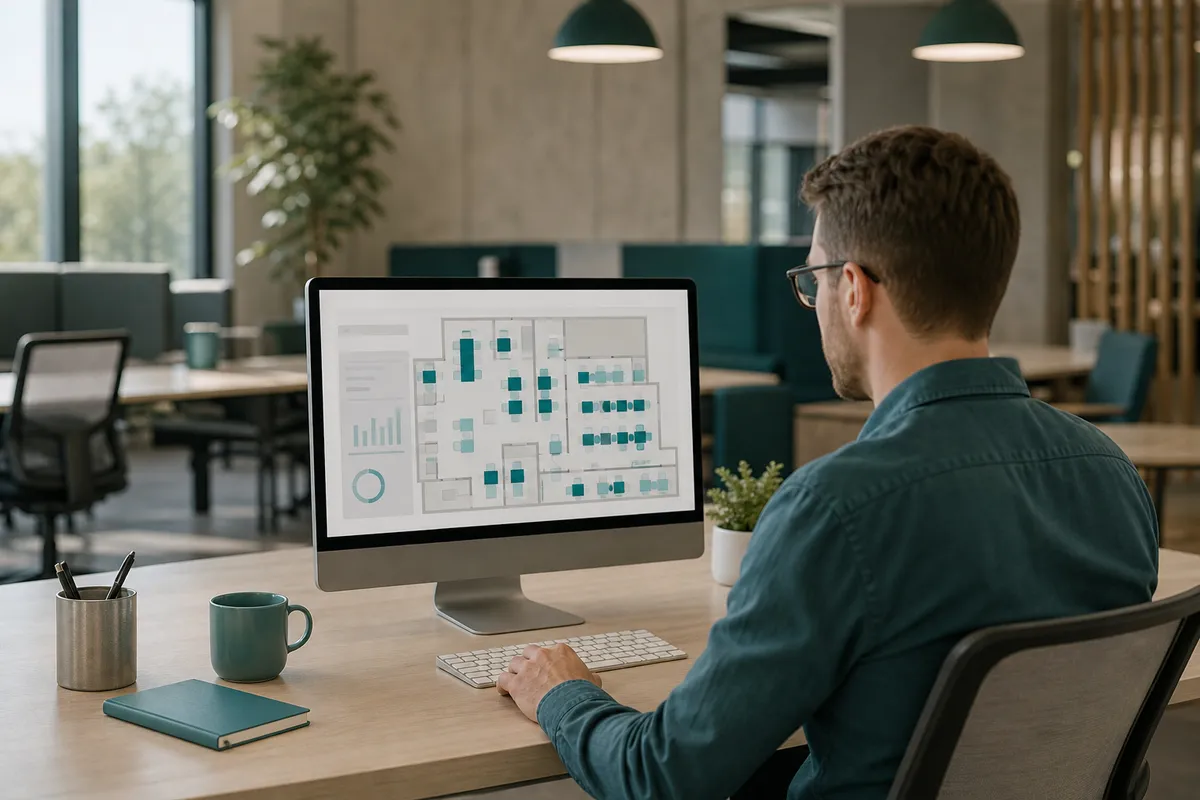
AI orchestration forecasts who is coming to which office and when, so facilities teams can adjust space and services before attendance spikes or drops, not after.
Attendance forecasting models pull from scheduling inputs and historical utilization data to predict occupancy days or weeks ahead. Upflex's UnifyAI engine, for example, forecasts attendance with 97% accuracy, giving workplace teams enough lead time to reconfigure floors, adjust cleaning and catering, or release underused space back to the portfolio. This approach suits multi-site companies juggling fluctuating attendance across several offices, where manual tracking across locations breaks down quickly.
It replaces guesswork with a forecast, letting real estate teams make consolidation or desk-ratio decisions based on predicted demand rather than last quarter's badge swipes.
The differentiator is coordinating co-attendance, aligning schedules so collaborators land on the same days, rather than just tracking who booked a desk. Upflex reports 88% co-attendance achievement among teams using this coordination layer, which matters more for collaboration quality than raw occupancy numbers. Orchestration of this kind addresses both failure modes of flexible work: offices sitting empty while leases still get paid, and offices overcrowded on the days everyone shows up unannounced. Perspectives on leadership and cost strategy in this piece on the hybrid work model and the future of work echo this point: orchestration only pays off when leadership treats it as a cost and culture decision together, not a facilities afterthought.
Flexible work arrangement benefits extend past the office: reduced commute burden and schedule autonomy lower voluntary turnover and the rehiring costs that follow it.
Employees who can skip a long commute or shift their hours around personal obligations leave less often, which means fewer open reqs, shorter ramp-up periods for replacements, and less institutional knowledge walking out the door. This matters most for companies competing in tight labor markets where relocation requirements or long commutes are dealbreakers for candidates with other options.
Flexibility functions as a form of compensation that doesn't show up on a pay stub, candidates increasingly weigh schedule control and location independence alongside salary when comparing offers, particularly for roles where several employers are bidding for the same skill set. It doesn't replace competitive pay, but it closes gaps that salary alone can't close, especially for candidates unwilling to relocate.
The real estate connection is the differentiator: lower turnover means fewer desks held in reserve for onboarding churn and backfill periods, which tightens the gap between seats owned and seats actually needed on a given day. Among the flexible work arrangement benefits companies cite most often, retention and talent attraction consistently rank alongside real estate savings.
Pick a model by sequencing three checks: role and task interdependence, current utilization data, then jurisdiction-specific compliance constraints.
Start with the role mix, how much of the workforce does independent, output-measured work versus client-facing or equipment-dependent work. Next, pull actual utilization data rather than assumptions; EY's research found more than 70% of employees were already working from home two to three days a week in 2022 [1], a pattern that makes stale badge-swipe data unreliable for planning. Only then layer in compliance: labor law varies by jurisdiction, remote work can trigger tax and data residency questions, and multi-region companies need jurisdiction-specific policy review before rolling out any single model globally.
Common pitfalls when evaluating flexible work arrangement benefits against real estate strategy include:
Communicate the reasoning behind the policy, not just the rule, employees adapt faster when they understand the real estate and collaboration logic driving schedule changes. Pair that with a clear feedback channel so friction surfaces early rather than showing up as attrition months later.
Measure ROI with two metrics together: a hard number like real estate cost per employee, and a soft number like engagement or retention score. Neither alone tells the full story, cost reduction that tanks engagement isn't a win. Start with a pilot group, watch the utilization and engagement data, and scale the model that holds up rather than mandating one company-wide from day one.

Organizations that right-size their portfolio based on actual attendance data commonly cut real estate spend by 40% or more. Upflex customers reach this benchmark by using attendance forecasting to identify underused floors or buildings, then consolidating into fewer, higher-utilization locations rather than cutting space blindly and risking desk shortages on peak days.
Tie desk ratios to forecasted attendance, not headcount, so the office never feels overcrowded or embarrassingly empty. A platform that predicts who's coming in and when lets you set a ratio like 1.3 employees per desk with confidence, because you know peak-day demand in advance instead of guessing and apologizing for it later.
Track attendance forecast accuracy, co-attendance rate, square footage per employee, and real estate cost per occupied seat. Upflex reports a benchmark of 88% co-attendance achievement, meaning teams actually show up together on scheduled days rather than missing each other, a metric that matters more to finance and HR leaders than raw occupancy percentage alone.
Rules shift by jurisdiction, so cross-border remote work can trigger payroll tax, permanent establishment, or employment-classification obligations the company didn't have before. Data residency requirements may also dictate where employee information can be stored or processed. These are legal and compliance questions outside the scope of workplace software, involve legal counsel and tax advisors before expanding flexible arrangements across borders.
Review utilization data on a rolling basis and adjust footprint before lease renewals, not after. Pairing owned office space with on-demand access to external workspaces, rather than leasing for peak capacity everywhere, lets you absorb demand spikes in specific cities without carrying empty square footage the other 48 weeks of the year.
Cutting real estate costs without damaging the employee experience comes down to three things: forecasting attendance instead of guessing it, tying desk supply to actual demand, and tracking co-attendance so in-office days deliver on collaboration goals. Platforms like Upflex combine these functions, 97% accurate attendance forecasting, desk booking, and access to a global on-demand workspace network, into one view of portfolio performance, which is what lets finance and HR agree on a plan instead of negotiating around guesswork. Taken together, these flexible work arrangement benefits make the case for treating workplace strategy as a continuous, data-driven process rather than a one-time policy decision.
Start by pulling your last two quarters of badge or booking data and mapping it against your current square footage before your next lease renewal date.
Explore more from our content library: