Share This Article
No items found.

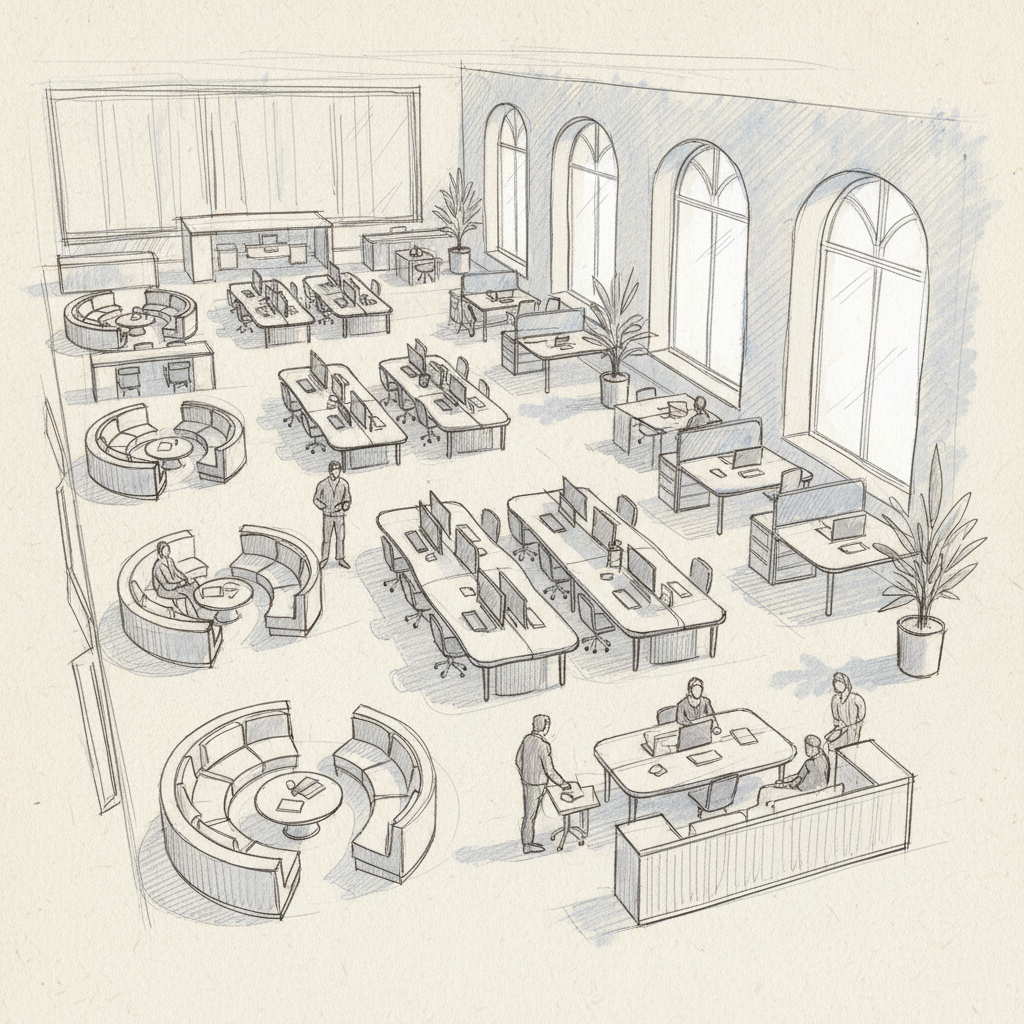
Half your floor is empty on a Tuesday. You're still paying full rent. Sound familiar? Corporate space management is the discipline of strategically planning, allocating, and optimizing a company's physical workspace to align with business goals, control costs, and support employee productivity. It's not just about floor plans. Done right, it's one of the most powerful levers a corporate real estate leader has. This article covers how it works, what the best organizations do differently in 2026, and how AI is changing the math entirely.
Corporate space management is the systematic process of tracking, allocating, and optimizing physical office space across an organization's real estate portfolio to support productivity, reduce cost, and align with workforce needs.
According to HOK's analysis of space management in corporate real estate, the function exists to guide a company's workplace portfolio in direct support of its core business strategy [1]. That's a useful framing. It positions space not as a fixed overhead cost, but as a strategic asset that should earn its keep every single day.
Corporate space management covers several interconnected functions:
IBM defines space management as the way a business strategically manages its physical spaces to align with its broader goals for productivity, sustainability, and cost efficiency [2]. That definition holds up well in 2026, especially as hybrid work has permanently altered how much space organizations actually need on any given day.
Real estate is typically the second or third largest operating cost for enterprise organizations, after payroll. Yet industry research consistently shows that 30 to 50 percent of corporate office space sits underutilized on an average workday [3]. That's not a rounding error. It's a structural inefficiency that compounds across every lease renewal, every facilities budget cycle, and every CFO conversation about cost reduction.
The shift to hybrid work has made this problem both worse and more solvable. Worse, because attendance is now variable and unpredictable. More solvable, because AI-powered platforms can now forecast that variability with enough accuracy to act on it.
Pro Tip: Before investing in space management software, audit your current utilization data sources. Badge access logs, desk booking records, and sensor data often tell different stories. Reconciling them first gives you a reliable baseline to measure improvement against.
Corporate space management works by combining utilization data, workforce planning inputs, and real estate analytics to make continuous, evidence-based decisions about how space is allocated and sized.
The Matterport office space management framework outlines an eight-step process that begins with building a measurement stack and ends with portfolio-level consolidation decisions [4]. The underlying logic is consistent across most enterprise implementations: you can't optimize what you can't measure.
Modern corporate space management starts with data collection. The primary inputs include:
These inputs feed into a space management system, which is software purpose-built to aggregate, visualize, and analyze workspace data. Planon describes space management software as the operational layer that connects physical space to organizational objectives, enabling both day-to-day management and strategic planning [5].
Collecting data is only half the job. The value comes from acting on it. In practice, the optimization loop looks like this:
This is where platforms like Upflex add measurable value. Upflex's UnifyAI engine forecasts office attendance with 97% accuracy, giving corporate real estate teams the confidence to make consolidation decisions based on what will actually happen, not last quarter's badge data. That kind of precision is what separates reactive space management from proactive portfolio optimization.
For teams exploring how productivity tools integrate with workspace strategy, resources like ClickUp workspace optimization offer practical frameworks for aligning digital workflows with physical space decisions.
Effective corporate space management delivers measurable reductions in real estate cost, improvements in employee experience, and better alignment between workforce strategy and physical footprint.

The financial case is straightforward. Less wasted space means lower lease costs, lower facilities overhead, and a smaller environmental footprint. Organizations that implement structured space management programs consistently report significant savings:
| Outcome Metric | Typical Range | Upflex Benchmark |
|---|---|---|
| Real estate cost reduction | 15–35% | 40%+ |
| Office utilization improvement | 20–40% | Tracked continuously |
| Team co-attendance achievement | Variable | 88% |
| Attendance forecast accuracy | 60–75% (manual) | 97% (UnifyAI) |
| Lease consolidation speed | 12–24 months | Data-ready within weeks |
Accruent's research on space management benefits highlights that organizations with mature space management programs also see secondary gains in employee satisfaction, because employees can reliably find the right type of space when they need it [6].
Space management isn't only a cost story. The experience side matters just as much to HR and workplace leaders. When space is well-managed:
According to Envoy's guide to space management, the employee experience dimension is increasingly the differentiator between organizations that succeed with hybrid work and those that see continued resistance to office attendance [7]. If the office isn't worth the commute, utilization stays low regardless of how well the data is tracked.
Pro Tip: Don't optimize purely for density. The goal isn't to fit more people into less space. It's to match space supply to attendance demand. Over-densifying a floor to hit a cost target often backfires when employees stop coming in because the environment feels crowded and unproductive.
The most common challenges in corporate space management include inaccurate utilization data, resistance to change from employees and managers, and the difficulty of coordinating hybrid attendance without predictive tools.
In practice, most large organizations are managing space with a patchwork of disconnected tools: a legacy IWMS (Integrated Workplace Management System) that was built for a pre-hybrid world, a desk booking app that employees use inconsistently, badge data that only captures building entry, and spreadsheets that someone in facilities updates manually once a quarter.
The GSA's Internal Space Allocation, Design, and Management Policy emphasizes that reliable utilization data is the foundation of any credible space planning process [8]. Without it, decisions default to gut instinct and political negotiation rather than evidence.
A common mistake is treating desk booking data as a proxy for actual utilization. Booking rates and actual occupancy often diverge significantly. Employees book desks they don't use, or show up without booking. Neither behavior tells you what's really happening on the floor.
For additional context on how office space planning principles have evolved, the Wikipedia overview of office space planning provides a useful historical and conceptual foundation that helps frame modern corporate space management challenges.
Hybrid work introduced a specific coordination problem that traditional space management frameworks weren't designed to solve: attendance is now variable, team-dependent, and hard to predict without the right tools.
Consider a scenario we've seen repeatedly: a company downsizes its office footprint based on average utilization data, only to discover that peak days are now severely overcrowded while off-peak days remain nearly empty. The average looked fine. The distribution was the problem.
This is precisely why attendance forecasting has become a core capability within modern corporate space management. Without knowing who's coming in and when, space allocation decisions are always playing catch-up.
Other frequent pitfalls include:
The best practices for corporate space management in 2026 center on combining real-time utilization data with AI-powered forecasting, integrating on-demand workspace access, and aligning space decisions with measurable workforce outcomes.

Start with measurement. Before making any allocation or consolidation decisions, establish a reliable utilization baseline across your portfolio. This means:
Cisco Spaces' framework for space management recommends treating utilization data as a continuous feed rather than a periodic snapshot, because hybrid attendance patterns shift with business cycles, leadership mandates, and seasonal factors [9].
The organizations achieving the strongest results in 2026 aren't just tracking utilization. They're predicting it. AI-powered attendance forecasting, like the UnifyAI engine built into Upflex, allows corporate real estate teams to plan space allocation based on forward-looking attendance models rather than historical averages.
At Upflex, we've found that the combination of predictive forecasting and on-demand workspace access changes the economics of space management entirely. Instead of sizing your owned office for peak-day demand, you can right-size for typical demand and route overflow to on-demand workspaces. That's how organizations achieve 40%+ reductions in real estate spend without compromising employee experience.
Additional best practices worth embedding into your program:
Pro Tip: When presenting a space consolidation case to your CFO, pair utilization data with forward-looking attendance forecasts. Historical averages alone won't justify a lease exit. A model showing predicted utilization over the next 24 months, backed by 97% accurate AI forecasting, is a far more persuasive business case.
| Approach | Traditional Space Management | AI-Powered Space Management |
|---|---|---|
| Utilization measurement | Periodic manual audits | Continuous real-time tracking |
| Attendance planning | Historical averages | Forward-looking AI forecasts (97% accuracy) |
| Overflow management | Fixed overflow rooms | On-demand workspace network |
| Portfolio decisions | Annual lease reviews | Continuous data-driven optimization |
| Team coordination | Manual scheduling | Automated co-attendance orchestration |
The four pillars of facilities management are people, processes, the facility itself, and technology. People refers to the workforce and occupant experience; processes covers the operational workflows that keep a building running; the facility encompasses the physical infrastructure and space; and technology includes the systems and software used to manage, monitor, and optimize all three. Effective corporate space management sits at the intersection of all four pillars, using technology to improve processes that serve people within the facility.
The 5 C's of people management are Clarity, Communication, Collaboration, Coaching, and Consistency. Clarity means setting unambiguous expectations about roles and goals. Communication ensures information flows effectively across the team. Collaboration builds shared ownership of outcomes. Coaching develops individual capability over time. Consistency creates the psychological safety that allows teams to perform reliably. In a hybrid work context, all five become harder to deliver without the right workplace infrastructure supporting in-person coordination.
A practical example of this approach is a global enterprise that uses utilization data to discover that its 500-desk headquarters averages only 310 occupied seats per day. Using AI attendance forecasting, the company identifies that Tuesday through Thursday account for 80% of all attendance. It consolidates two underutilized floors, introduces hot-desking with a desk booking system, and routes employees to on-demand workspaces on Mondays and Fridays. The result: a 35% reduction in real estate costs with no reduction in headcount or employee satisfaction scores.
A space management system aggregates data from sensors, booking tools, and access control systems to give facilities and real estate teams a real-time and historical view of how space is being used. Its primary purpose is to replace guesswork with evidence, enabling decisions about space allocation, lease consolidation, and workplace design to be grounded in actual occupancy patterns. Modern systems add AI forecasting to predict future demand, not just report past usage, which is critical for hybrid work environments where attendance varies significantly day to day.
Traditional facilities management focuses on maintaining the physical environment, covering maintenance, safety, compliance, and building operations. it is a strategic layer on top of that, concerned with how space is allocated, how efficiently it's used, and how it supports workforce and business goals. The two disciplines overlap but aren't interchangeable. As hybrid work has grown, this method has taken on a more prominent role because the financial and operational stakes of getting space allocation wrong have increased substantially.
Common software categories include IWMS (Integrated Workplace Management Systems) like Planon and Archibus for enterprise portfolio management, desk booking platforms for day-to-day reservation workflows, and AI-powered workplace optimization platforms like Upflex that combine attendance forecasting, desk booking, and on-demand workspace network access in a single interface. The right choice depends on your organization's size, hybrid work model, and whether you need to manage only your owned offices or also access flexible third-party workspaces for distributed employees.
this strategy has moved from a back-office facilities function to a boardroom priority. With real estate costs under pressure and hybrid attendance patterns making traditional allocation models obsolete, the organizations winning in 2026 are those treating space as a dynamic, data-driven asset rather than a fixed overhead line.
The fundamentals haven't changed: measure accurately, allocate deliberately, and align space supply with workforce demand. What has changed is the quality of tools available to do all three. AI-powered forecasting, continuous utilization tracking, and on-demand workspace networks have made it possible to achieve outcomes that weren't realistic even three years ago.
Upflex combines all of these capabilities in a single platform. From AI attendance forecasting with 97% accuracy to access to the world's largest on-demand workspace network, it gives corporate real estate and HR leaders the data and infrastructure to cut real estate spend by 40%+ while maintaining the team collaboration and employee experience that make the office worth coming to.
If your organization is approaching a lease renewal, managing a hybrid workforce across multiple locations, or simply trying to make better use of the space you already have, now is the right time to build a more intelligent this approach program.
Explore more from our content library: