Share This Article
No items found.

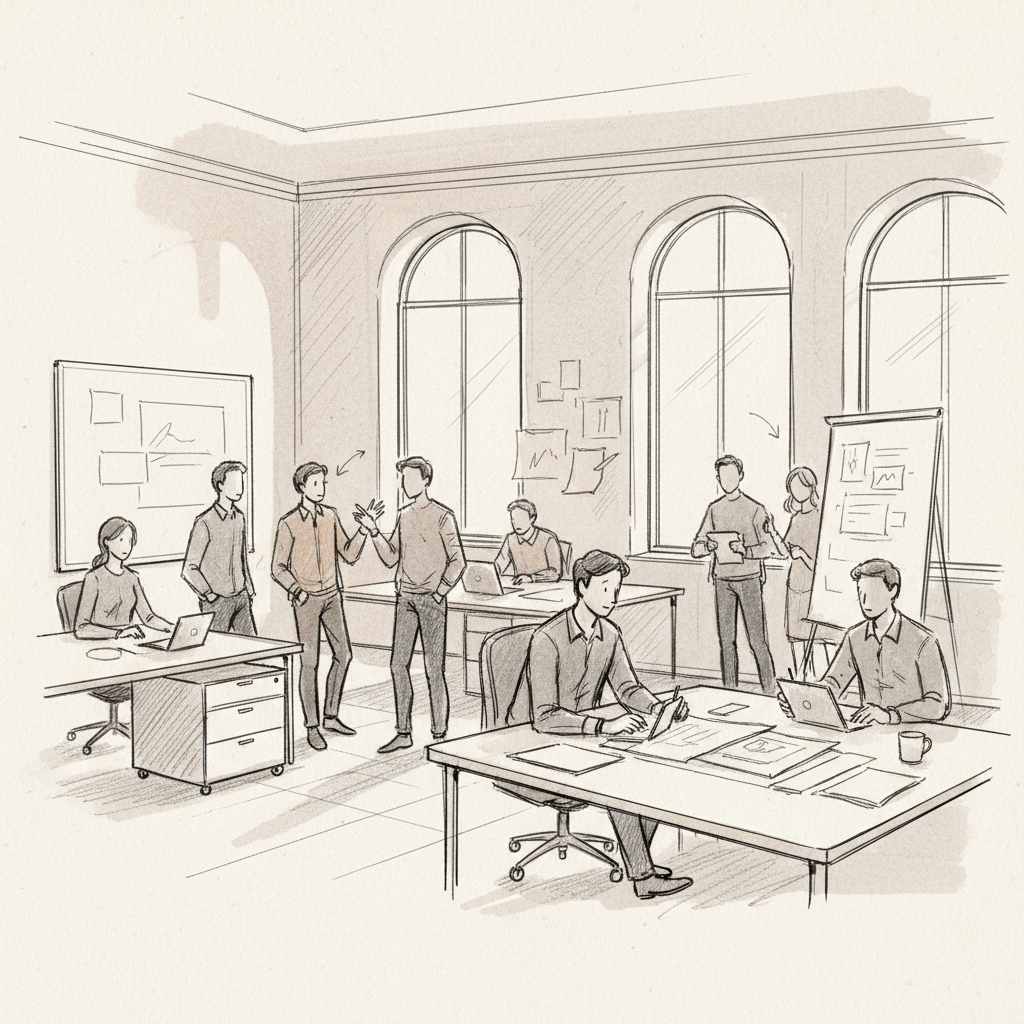
Workplace agility strategies are the structured approaches organizations use to build responsiveness, adaptability, and speed into how their teams work and how their real estate performs. In 2026, with hybrid work now the default for most global enterprises, agility isn't optional — it's the difference between a portfolio that earns its cost and one that quietly drains the balance sheet. Research published in PMC confirms that workforce agility "facilitates the rapid achievement of business objectives by adopting innovative management models and organizational cultures" [1]. This guide covers the most effective strategies, the metrics that matter, and the technology making it all measurable.
Workplace agility strategies are deliberate organizational practices that combine people, processes, and physical space to help enterprises respond faster to change without sacrificing productivity or culture. They go well beyond flexible scheduling — the best strategies integrate data, technology, and space design into a single operating model.
According to TalentGuard, workplace agility is "an organizational capability that emphasizes responsiveness, adaptability, and flexibility in the face of change" [2]. That definition matters because it frames agility as a capability, not a policy. You can't mandate it with a memo. You build it through systems.
The University of Alabama at Birmingham's Human Resources division reinforces this point: "Organizations that cultivate adaptability and agility benefit from improved problem-solving, stronger collaboration, and greater resilience during transitions" [3]. The implication is clear — agility is a competitive asset, not just an HR talking point.
Three forces are converging right now. First, post-pandemic lease cycles are expiring, forcing real estate decisions that will lock in costs for the next decade. Second, AI-powered forecasting has matured enough to deliver actionable attendance predictions at scale. Third, employee expectations around flexibility have stabilized into a new normal that most organizations are still trying to price correctly.
Gallup has identified eight key drivers of organizational agility: cooperation, speed of decision-making, trial tolerance, empowerment, technology adoption, simplicity, knowledge sharing, and innovation focus. What Gallup's framework doesn't address is the physical dimension — where people work is just as important as how they work. That's the gap most workplace agility strategies fail to close.
| Agility Driver | What It Looks Like in Practice | Primary Owner |
|---|---|---|
| Speed of decision-making | Flat approval chains, delegated authority | Leadership |
| Technology adoption | AI forecasting, desk booking, real-time data | IT / CRE |
| Empowerment | Employees choose when and where they work | HR / Managers |
| Knowledge sharing | Co-attendance coordination, team overlap days | Workplace Experience |
| Simplicity | Single platform for booking, forecasting, access | CRE / Ops |
The most effective workplace agility strategies combine people practices, physical space decisions, and technology into a coherent system — not a collection of disconnected initiatives.
1. Build psychological safety as a structural priority. Great Place to Work research identifies psychological safety as one of the eight ways great workplaces adapt and thrive [4]. Teams that feel safe to experiment, raise concerns, and try new approaches make faster, better decisions. This isn't a culture initiative — it's a performance lever.
2. Prioritize skills-based talent strategies. Gloat's research shows that agile organizations "prioritize skills-based strategies" over role-based ones, enabling employees to move fluidly between projects [5]. In practice, this means building internal talent marketplaces where skills are visible and deployable across teams.
3. Invest in learning agility as a foundational capability. Harvard Business Publishing frames learning agility as "an important foundational strategy that will help organizations and people become more agile and resilient overall" [6]. A common mistake is treating learning as a benefit rather than a business-critical input. Organizations that budget for continuous upskilling outperform those that don't — full stop.
4. Democratize access to career development. Harvard Business Review notes that "progress towards career goals" is the number one reason employees want to learn [7]. Agile organizations use this insight to retain talent and build the internal mobility that makes workforce redeployment possible during disruption.
5. Recognize and reward experimentation. Great Place to Work highlights "recognition for those who try new and better ways of doing things" as a direct driver of business agility [4]. If your incentive structures only reward outcomes, you'll kill the experimentation that generates them.
6. Replace static space allocation with dynamic desk booking. Fixed desks made sense when everyone came in every day. They're expensive liabilities in a hybrid model. Dynamic desk booking — supported by real-time utilization data — lets you right-size space based on actual demand, not assumptions.
7. Use AI-powered attendance forecasting to coordinate co-presence. Forecasting who will be in the office, and when, is the critical capability most workplace agility strategies overlook. Without it, you're reacting to empty floors rather than preventing them. At Upflex, we've found that AI forecasting with 97% accuracy (delivered through our UnifyAI engine) transforms attendance from an unpredictable variable into a manageable input — enabling teams to achieve 88% co-attendance rates consistently.
8. Build a global on-demand workspace network into your real estate strategy. Employees don't always work near a company office. An on-demand workspace network (access to third-party workspaces on a per-use basis) fills the geographic gaps without long-term lease commitments. This is one of the most cost-efficient workplace agility strategies available to distributed enterprises.
9. Consolidate your real estate portfolio using utilization data. ThoughtExchange defines agility as "the ability to combine speed and data-driven innovation to maintain a competitive advantage" [8]. Applied to real estate, that means using occupancy data to identify underperforming locations and consolidate with confidence. Organizations using Upflex have reduced real estate spend by 40%+ through data-driven portfolio decisions.
10. Simplify your technology stack into a single workplace platform. The Agile Business Consortium notes that complexity is one of the biggest barriers to agility transformations [9]. Running desk booking, badge data, and attendance tracking across separate tools creates friction and blind spots. A unified platform eliminates the coordination tax.
Pro Tip: When auditing your current workplace agility strategies, map each initiative to a measurable outcome (cost per seat, co-attendance rate, utilization percentage). If an initiative can't be tied to a number, it's probably a policy, not a strategy.
Implementing workplace agility strategies effectively requires a sequenced approach — starting with data, moving through process redesign, and landing on technology enablement. Skipping steps is the most common reason agility programs stall.

One pitfall to watch for is treating agility as a one-time transformation rather than an ongoing operating model. Organizations that run a six-month "agility program" and then return to static processes don't retain the gains. Agility requires continuous measurement and adjustment.
A second common mistake is deploying technology before fixing the underlying process. Desk booking software on top of a broken space allocation model just automates the problem. Fix the model first, then automate it.
Pro Tip: FranklinCovey's research on organizational agility recommends starting with a small pilot team rather than an enterprise-wide rollout [11]. Run a 90-day proof of concept with one business unit, measure the outcomes, and use those results to build the internal business case for broader deployment.
Measuring the ROI of workplace agility strategies requires tracking both financial outcomes (real estate cost reduction, cost per seat) and operational outcomes (co-attendance rates, utilization percentages, employee satisfaction scores).
Corporate Real Estate leaders need hard numbers to justify portfolio decisions to their CFOs. The most credible metrics connect space decisions directly to cost outcomes. Here's the framework our team at Upflex recommends:
| Metric | What It Measures | Target Benchmark (2026) |
|---|---|---|
| Space utilization rate | % of desks/rooms occupied vs. available | 65–80% for hybrid portfolios |
| Co-attendance rate | % of team members present on shared days | 85%+ (Upflex benchmark: 88%) |
| Cost per occupied seat | Total real estate cost ÷ average daily occupancy | Reduce by 25–40% vs. baseline |
| Attendance forecast accuracy | Predicted vs. actual daily occupancy | 90%+ (AI-powered: 97%) |
| Portfolio consolidation progress | Locations exited or downsized vs. plan | Track quarterly against 18-month target |
A SaaS enterprise we worked with recently faced a lease renewal decision on a 60,000 sq ft headquarters. Their badge data showed average daily occupancy of 34%. Without forecasting capability, the instinct was to renew at a smaller size — but the question was: how much smaller?
After deploying AI-powered attendance forecasting, they identified that peak demand never exceeded 52% of capacity, and that 80% of in-office days clustered around Tuesday through Thursday. That data supported a 40% footprint reduction with confidence, backed by numbers the CFO could take to the board.
Axonify's research on workforce agility reinforces this point: practical, data-driven tools that "boost adaptability and performance" are what separate organizations that talk about agility from those that actually achieve it [12].
Pro Tip: Track your co-attendance rate separately from your utilization rate. A high utilization rate with low co-attendance means people are coming in — but not together. That's a collaboration problem, not a space problem, and it requires a different intervention.
Choosing the right workplace agility platform means evaluating tools against three criteria: forecasting accuracy, integration capability, and network reach for distributed employees.
Most organizations already have some form of desk booking software. The question isn't whether to add a tool — it's whether your current tools give you the data and automation you need to make real estate decisions with confidence. Here's what a best-in-class platform should deliver:
Beamery's LinkedIn research on workforce agility foundations identifies "connected, actionable workforce data" as a critical gap in most organizations [13]. The same principle applies to workplace technology: fragmented tools produce fragmented insights. A platform that unifies booking, forecasting, and network access into one interface eliminates the coordination tax that slows down real estate decisions.
One pitfall to watch for is evaluating platforms on feature lists alone. In practice, what matters is whether the platform can answer the three questions your CFO will ask: How many people are actually using our space? What will demand look like next quarter? And how much can we safely reduce our footprint?
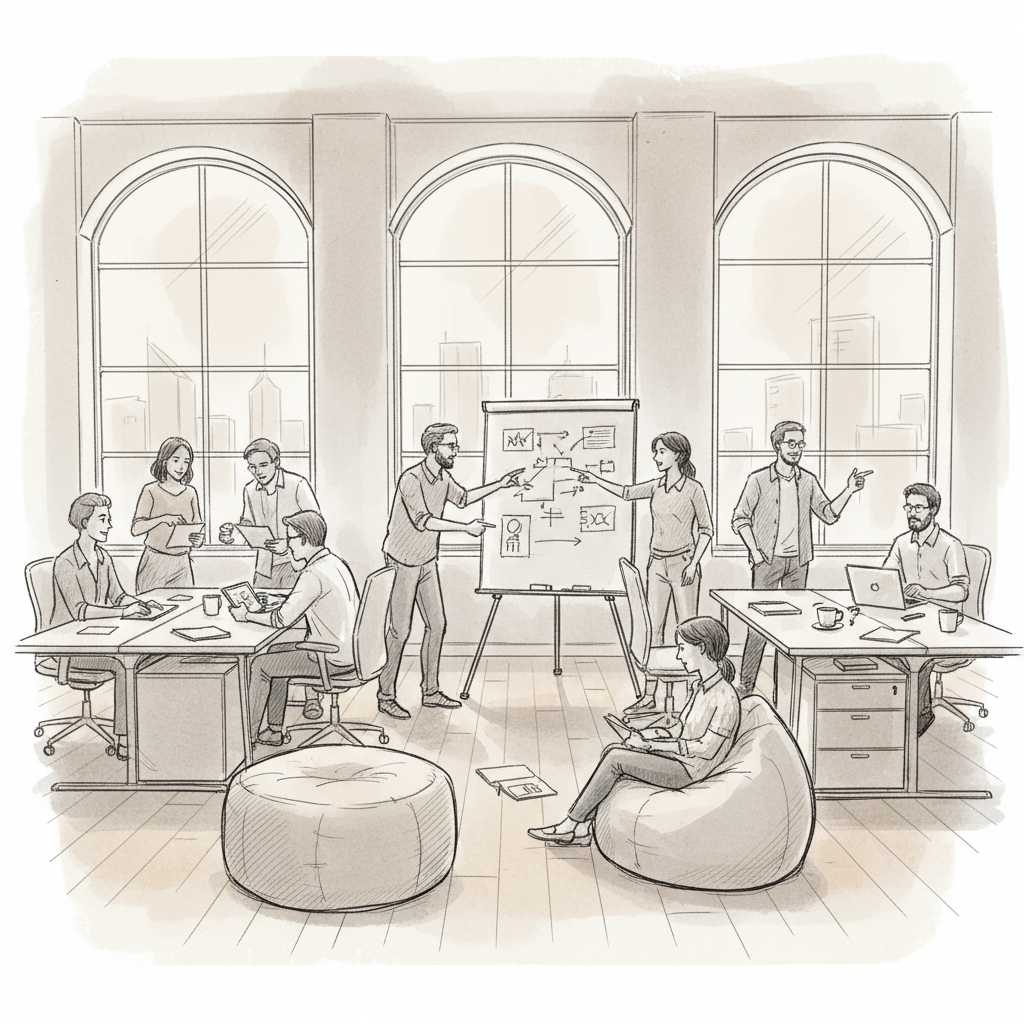
The 5 C's of agile management are collaboration, communication, customer focus, continuous improvement, and change readiness. In a workplace context, these principles translate into concrete practices: cross-functional team structures (collaboration), transparent reporting chains (communication), employee experience metrics tied to business outcomes (customer focus), regular retrospectives and process reviews (continuous improvement), and scenario planning that anticipates disruption before it arrives (change readiness). Together, they form the behavioral operating system that makes workplace agility strategies sustainable rather than episodic.
The most compelling real-world example of workplace agility is a global enterprise that uses AI-powered attendance forecasting to dynamically allocate desk inventory, coordinate team co-presence, and make data-driven decisions to exit or consolidate underperforming office locations — all without imposing rigid attendance mandates on employees. In practice, this looks like a Corporate Real Estate team that can answer "how much space do we need next quarter?" with a specific number backed by predictive data, rather than a gut estimate. That combination of people empowerment and operational precision is the clearest expression of what effective workplace agility strategies produce.
Workplace agility is best measured through a combination of financial metrics (cost per occupied seat, real estate spend as a percentage of revenue), operational metrics (space utilization rate, attendance forecast accuracy), and people metrics (co-attendance rate, employee satisfaction with workspace options). The key is connecting all three categories in a single reporting view — organizations that track space utilization in isolation from cost data can't make confident portfolio decisions. As of 2026, best-in-class organizations are targeting 65–80% space utilization, 85%+ co-attendance rates, and 90%+ attendance forecast accuracy.
Workforce agility refers specifically to the ability of people — employees and teams — to adapt their skills, roles, and working patterns in response to changing demands. Organizational agility is the broader capability of the entire enterprise, including its structures, processes, technology, and physical infrastructure, to respond to change. Workforce agility is a component of organizational agility. Effective workplace agility strategies address both: they build adaptable people practices (skills-based hiring, learning agility, psychological safety) and adaptable operational systems (dynamic space allocation, AI forecasting, on-demand workspace access).
HR leaders build effective workplace agility strategies by aligning three levers: talent practices (skills-based hiring, internal mobility programs, continuous learning investment), leadership development (training managers to lead distributed and hybrid teams), and technology adoption (deploying tools that give employees flexibility without sacrificing coordination). HR Morning's research emphasizes that agility requires "aligning hiring, leadership, and culture to meet the demands of continuous change" — which means HR can't operate in isolation from Corporate Real Estate and Finance when designing these strategies. The most effective programs are co-owned across all three functions.
Physical workspace is one of the most underestimated variables in workplace agility strategies. A static office footprint — fixed desks, long-term leases, single-location assumptions — constrains organizational agility even when people practices and technology are well-designed. Agile physical strategies include dynamic desk allocation, access to on-demand workspaces for distributed employees, and data-driven portfolio consolidation that reduces cost without reducing employee experience. The most agile organizations treat their real estate portfolio as a flexible asset, not a fixed cost — adjusting it continuously based on utilization data rather than annual planning cycles.
this strategy aren't a trend to adopt and move on from — they're a permanent operating model for enterprises that want to stay competitive as work continues to evolve. The organizations winning in 2026 are the ones that have connected their people practices to their space decisions, and their space decisions to hard data. That means AI-powered forecasting, dynamic space allocation, and a real estate portfolio that earns its cost every quarter.
Upflex delivers exactly that combination: AI-powered office orchestration through UnifyAI (97% attendance forecast accuracy, 88% co-attendance achievement) paired with access to the world's largest on-demand workspace network. For Corporate Real Estate leaders facing lease decisions, and for HR leaders trying to make hybrid work actually work, that's the platform that turns this approach from aspiration into a measurable result — including 40%+ reductions in real estate spend that you can take directly to your CFO.
Explore more from our content library: