Share This Article
No items found.


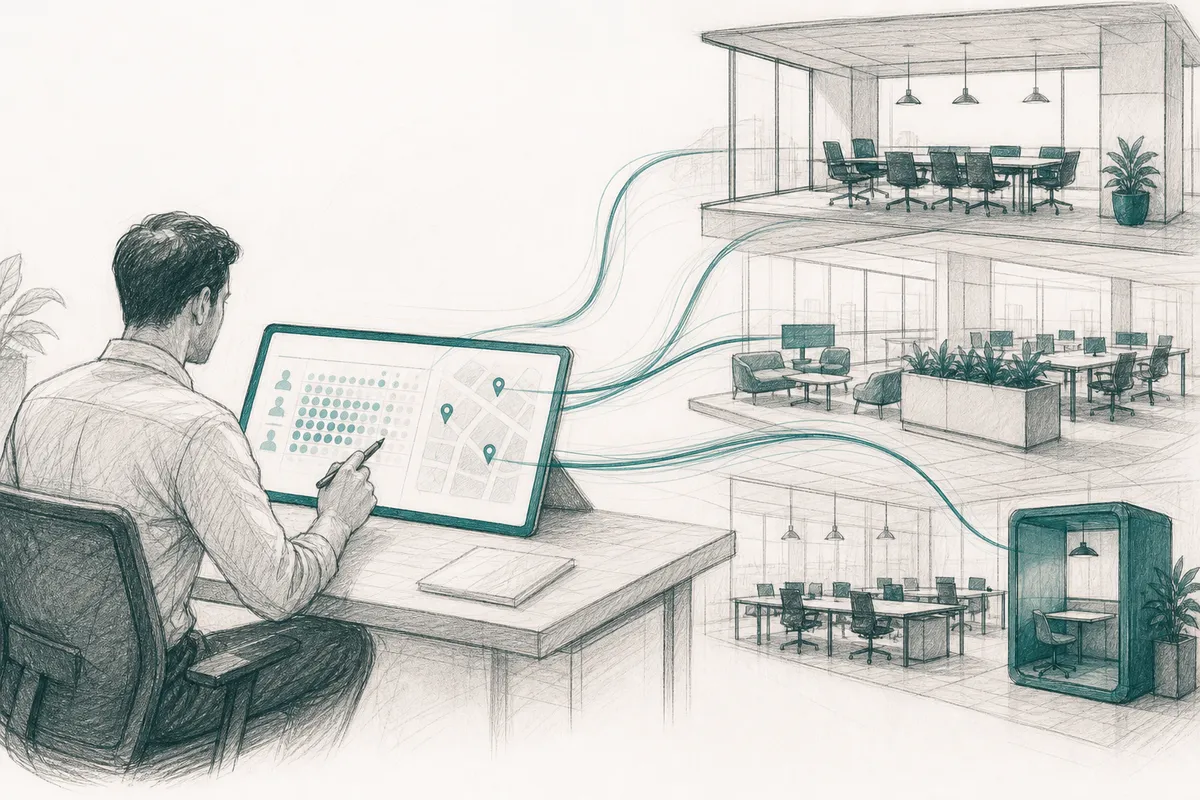
Half your office sits empty on a Tuesday. You're paying full lease price for it anyway. That's not a facilities problem — it's a data problem. Workplace data analytics is the discipline of collecting, analyzing, and acting on data about how your office space and workforce are actually used, so you can make decisions grounded in evidence rather than assumption. It covers everything from desk occupancy rates and attendance patterns to collaboration behaviors and real estate utilization. Done right, it gives corporate real estate, finance, and HR leaders the hard numbers they need to right-size portfolios, coordinate hybrid teams, and prove the ROI of every square foot they pay for.
Workplace data analytics is the systematic process of gathering and interpreting data from physical office environments, workforce systems, and collaboration tools to improve operational efficiency, space utilization, and employee experience. It transforms raw signals — badge swipes, desk bookings, calendar data, sensor readings — into actionable intelligence for business decisions.
The field draws on several distinct data streams, each answering a different question about how work actually happens [1]:
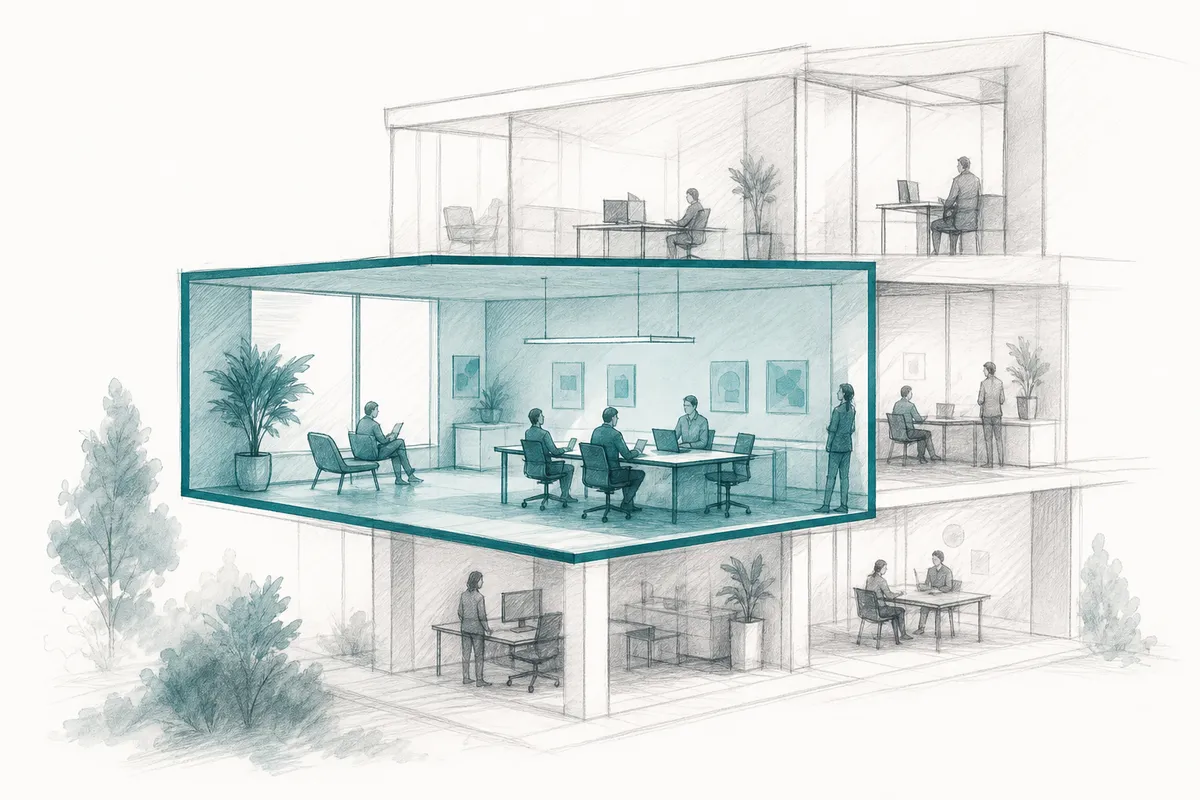
Hybrid work has fundamentally changed the relationship between headcount and space. Most enterprises now operate with 40–60% of their workforce in the office on any given day, yet many still pay for space designed for 100% occupancy [3]. That gap is expensive. Research from Global Workplace Analytics indicates that organizations can reduce real estate costs significantly when they base portfolio decisions on utilization data rather than headcount assumptions.
The discipline also intersects directly with workforce compliance. The U.S. Office of Personnel Management (OPM) conducts ongoing workforce data analysis to identify trends affecting federal agencies [4], and private-sector organizations face similar pressure to document how space and labor resources are deployed.
Beyond cost, workplace analytics informs culture. Understanding when teams are co-located, whether collaboration goals are being met, and how the office experience compares to remote alternatives gives HR leaders evidence to design better policies — not just mandate attendance.
Pro Tip: Don't start your analytics program by buying software. Start by writing down the three decisions you most need data to make — whether to renew a lease, which floors to consolidate, or which days to anchor for team meetings. The right data follows the right question.
Workplace data analytics works by collecting signals from multiple sources, processing them through analytical models, and surfacing insights that guide specific business decisions — from daily desk booking to multi-year lease strategy.
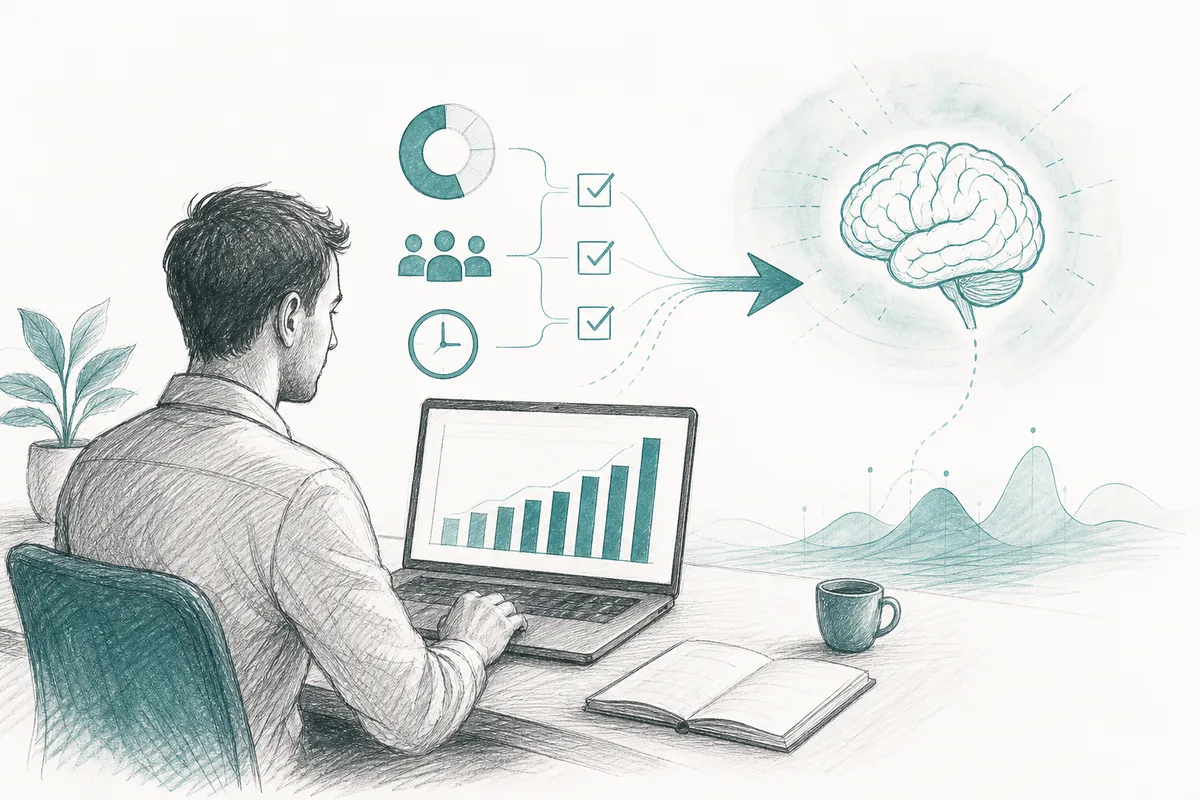
Effective workplace analytics starts with reliable data ingestion. Most enterprise programs combine several input types [5]:
One limitation worth acknowledging: no single data source tells the full story. Badge data shows who entered the building, not where they sat. Sensor data shows occupancy, not identity. Booking data shows intent, not behavior. Strong analytics programs triangulate across sources rather than relying on any one feed.
Once data is collected, it moves through a processing pipeline that typically includes cleaning (removing duplicates and anomalies), normalization (converting different data formats to a common schema), and analysis (applying statistical models or machine learning to identify patterns).
This is where AI-powered platforms create a meaningful advantage. At Upflex, we've found that organizations relying on historical badge data alone miss the predictive dimension entirely. Upflex's UnifyAI engine goes further: it forecasts who's coming in, when, and where — with 97% attendance forecast accuracy — so space can be allocated proactively rather than reactively. That's the difference between a utilization report and an operational decision engine.
Industry analysts at MIT Professional Education have noted that the most effective workforce analytics programs combine quantitative data with behavioral science frameworks, ensuring that the metrics being tracked actually connect to the outcomes organizations care about [6].
| Maturity Level | Data Used | Decision Type | Typical Outcome |
|---|---|---|---|
| Level 1: Descriptive | Historical badge/booking data | What happened? | Utilization reports |
| Level 2: Diagnostic | Sensor + survey data | Why did it happen? | Root cause analysis |
| Level 3: Predictive | AI-processed multi-source data | What will happen? | Attendance forecasting |
| Level 4: Prescriptive | Integrated platform data | What should we do? | Automated orchestration |
The most direct benefit of workplace data analytics is cost reduction — but the full value extends into talent retention, compliance, and strategic agility.
This is where the numbers get compelling. When organizations apply workplace analytics to their portfolio decisions, they stop paying for space based on theoretical headcount and start paying based on actual demand. Upflex customers have achieved 40%+ reductions in real estate spend by using utilization data to consolidate floors, exit underperforming leases, and shift overflow demand to on-demand workspace rather than long-term commitments.
The logic is straightforward. If your analytics show that peak occupancy on your busiest day (typically Tuesday or Wednesday in most hybrid organizations) reaches 65% of total capacity, you likely don't need 100% of your current footprint. That insight, documented and repeatable, is what gives a CFO the confidence to sign off on a consolidation.
For organizations managing employees who work across different locations, understanding Data Sharing Opt Out policies is also relevant when designing employee-facing analytics programs, since transparency around what data is collected builds the trust needed for high participation rates.
Beyond real estate, workplace data analytics drives measurable improvements in how people work [7]:
Pro Tip: Track co-attendance rates alongside occupancy rates. A floor can be 70% occupied but have zero cross-team collaboration happening. The first metric tells you about space efficiency; the second tells you whether the office is actually delivering its intended purpose.
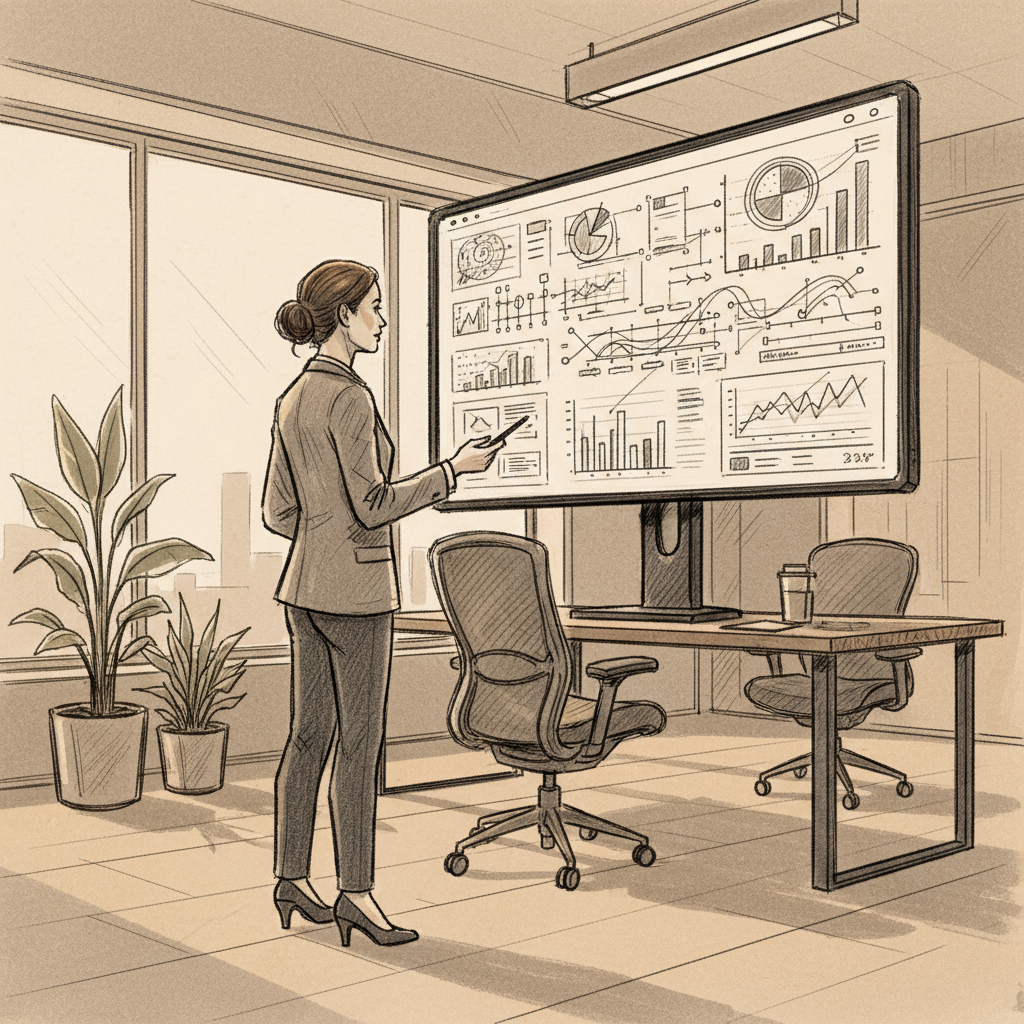
Most workplace analytics programs underdeliver not because the data is bad, but because of avoidable errors in how programs are designed and governed.
A common mistake is collecting every available data point before deciding what decisions the data needs to support. Organizations end up with dashboards full of metrics — average desk utilization, peak occupancy by floor, meeting room no-show rates — but no clear link to a business decision. Engage for Success research on workplace analytics programs notes that the most effective initiatives start with a defined set of strategic questions and work backward to the metrics that answer them [10].
In practice, this means resisting the temptation to instrument everything at once. Start with one high-stakes decision — a lease renewal, a floor consolidation, a hybrid policy redesign — and build your data collection around it.
One pitfall to watch for: treating employee data as a surveillance tool rather than an optimization input. When employees perceive analytics as monitoring rather than enabling, participation drops and data quality degrades. Survey data becomes unreliable. Desk booking systems get gamed. Badge data no longer reflects actual behavior.
The solution isn't to collect less data. It's to be explicit about what's collected, why, and how it's used. HR Acuity's 2026 guide to HR data analytics recommends publishing a clear data governance policy, anonymizing individual-level data wherever possible, and involving employees in defining the metrics that affect their experience [11].
Many enterprises have badge data in one system, desk booking data in another, and HR headcount data in a third. None of these talk to each other. The result is a fragmented picture that can't answer the question a CFO actually needs answered: "If we consolidate floors 8 and 9, will our employees have enough space on peak days?"
That question requires combining occupancy data, attendance forecasts, headcount by team, and booking patterns. It's only answerable with an integrated platform — not a collection of disconnected point solutions.
The organizations getting the most from workplace data analytics share a set of common practices: they integrate data sources, invest in predictive capability, and tie metrics directly to financial outcomes.
Start by auditing every data source you currently have access to. Map them against the decisions you need to make. Then identify the gaps. According to OfficeSpace Software's analysis of enterprise analytics programs, the most common gap isn't data volume — it's the absence of a unified schema that lets different data types be analyzed together [12].
Practical steps to build that foundation:
Descriptive analytics tells you what happened. Predictive analytics tells you what will happen — and that's where the real operational value lives. Indeed's workforce analytics guide highlights that organizations using predictive models for workforce planning outperform those using historical averages on both cost and retention metrics [13].
For hybrid work specifically, predictive attendance forecasting is the capability that separates reactive space management from proactive office orchestration. Knowing that your London office will be at 78% capacity next Wednesday — before Wednesday arrives — lets you activate overflow workspace, adjust cleaning schedules, and notify teams to coordinate their visits. That's the kind of operational intelligence that justifies the analytics investment.
| Dimension | Descriptive Analytics | Predictive Analytics |
|---|---|---|
| Time orientation | Past (what happened) | Future (what will happen) |
| Primary use | Reporting, compliance | Space planning, cost reduction |
| Data requirement | Historical records | Real-time + ML models |
| Decision speed | Periodic (monthly/quarterly) | Daily/weekly operational |
| Example output | Last quarter's occupancy rate | Tomorrow's attendance forecast |
Pro Tip: When presenting analytics findings to a CFO or board, always translate utilization metrics into dollar terms. "Our average occupancy is 52%" is interesting. "We're paying $2.4M annually for space that's empty 48% of the time" is a decision-forcing number.
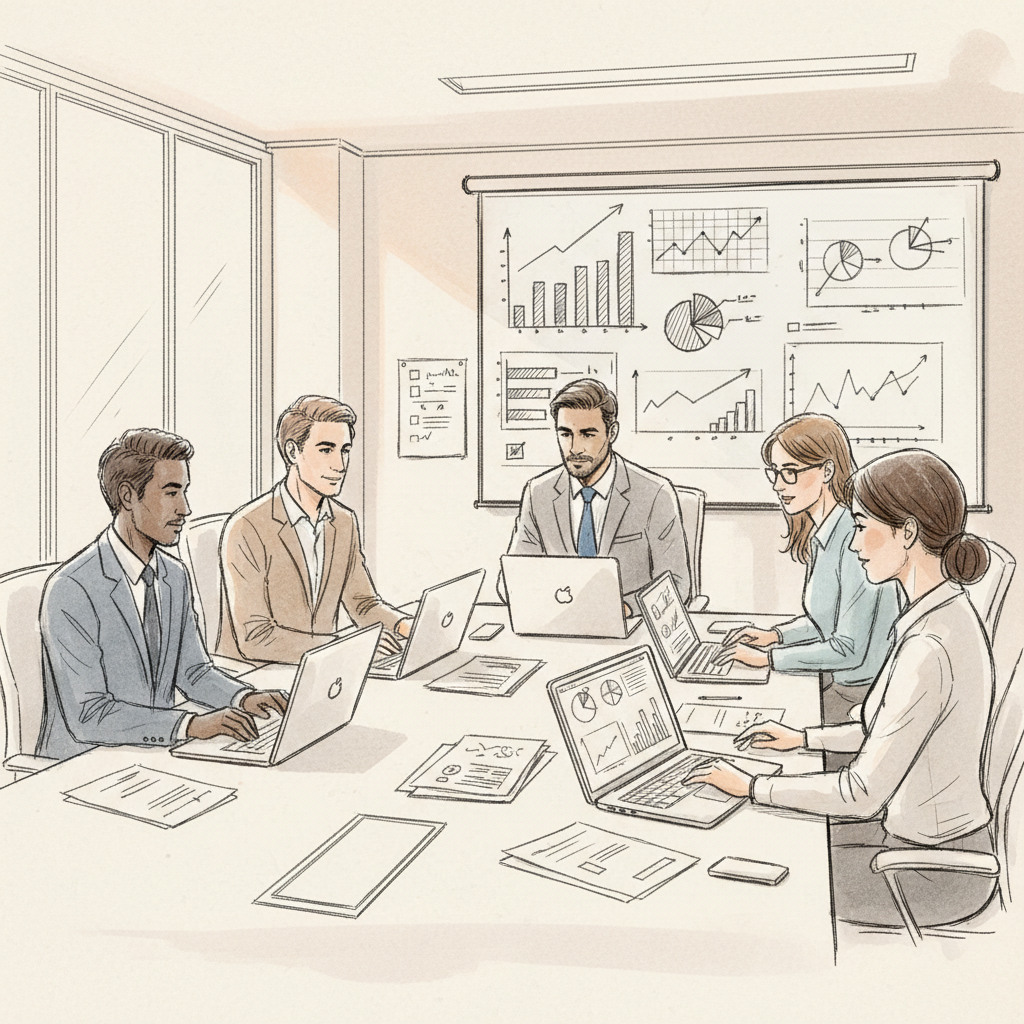
The 5 C's of data analytics are Consent, Clarity, Consistency, Control and Transparency, and Consequences and Harm. They form a responsible analytics framework that ensures data is collected with employee knowledge (Consent), communicated in understandable terms (Clarity), applied uniformly (Consistency), governed with clear access controls (Control and Transparency), and evaluated for potential negative outcomes (Consequences and Harm). In a workplace data analytics context, applying the 5 C's helps organizations build employee trust, improve data quality, and avoid legal and reputational risk from misuse of workforce data.
Data analysis in the workplace is the process of collecting, cleaning, and interpreting data from office systems, workforce tools, and employee feedback to inform operational and strategic decisions. It goes beyond five basic steps: in a hybrid work environment, workplace data analytics specifically connects space utilization signals (sensor data, desk bookings, badge access) with workforce patterns (attendance, collaboration frequency, headcount by location) to answer questions like "Are we using our real estate efficiently?" and "Are our hybrid teams actually collaborating when they're in the office together?" The goal isn't just insight — it's a specific, data-backed decision.
The four types of HR analytics are descriptive (summarizing historical workforce data), diagnostic (identifying why patterns occurred), predictive (forecasting future workforce behaviors using statistical models), and prescriptive (recommending specific actions based on data). In a workplace analytics program, these four types form a maturity progression: most organizations start with descriptive reporting and work toward prescriptive automation. Predictive and prescriptive analytics — for example, AI-powered attendance forecasting that automatically coordinates team schedules — deliver the highest business value but require integrated, high-quality data foundations to function reliably.
Workforce analytics focuses on people data — headcount, performance, retention, compensation, and skills gaps. Workplace analytics focuses on environment data — how physical and digital spaces are used, when and by whom. In practice, the most valuable programs combine both: knowing that your engineering team is 40 people (workforce data) and that they collectively use 12 desks on their peak day (workplace data) is what lets you make a defensible real estate consolidation decision. Integrated workplace data analytics treats people and space as two sides of the same operational equation.
Office space utilization is typically measured using a combination of occupancy sensors (which detect physical presence), desk and room booking system data (which shows reservations and no-show rates), and badge access logs (which count entries and exits). The key metric is utilization rate: the percentage of available workstations or rooms that are in use during working hours, averaged across a defined period. A floor with 100 desks that averages 45 occupied seats between 9am and 5pm has a 45% utilization rate. Most hybrid enterprises target 70–80% peak utilization as a healthy benchmark before considering consolidation.
Yes — and this is one of the most direct and measurable applications of workplace data analytics. By documenting actual space utilization over time, organizations can identify consistently underused floors, buildings, or markets and make data-backed decisions to consolidate or exit those leases. Upflex customers have achieved 40%+ reductions in real estate spend using utilization data combined with AI-powered attendance forecasting. The key is having data that's granular enough (by floor, by team, by day of week) and reliable enough to withstand CFO scrutiny during a lease renegotiation.
Workplace data analytics isn't a reporting exercise. It's the operational foundation that lets you stop guessing about your office and start managing it with confidence. The organizations winning on real estate cost, hybrid coordination, and employee experience in 2026 share one thing: they've replaced assumption-based decisions with data-backed ones.
That means integrating your data sources, moving beyond descriptive dashboards to predictive intelligence, and tying every metric to a decision that matters. It also means being transparent with employees about what's collected and why — because analytics programs only work when people trust them enough to participate honestly.
Upflex brings this together in a single platform: AI-powered attendance forecasting via UnifyAI, desk booking and space management, and access to the world's largest on-demand workspace network. The result is a consolidated view of your real estate portfolio — owned and flexible — that gives corporate real estate, finance, and HR leaders the hard numbers they need to act. If your office is still half-empty on Tuesdays, workplace data analytics is how you fix that. And Upflex is how you do it at scale.
Explore more from our content library: