Share This Article
No items found.

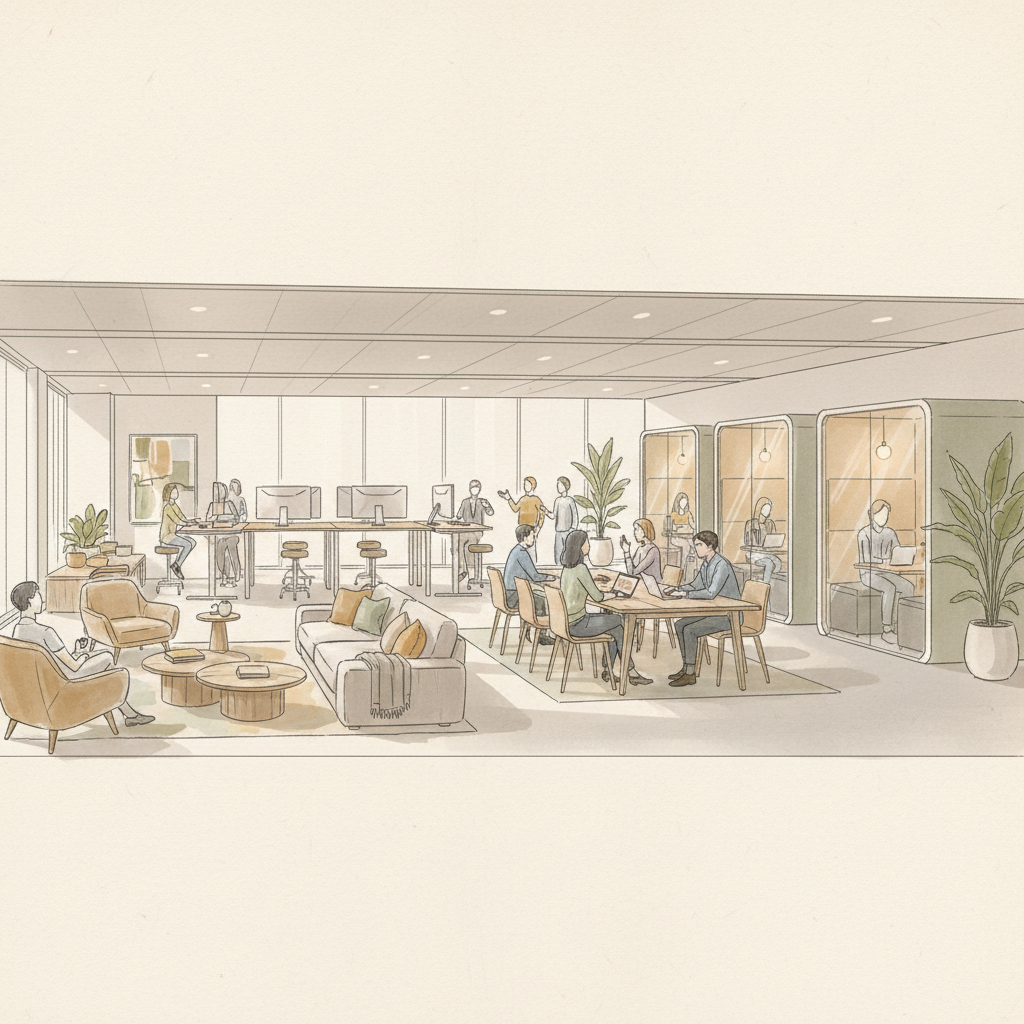
Activity based working (ABW) is reshaping how enterprises design offices and manage real estate portfolios. Rather than assigning every employee a fixed desk, ABW gives people the freedom to choose from a range of purpose-built workspaces that match the task at hand, whether that's deep-focus solo work, collaborative brainstorming, or a quick video call. For corporate real estate and HR leaders under pressure to justify every square foot of office spend, this shift isn't just a design trend. It's a cost strategy. As of 2026, organizations that have implemented ABW properly report measurable reductions in space requirements, higher employee satisfaction scores, and stronger team co-attendance rates. This guide walks you through what activity based working actually means, how to implement it step by step, the pitfalls to avoid, and how AI-powered platforms like Upflex are making it easier to manage at scale.
Activity based working requires more than rearranging furniture. A successful ABW rollout depends on upfront data, stakeholder alignment, and the right technology infrastructure before a single desk is moved.
Pro Tip: Before committing to a full ABW redesign, run a 90-day pilot on one floor or one team. Measure zone utilization, employee satisfaction, and co-attendance rates. The data you collect will sharpen your business case and reduce the risk of a costly full-scale misstep.
Auditing your existing office utilization is the non-negotiable first step in any activity based working implementation. You can't design for how people work until you know how they actually work today.
From experience, most organizations are surprised by the audit results. A global financial services firm recently found that despite a 500-desk office, peak simultaneous occupancy never exceeded 280 people. That gap represents significant wasted real estate spend that ABW, combined with portfolio optimization, can directly address.
CBRE's research confirms that a well-executed audit is foundational to any successful workplace strategy [2]. Without it, you're designing for assumptions, not reality.
One pitfall to watch for at this stage: relying solely on badge data. Badge swipes tell you when someone entered the building, not where they sat or what they did. Supplement badge data with sensor coverage and employee self-reporting for a complete picture.
Designing ABW zones means creating distinct spaces that each serve a specific type of work, based on the audit data you've collected. This is where activity based working moves from concept to physical reality.
According to Advanced Workplace Associates, a well-designed ABW environment typically includes at least five distinct zone types [3]:
| Zone Type | Primary Activity | Design Features | % of Floor Space (Typical) |
|---|---|---|---|
| Focus Pods / Quiet Zones | Deep concentration work | Acoustic panels, no-talk policy, single workstations | 25–35% |
| Collaboration Zones | Team meetings, workshops | Whiteboards, movable furniture, AV screens | 20–30% |
| Phone Booths / Call Pods | Private calls, video meetings | Soundproofing, single seat, camera-ready lighting | 10–15% |
| Social / Lounge Areas | Informal conversation, breaks | Soft seating, café-style tables, natural light | 15–20% |
| Project Rooms | Long-form team work | Bookable, lockable, persistent project displays | 10–15% |
Veldhoen + Company, widely credited with originating the ABW concept in the early 1990s, emphasizes that the mix of zones must reflect actual work patterns rather than generic assumptions [4]. If your audit shows 60% of work time is spent in focused solo tasks, a design that allocates 50% of space to collaboration zones will frustrate employees and undermine adoption.
For organizations with employees who travel between offices or work remotely, supplementing owned zones with access to an activity-based coworking space design can extend the ABW model beyond your four walls without additional lease commitments [5].
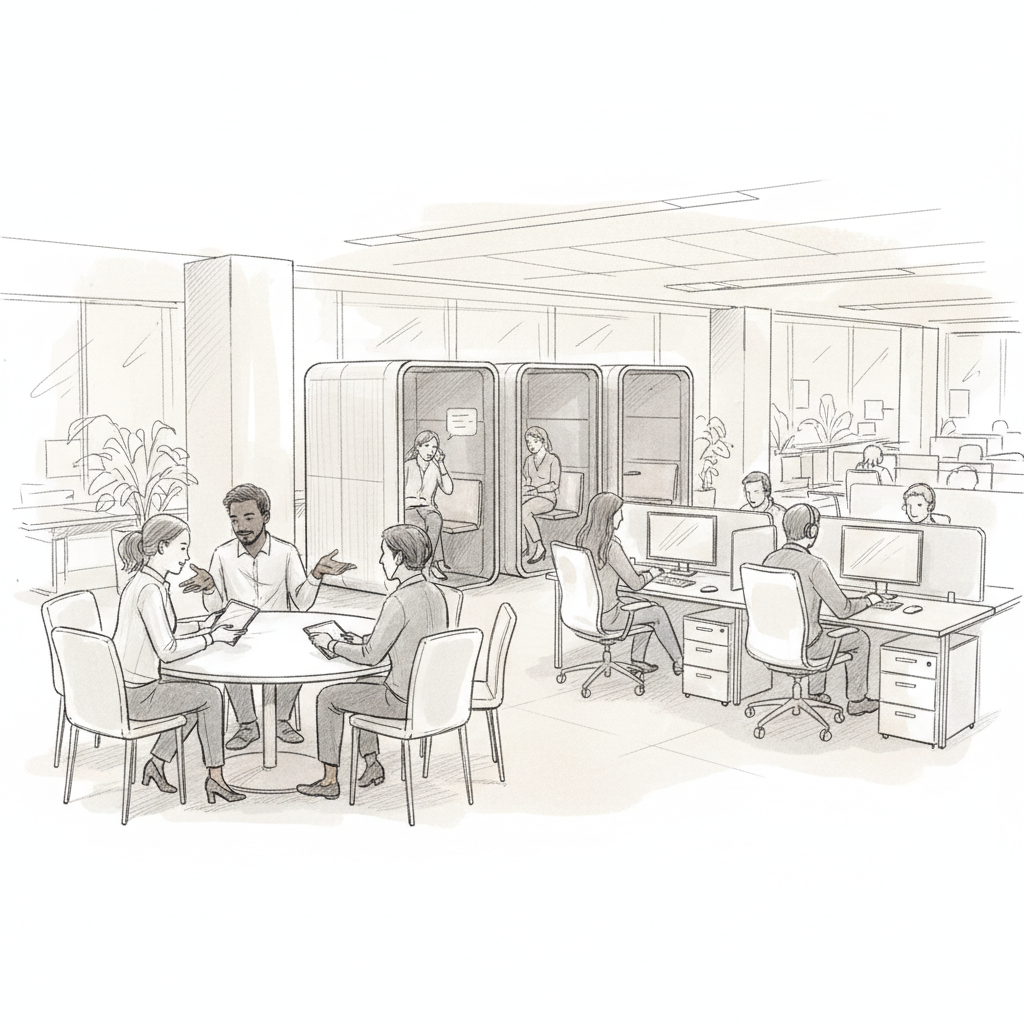
Implementing desk booking and attendance coordination is where activity based working transitions from a design project into an operational system. Without this layer, ABW quickly degenerates into a free-for-all where popular zones are always overcrowded and others sit empty.
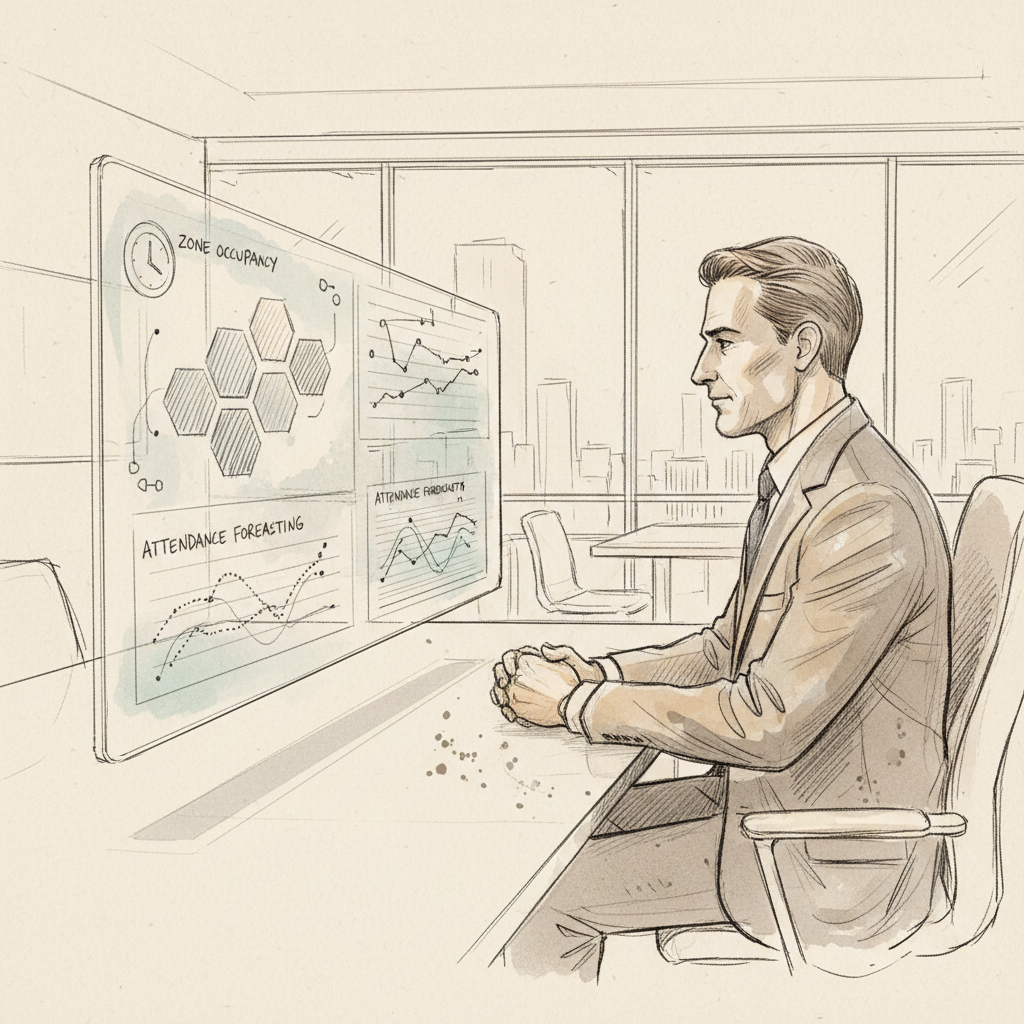
At Upflex, we've found that the single biggest failure point in ABW rollouts isn't the physical design. It's the absence of reliable attendance data. AI that forecasts who's coming in, when, and where — that's what Upflex's UnifyAI engine delivers, with 97% attendance forecast accuracy. That level of precision lets corporate real estate teams right-size zone allocations in real time rather than guessing based on last month's badge swipes.
Research from PubMed confirms that employees in activity-based offices need a clear adoption period to learn how to use facilities effectively [6]. A well-configured booking system shortens that curve significantly by removing ambiguity about where to sit and when to come in.
Pro Tip: Don't launch your ABW booking system with all features enabled on day one. Start with simple desk reservation and zone browsing, then layer in team coordination and attendance forecasting features over the first 60 days. Gradual onboarding drives adoption rates significantly higher than a feature-complete cold launch.
Organizations managing distributed teams across multiple cities should also consider how on-demand workspace access fits into the ABW model. Platforms that connect employees to a global network of flexible workspaces extend the ABW principle beyond the headquarter office, giving remote employees the same range of task-appropriate spaces without requiring additional leases. For workspace design inspiration and ergonomic considerations, resources like senejac.com offer practical guidance on creating productive work environments that align with ABW principles.
Managing change is arguably the hardest part of an activity based working rollout. The physical redesign and the technology setup are solvable problems. Getting 500 or 5,000 employees to abandon their territorial instincts about "their" desk is a different challenge entirely.
According to research published in Ergonomics, managers play a disproportionate role in whether employees successfully adapt to activity-based offices [1]. Managers who model ABW behaviors (choosing zones based on task type, using the booking system visibly, participating in team coordination workflows) accelerate adoption across their entire team.
Stanford University's workplace resources highlight that ABW requires a fundamental rethinking of how work is organized, not just where it happens [7]. That rethinking starts with managers.
In practice, organizations that invest in manager enablement before launch achieve 88% co-attendance rates, the benchmark Upflex customers consistently hit, versus the 40–50% co-attendance that poorly managed ABW environments typically produce.
Optimizing your real estate portfolio is the payoff stage of activity based working. Once your ABW environment is running and generating utilization data, you have the evidence base needed to make confident decisions about your office footprint.
| Factor | Traditional Assigned Desks | Activity Based Working + AI Optimization |
|---|---|---|
| Desk-to-employee ratio | 1:1 (one desk per employee) | 0.6:1 to 0.7:1 (based on actual attendance) |
| Average desk utilization | 40–50% on peak days | 75–85% across booked zones |
| Real estate cost per employee | High (full footprint maintained) | 40%+ lower with portfolio consolidation |
| Employee flexibility | Low (fixed location) | High (task-matched workspace choice) |
| Co-attendance management | Manual / ad hoc | AI-coordinated, 88% achievement rate |
Tango Analytics notes that organizations implementing ABW with proper data infrastructure consistently outperform those that treat it purely as a design exercise [8]. The data layer isn't optional. It's what separates ABW as a cost strategy from ABW as an aesthetic choice.
Pro Tip: When presenting your ABW business case to the CFO, lead with the utilization gap: "We're paying for X desks and using Y% of them on peak days." That number, pulled directly from your audit data, frames the ROI of ABW more compellingly than any design presentation ever will.
Activity based working fails more often from implementation errors than from conceptual flaws. Most of these mistakes are avoidable with proper planning.
A practical example of activity based working is a financial services firm that replaces 400 assigned desks with a mix of 120 quiet focus pods, 80 collaboration tables, 40 phone booths, 30 project rooms, and a 200-seat social lounge. Employees book the space that fits their task for the day rather than returning to the same seat. This configuration typically supports a workforce of 500–600 people, because not everyone is in the office simultaneously, while delivering a measurably better work environment for every task type.
The 3-3-3 rule is a personal productivity framework, not an ABW-specific concept, that structures the workday into three hours of deep focused work on a single priority, followed by three important but less cognitively demanding tasks, and then three routine maintenance activities such as email, admin, or brief check-ins. It's a useful complement to activity based working because it helps employees consciously choose which workspace zone matches each part of their day: focus pods for the first three hours, collaboration zones for team tasks, and social areas for lighter work.
Activity based working (ABW) is a workplace strategy that removes fixed desk assignments and replaces them with a portfolio of purpose-designed spaces, each optimized for a specific type of work activity. Employees choose their workspace based on what they're doing at any given moment: a quiet pod for focused writing, a collaboration table for team ideation, a phone booth for a sensitive call. Pioneered by Veldhoen + Company in the Netherlands in the early 1990s, ABW has evolved into a cornerstone of hybrid workplace strategy, particularly for enterprises seeking to reduce real estate costs while improving the employee experience.
The 3 C's of meaningful work are Community, Contribution, and Challenge. Community refers to the sense of belonging and connection with colleagues. Contribution describes the feeling that one's work has impact and purpose. Challenge captures the growth and engagement that comes from tackling difficult problems. Activity based working supports all three: well-designed collaboration zones strengthen community, task-appropriate spaces improve the quality of individual contribution, and an environment that trusts employees to manage their own workday creates the psychological conditions for genuine challenge and growth.
The primary advantages of activity based working include reduced real estate costs (typically 30–40%+ when combined with portfolio consolidation), higher desk utilization rates, greater employee flexibility, and better alignment between workspace design and actual work tasks. The main disadvantages include the loss of personal workspace identity, potential noise and distraction in poorly designed open zones, the risk of reduced team cohesion if co-attendance isn't actively managed, and the technology investment required to run booking and forecasting systems effectively. Results depend heavily on how well the implementation is planned and supported.
Activity based working and hybrid work are natural complements. In a hybrid model, employees split time between the office and remote locations, which means office attendance is inherently variable. ABW's flexible, non-assigned workspace design is well-suited to variable attendance because space isn't wasted on empty assigned desks when people work from home. The key is pairing ABW with accurate attendance forecasting so that zone capacity is calibrated to actual occupancy patterns rather than headcount. Platforms that combine AI-powered attendance prediction with on-demand workspace access extend the ABW model to cover employees wherever they work.
Activity based working is one of the most effective tools available to corporate real estate and HR leaders who need to reduce costs without reducing the quality of the employee experience. Done right, it cuts desk-to-employee ratios, drives utilization up, and gives organizations the data they need to make confident portfolio consolidation decisions.
The steps are clear: audit your current space, design zones that reflect actual work patterns, implement booking and forecasting technology, manage change proactively, and use utilization data to optimize your real estate footprint over time. Each step builds on the last. Skip one and the whole model underperforms.
The difference between ABW as a design trend and ABW as a cost strategy is data. Organizations that pair this approach with AI-powered attendance forecasting, like the 97% accuracy Upflex's UnifyAI delivers, achieve the 40%+ real estate savings and 88% co-attendance rates that turn a workplace redesign into a boardroom-level win. If your organization is ready to move from guessing to knowing, Upflex is the platform built for exactly that.
Explore more from our content library: