Share This Article
No items found.

Half your floor sits empty on a Tuesday. Your lease renewal is six months out. And your CFO wants answers. This hybrid workplace guide exists for exactly that moment. Hybrid work, where employees split time between a company office and remote locations, has shifted from a pandemic-era experiment into the dominant operating model for global enterprises. As of 2026, the CIPD reports that hybrid working is now the most common flexible arrangement offered by employers across industries [1]. Getting it right requires more than a flexible policy. It demands a structured approach to space, technology, culture, and cost.
This guide walks you through every layer of a successful hybrid workplace strategy, from defining your model to optimizing your real estate portfolio with AI-powered forecasting. Whether you're a Corporate Real Estate leader preparing a business case for consolidation or an HR director trying to get teams into the office on the same days, you'll find a practical, step-by-step framework here. Expect to invest 20 to 30 minutes reading this guide thoroughly. The return on that time can be measured in millions of dollars of real estate savings. This is particularly relevant for hybrid workplace guide.
Before redesigning your hybrid workplace, you need a clear picture of your current state across three dimensions: space utilization, workforce data, and technology infrastructure.
A hybrid workplace strategy fails when it's designed in isolation. Bring these roles into the planning process from day one:
Pro Tip: Before your first planning meeting, pull three months of badge data and calculate your average daily occupancy rate. If it's below 60%, you already have the business case for real estate consolidation. That number is your opening slide.
According to the LLNL Hybrid Workplace Guide, a successful hybrid framework requires clear definitions of flexible workplace options, equipment standards, and safety protocols before any employee-facing rollout [2]. Skipping this groundwork is the single most common reason hybrid programs stall in their first quarter.
A hybrid work model is a structured policy that specifies when, where, and how employees are expected to work, balancing remote flexibility with intentional in-person collaboration.
Not all hybrid models are built the same. The right choice depends on your industry, culture, and real estate footprint. Here's a comparison of the four most widely adopted structures as of 2026:
| Model | Structure | Best For | Real Estate Impact |
|---|---|---|---|
| Fixed Hybrid | Set days in office (e.g., Tue/Thu) | Teams needing predictable collaboration | Moderate reduction (20-30%) |
| Flexible Hybrid | Employee chooses days within guidelines | Knowledge workers, creative roles | High reduction potential (30-40%+) |
| Remote-First Hybrid | Default remote, office for specific events | Distributed global teams | Maximum reduction, on-demand space reliance |
| Team-Led Hybrid | Each team sets its own in-office rhythm | Large enterprises with diverse functions | Variable, requires strong forecasting |
Organizational psychologist Liane Davey notes that hybrid arrangements offer measurable advantages over fully office-based work, but only when the model is explicitly defined rather than left to individual interpretation [3]. Ambiguity is the enemy of co-attendance. Teams that don't know which days their colleagues will be in tend to default to remote, defeating the purpose of the hybrid model entirely. When considering hybrid workplace guide, this point stands out.
Choose your model based on your collaboration data, not on what feels fair. Fairness comes from consistent policy application, not from giving everyone identical flexibility.
A real estate portfolio audit quantifies the gap between what you're paying for and what your workforce actually uses, creating the data foundation for consolidation decisions.
Industry analysts at Eptura describe hybrid work as having evolved from a temporary disruption response into a long-term operating model that reshapes how organizations plan and allocate physical space [4]. That shift makes portfolio audits a recurring operational discipline, not a one-time project.
Pro Tip: Don't just measure average occupancy. Measure peak-day occupancy. If your busiest day hits 85% and your average is 40%, you need enough space for the peak, not the average. Many consolidation plans fail because they're built on averages that don't reflect Tuesday-Thursday demand spikes.
At Upflex, we've found that most enterprise clients discover their real estate is 35 to 50% underutilized when they run their first proper audit. That's not a small inefficiency. For a company paying $10 million annually in office leases, that's $3.5 to $5 million in recoverable spend sitting in empty desks.
Just as manufacturers are rethinking production methods, for example exploring 3D Printing In Machining: The Complete Guide To Hybrid Manufacturing, enterprise real estate leaders are combining traditional owned-office models with on-demand workspace access to create more efficient, flexible portfolios. For those exploring hybrid workplace guide, this matters.

A hybrid work policy is the formal document that defines expectations, eligibility, in-office requirements, and accountability structures for all employees operating under a hybrid arrangement.
Joan Workplace's 2026 hybrid work policy research identifies four essential policy components that eliminate confusion and create fairness for distributed teams [5]:
From experience working with global enterprises, the most damaging policy errors tend to be:
The University of Washington's HR guidance on managing hybrid workplaces emphasizes designing for inclusion, establishing clear meeting norms, and ensuring work location transparency as foundational policy elements [6]. These aren't soft culture considerations. They're operational requirements that prevent a two-tier experience where remote employees feel systematically disadvantaged.
According to Harvard Law School's hybrid work best practices guidance, creating dedicated channels for informal communication and non-work conversation is equally important as formal policy, because it preserves the social fabric that keeps distributed teams cohesive [7]. This directly impacts hybrid workplace guide outcomes.
AI-powered attendance forecasting uses machine learning to predict which employees will be in the office on any given day, enabling proactive space management instead of reactive desk scrambling.
Most organizations have desk booking tools. Very few have forecasting tools. The difference is significant. Desk booking tells you where someone sat yesterday. Attendance forecasting tells you who's coming tomorrow, which teams will overlap, and whether you have a space surplus or deficit before the day begins.
Upflex's UnifyAI engine delivers 97% attendance forecast accuracy by processing scheduling inputs, historical attendance patterns, and team calendar data to predict office demand at the team and floor level. That accuracy isn't a marketing claim. It's the operational foundation that allows customers to achieve 88% co-attendance rates, meaning teams actually end up in the office on the same days, which is the whole point of hybrid work.
| Capability | Without AI Forecasting | With UnifyAI |
|---|---|---|
| Attendance Prediction | Manual estimates or badge history | 97% accurate daily forecasts |
| Co-Attendance Achievement | Unpredictable, often below 50% | 88% team co-attendance rate |
| Space Allocation | Fixed desks, over-provisioned | Dynamic, demand-matched allocation |
| Real Estate Decisions | Gut feel or lagging badge data | Data-driven consolidation with 40%+ savings |
| Workspace Coverage | Owned offices only | Owned offices + global on-demand network |
Moveworks' enterprise hybrid workplace research identifies consistent support delivery across locations and unified AI-powered workflows as the top two best practices for managing hybrid at scale [8]. Forecasting is the connective tissue between those two capabilities.
On-demand workspace access gives employees the ability to book professional workspace outside their company's owned offices, covering locations where the company has no lease and eliminating the "dead zones" in a distributed workforce. This is particularly relevant for hybrid workplace guide.
Consider a scenario that's increasingly common: a company with offices in New York, London, and Singapore has 40 employees in cities without a company office. Those employees either work from home every day or expense ad hoc café costs. Neither option is sustainable at scale.
On-demand workspace networks solve this by giving those 40 employees access to professional, bookable workspaces in their cities, without the company signing a single new lease. Upflex's on-demand workspace network, the largest of its kind globally, means employees in over 75 countries can book a professional desk or meeting room the same way they'd book a hotel room.
Pro Tip: When evaluating on-demand workspace networks, don't just count locations. Ask about booking reliability, cancellation policies, and whether the network includes private offices and meeting rooms, not just open coworking desks. Your senior employees won't use a network that only offers hot desks in loud coworking spaces.
Hubble HQ's comprehensive hybrid working guide highlights that successful hybrid arrangements require employees to have access to productive work environments wherever they're located, not just on days they commute to a company office [9]. That principle is what makes on-demand workspace access a strategic asset rather than a perk.
The combination of owned office management and on-demand workspace access, unified in a single platform, is what allows organizations to reduce their real estate footprint by 40%+ without reducing the quality of the employee experience. You're not cutting space. You're replacing expensive fixed leases with intelligent, flexible access.
Hybrid culture is the set of norms, rituals, and accountability structures that ensure remote and in-office employees have equitable access to collaboration, visibility, and career advancement. When considering hybrid workplace guide, this point stands out.
Officely's research on hybrid work culture identifies several high-impact practices for building cohesion across distributed teams [10]:
Measuring hybrid workplace health requires tracking both operational and cultural metrics. Focus on:
MindShare Partners' employer guide to hybrid wellbeing notes that mental health outcomes in hybrid environments depend heavily on whether employees feel connected to their teams, not just whether they have schedule flexibility [11]. Culture metrics need to capture that connection, not just physical attendance numbers.
The Transform workplace strategy research, drawing on the work of author Gary Cookson, emphasizes that hybrid strategies built around stronger human connections produce more future-ready organizations than those built purely around cost reduction [12]. Both objectives are achievable. They're not in conflict.
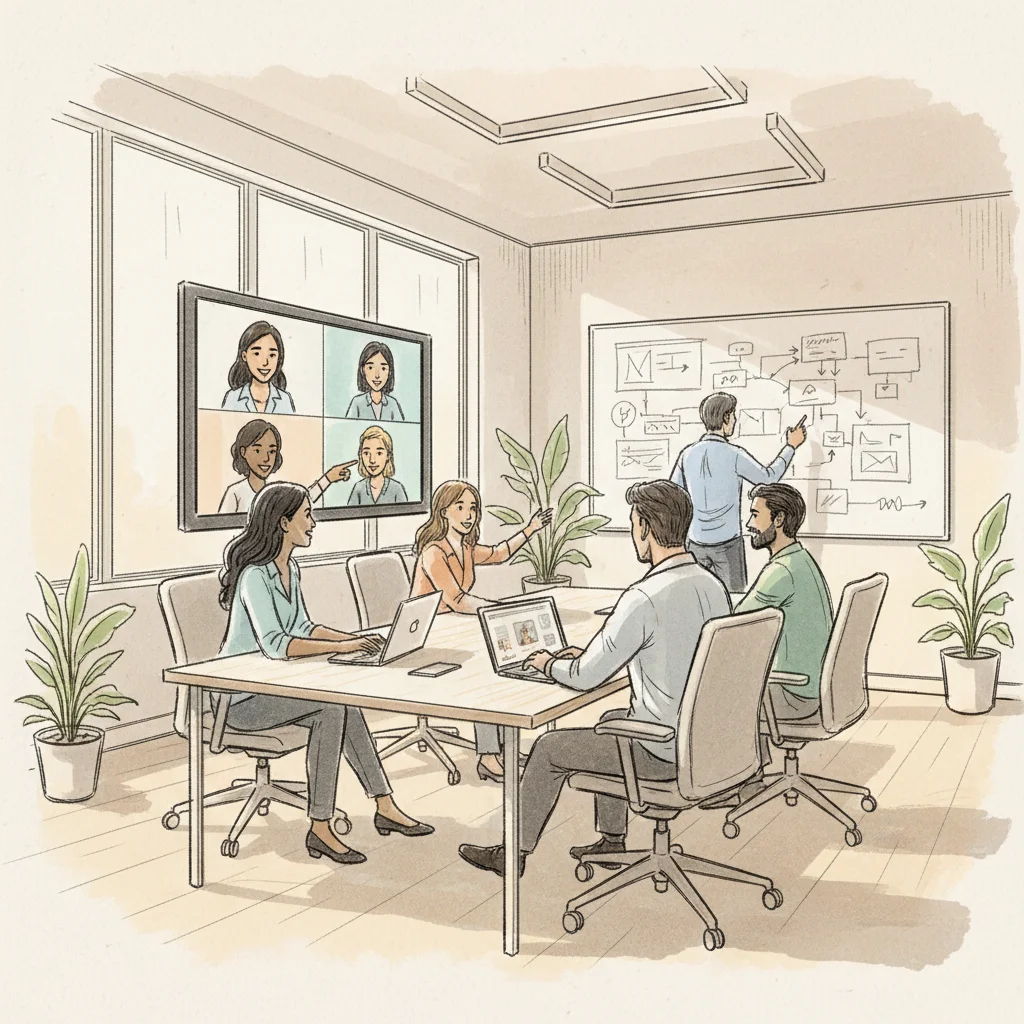
The most costly hybrid workplace mistakes share a common thread: they treat hybrid as a policy problem rather than an operational one. For those exploring hybrid workplace guide, this matters.
One pitfall worth calling out specifically: many organizations implement hybrid work policies without a co-attendance (the metric measuring whether team members are actually in the office on the same days) tracking mechanism. Without that measurement, you can have 100% policy compliance and still have no team overlap, which means no collaboration benefit and no justification for maintaining office space.
A hybrid workplace guide is a structured framework covering policy, space management, technology, and culture for organizations where employees split time between remote and in-office work. Any company with more than 100 employees operating a hybrid model needs one. Without a documented guide, hybrid defaults to informal arrangements that produce inconsistent attendance, wasted real estate spend, and unequal employee experiences.
Most enterprises as of 2026 require two to three in-office days per week. The right number depends on your industry, role type, and collaboration needs. What matters more than the number of days is team synchronization: employees should be in the office on the same days as their direct collaborators. A team all in on Tuesday and Thursday is far more valuable than individuals each choosing different days.
Track co-attendance rates (are teams actually overlapping in person?), office utilization rates (are you using the space you're paying for?), real estate cost per employee, and employee satisfaction with hybrid arrangements. Co-attendance is the most underused metric. You can have 100% individual compliance with a two-day policy and still have zero team overlap if everyone picks different days.
A complete hybrid workplace technology stack includes desk booking software, attendance forecasting tools, video conferencing infrastructure, and ideally access to an on-demand workspace network for employees outside your office locations. AI-powered forecasting, like Upflex's UnifyAI, adds a layer that basic desk booking tools don't provide: the ability to predict who's coming in before they arrive, enabling proactive space management rather than reactive scrambling.
Reducing real estate costs in a hybrid model requires three things: accurate utilization data, a clear consolidation plan, and the right technology to manage a smaller footprint effectively. Organizations that implement AI-powered attendance forecasting and combine owned-office management with on-demand workspace access have achieved reductions of 40%+ in real estate spend. The key is right-sizing your owned office portfolio and filling coverage gaps with flexible workspace access rather than new leases. This directly impacts hybrid workplace guide outcomes.
Remote work means employees work outside a company office full time. Hybrid work means employees split their time between a company office and remote locations, typically following a defined schedule or minimum in-office requirement. Hybrid work preserves the in-person collaboration benefits of office environments while offering the flexibility employees have come to expect. Remote work maximizes flexibility but requires more deliberate effort to maintain team cohesion and culture.
Policies get followed when employees understand the purpose behind them and experience a meaningful benefit from compliance. Be explicit about why in-office days matter, what collaboration outcomes you're trying to achieve, and what the in-office experience offers that remote work doesn't. Pair your policy with technology that makes booking desks and coordinating with teammates effortless. Friction in the booking experience is one of the most underestimated reasons hybrid policies fail in practice.
A global hybrid workplace guide template can establish common principles, but local implementation must account for jurisdiction-specific labor laws, data privacy regulations (including GDPR in Europe), and cultural norms around work hours and flexibility. Build your core policy framework centrally, then allow regional HR and legal teams to adapt the specifics. Technology platforms with global on-demand workspace access, like Upflex, help standardize the employee experience across geographies even when policy details vary.
A hybrid workplace guide isn't a document you write once and file away. It's an operational framework you build, test, and refine as your workforce data and business needs evolve. The organizations winning at hybrid work in 2026 share a common approach: they've replaced guesswork with data, replaced fixed assumptions with flexible infrastructure, and replaced vague flexibility with intentional co-attendance design.
The steps in this guide give you a complete path from audit to implementation. Start with your utilization data. Define your model. Build a policy with teeth. Deploy forecasting technology that tells you what's coming before it arrives. Fill your coverage gaps with on-demand workspace access. And measure what actually matters, which is whether your teams are showing up together, not just showing up.
Upflex combines AI-powered office orchestration with the world's largest on-demand workspace network to make every step of this process measurable and manageable. The results our customers achieve, 40%+ reductions in real estate spend and 88% co-attendance rates, aren't aspirational targets. They're documented outcomes from organizations that committed to running their hybrid workplace like an operational system rather than a workplace experiment.
Explore more from our content library: