Share This Article
No items found.


Corporate real estate trends in 2026 point to one clear reality: the office isn't dead, but the way enterprises manage, size, and pay for space has changed permanently. Hybrid work has settled from experiment to operating model, AI is reshaping how portfolio decisions get made, and CFOs are demanding that every square foot justify its cost. This article breaks down the forces driving the market right now, the data behind them, and what corporate real estate leaders need to do to stay ahead.
Corporate real estate trends describe the structural shifts in how enterprises acquire, manage, and optimize office space over time. In 2026, those shifts are being driven by hybrid work adoption, AI-powered space intelligence, sustainability mandates, and acute pressure to reduce fixed real estate costs without sacrificing employee experience.
The U.S. commercial real estate industry has grown at a compound annual growth rate (CAGR) of 2.1% between 2021 and 2026, according to IBISWorld's 2026 industry analysis [1]. That headline number masks a split story: industrial and multifamily assets are outperforming, while traditional office space continues to face structural headwinds from hybrid work patterns.
As of 2026, the U.S. median commercial real estate price across all property types has reached $129 per square foot, an all-time record, per Altus Group's Q1 2026 research [2]. For corporate occupiers, that means the cost of holding underutilized space has never been higher.
The office sector specifically sits at an inflection point. According to CBRE's U.S. Real Estate Market Outlook 2026, GDP growth is expected to slow to 2.0% this year, creating additional pressure on corporate occupiers to demonstrate ROI on every real estate dollar [3]. Enterprises that locked into long-term leases before 2022 are now actively renegotiating, consolidating, or exiting space.
Previous cycles of office market softness were largely demand-driven, tied to recessions or sector contractions. The current shift is structural. Hybrid work has permanently altered attendance patterns, with most enterprise offices operating at 30 to 50% utilization on any given day. That's not a temporary dip. It's the new baseline.
The U.S. Government Accountability Office's report on commercial real estate trends and risks specifically flags post-pandemic behavioral shifts as a long-term structural factor, not a cyclical one [4]. Corporate real estate leaders who treat this as a temporary problem will consistently overspend.
Pro Tip: Before your next lease renewal decision, pull 90 days of badge and booking data. If average daily utilization is below 60%, you're likely holding more space than your workforce actually needs. That data is your strongest argument for rightsizing with the CFO.
Six interconnected forces are reshaping corporate real estate strategy in 2026, from AI adoption to sustainability requirements to the rise of flexible workspace as a portfolio strategy.
Artificial intelligence has moved from pilot project to operational infrastructure in corporate real estate. JLL's analysis of top global CRE trends notes that AI exploration among corporate real estate teams jumped from under 5% planning pilots in 2023 to 92% by 2025 [5]. As of 2026, the leading organizations aren't exploring AI anymore. They're deploying it.
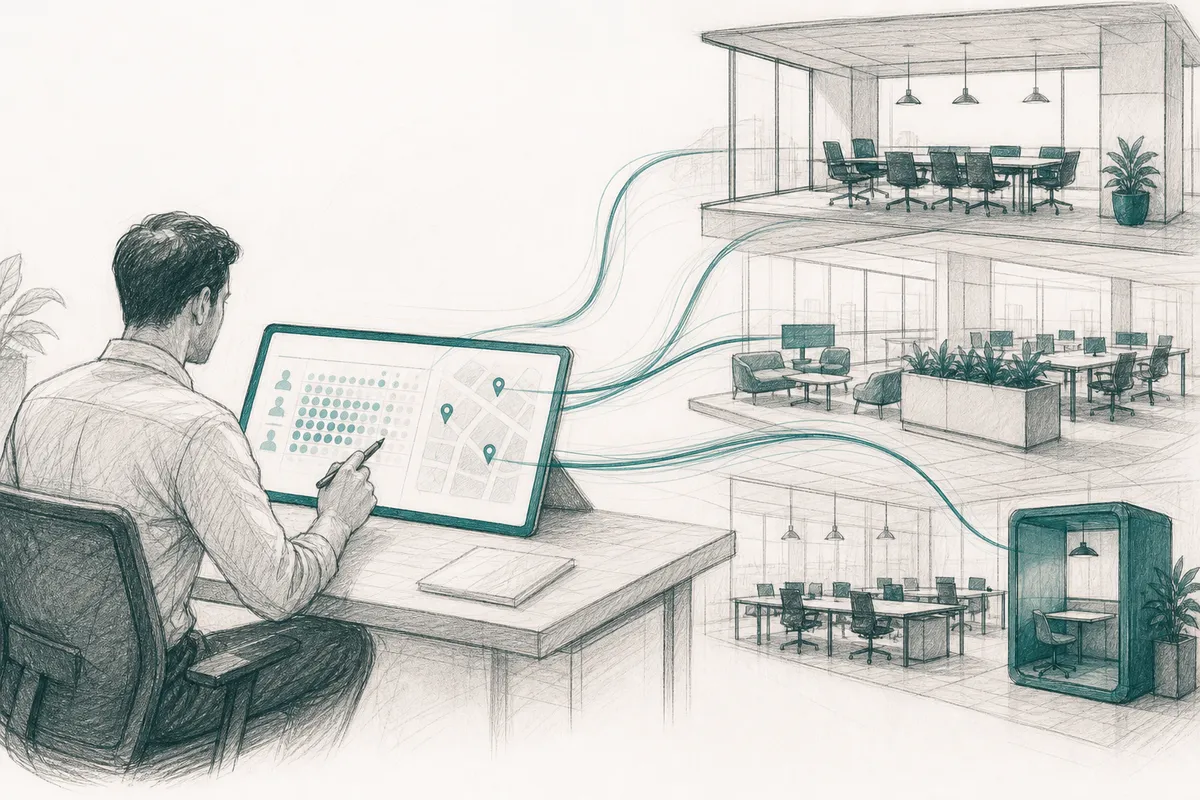
The practical application isn't just predictive analytics for market timing. It's operational: AI is now being used to forecast office attendance, automate desk booking, and generate utilization data that directly informs portfolio consolidation decisions. At Upflex, we've found that AI-powered attendance forecasting (delivered through our UnifyAI engine at 97% accuracy) gives corporate real estate leaders the confidence to make data-backed space reduction decisions rather than guessing based on last quarter's badge swipes.
Key AI applications in corporate real estate today include:
Flexible workspace (on-demand coworking and third-party workspace access) has graduated from an employee benefit into a core real estate strategy. Enterprises are using flex space to reduce long-term lease commitments, serve distributed employees without new fixed locations, and absorb demand spikes without overpaying for permanent square footage.
According to PwC's Emerging Trends in Real Estate 2026 report, flexible space demand is one of the most consistently cited strategic priorities among corporate occupiers this year [6]. Organizations that pair owned office management with access to a global on-demand workspace network can serve employees wherever they are without signing leases they'll regret in three years.
The sustainability agenda is equally significant. Deloitte's 2026 commercial real estate outlook reports that ESG (Environmental, Social, and Governance) requirements are now influencing lease decisions, with tenants increasingly demanding green-certified buildings and landlords investing in energy-efficient upgrades to retain occupiers [7]. For corporate real estate leaders, sustainability isn't a nice-to-have. It's a procurement filter.

Hybrid work has fundamentally restructured the relationship between headcount and square footage, forcing corporate real estate leaders to manage space for peak demand rather than average occupancy.
Most enterprise offices are running at 30 to 50% utilization. That means organizations are paying full rent, full facilities costs, and full maintenance for space that sits empty more than half the time. The NAIOP research on challenges facing commercial real estate identifies high financing costs and underutilized office space as two of the most pressing pressures on the sector [8].
The utilization gap isn't just a cost problem. It's a coordination problem. Employees who do come into the office often can't find their teammates because attendance is unpredictable. That erodes the value of the office, reduces co-attendance, and creates a cycle where fewer people bother showing up.
In practice, the organizations solving this best are doing two things simultaneously:
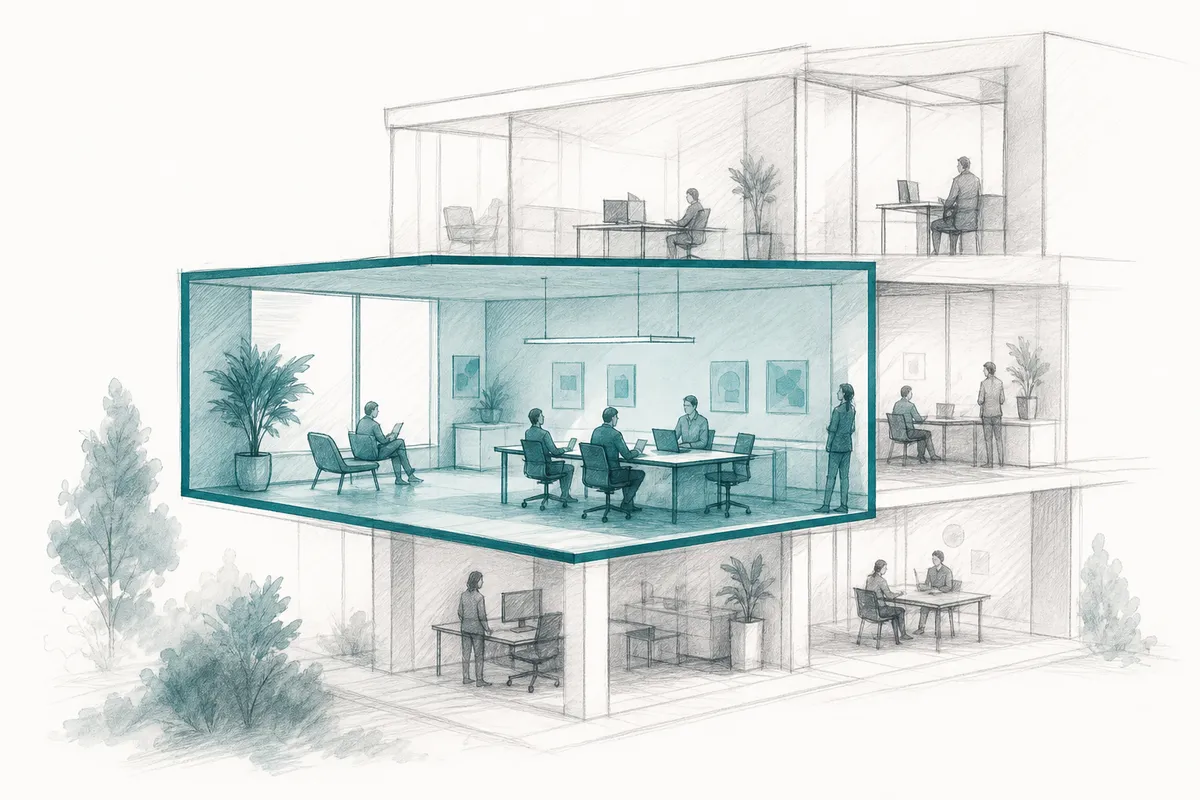
The traditional corporate real estate model, one large headquarters plus regional offices on 10-year leases, is giving way to a dynamic portfolio model. This model combines a smaller, optimized core office with flexible workspace access across multiple locations.
According to J.P. Morgan's 2026 commercial real estate trends analysis, office is "bouncing back" in select markets, but the recovery is concentrated in high-quality, amenity-rich buildings [9]. Class A and trophy office space is absorbing demand, while Class B and C office buildings continue to struggle with vacancy. Corporate real estate leaders are upgrading to less space, not more.
For organizations managing this transition, the practical challenge is having the data to make confident decisions. How much space do you actually need? On which days? In which locations? Those questions can't be answered with spreadsheets and badge swipes. They require integrated workplace intelligence.
Pro Tip: Don't wait for lease expiration to start rightsizing. Use the 18-24 months before renewal to build a utilization data record that supports your renegotiation position. Landlords respond to hard numbers, not anecdotes about hybrid work.
Even well-resourced corporate real estate teams make predictable mistakes when responding to market shifts. Recognizing these pitfalls early saves significant cost and credibility.
A common mistake is pulling one month of badge data, concluding the office is underused, and immediately cutting space. Utilization fluctuates significantly by season, by team cycle, and by external factors. One limitation is that badge data alone doesn't tell you why people aren't coming in or which teams need to be in the same place at the same time.
The better approach is continuous utilization monitoring combined with attendance forecasting. When you can predict who's coming in tomorrow with 97% accuracy, you can make space decisions based on structural patterns rather than temporary dips.
Organizations that aggressively reduce their permanent footprint without providing an alternative for distributed employees or overflow days create a new problem: employees who need a professional workspace can't find one. This drives shadow IT in real estate, where employees expense coworking memberships individually with no central oversight or cost control.
The solution is to pair portfolio consolidation with structured access to an on-demand workspace network. That way, you reduce fixed costs while maintaining coverage. Upflex clients have achieved 40%+ reductions in real estate spend using exactly this model, combining a smaller core office with global on-demand workspace access for the rest of the workforce.
Reducing space while failing to coordinate team attendance defeats the purpose of having an office. If your teams are never in on the same days, the office delivers no collaboration value, and employees stop seeing the commute as worthwhile.
Research from the Wharton School's real estate research program highlights that demand patterns in commercial real estate are increasingly driven by behavioral factors, not just economic ones [10]. Co-attendance coordination is now a real estate strategy, not just an HR concern.
| Common Mistake | Risk | Best-Practice Alternative |
|---|---|---|
| Using badge data as the sole utilization metric | Misses team coordination needs and future demand | Combine badge data with AI attendance forecasting |
| Cutting space without flex alternatives | Leaves distributed employees without workspace | Pair consolidation with on-demand workspace access |
| Ignoring co-attendance in space planning | Office loses collaboration value; attendance drops | Use scheduling tools to coordinate team presence |
| Waiting for lease expiration to act | Missed renegotiation leverage; higher exit costs | Build utilization data record 18-24 months ahead |
| Treating sustainability as optional | Lease options narrow as ESG mandates tighten | Integrate ESG criteria into lease evaluation process |
The most effective corporate real estate strategies in 2026 combine hard utilization data, AI-powered forecasting, flexible workspace access, and clear alignment between real estate decisions and business outcomes.
The static portfolio model, fixed leases at fixed locations, is increasingly difficult to justify to a CFO who can see utilization data. The dynamic portfolio model treats real estate as a variable cost, adjusting supply to match actual and forecasted demand.
Key components of a dynamic portfolio model include:
According to Markets Group's 2026 U.S. commercial real estate outlook, organizations that have adopted flexible portfolio strategies are outperforming peers on both cost efficiency and employee satisfaction metrics [11].
One of the most impactful shifts in corporate real estate strategy is moving from input metrics (square footage, cost per seat) to outcome metrics (co-attendance rate, collaboration frequency, real estate cost as a percentage of revenue).
The National Association of Realtors' commercial real estate market insights consistently shows that organizations with clearly defined real estate KPIs make faster, more confident portfolio decisions [12]. When your CFO can see that 88% of teams are hitting co-attendance targets in a space that costs 40% less than it did two years ago, the business case for continued investment in workplace optimization becomes self-evident.
For compliance and legal considerations related to real estate portfolio management across jurisdictions, it's worth reviewing applicable regulatory frameworks. Resources like the Mentions Legales framework provide useful context for organizations operating across multiple legal environments.
Pro Tip: Present your real estate optimization results in CFO language: cost per productive seat, not cost per square foot. A seat that generates co-attendance and collaboration is worth more than one that's technically available but rarely used. That framing shifts the conversation from expense management to capital allocation.
| Traditional Metric | Outcome-Based Alternative | Why It Matters |
|---|---|---|
| Cost per square foot | Real estate cost as % of revenue | Ties real estate to business performance |
| Total square footage | Utilization rate (actual vs. capacity) | Reveals true space efficiency |
| Headcount per location | Co-attendance achievement rate | Measures collaboration value of office |
| Lease cost per annum | Cost per productive in-office day | Connects cost to actual usage |
| Number of office locations | Employee workspace coverage rate | Includes on-demand access in coverage calculation |

The dominant corporate real estate trends in 2026 include AI-powered space optimization, portfolio consolidation driven by hybrid work utilization data, the rise of flex space as a core portfolio strategy, ESG-driven lease decisions favoring green-certified buildings, and the shift from fixed-lease models to dynamic portfolio management. Organizations combining AI forecasting with on-demand workspace access are achieving the strongest cost outcomes.
Hybrid work has reduced average office utilization to 30-50% across most enterprise organizations, creating a significant gap between space capacity and actual usage. This has accelerated lease renegotiations, portfolio consolidations, and the adoption of flexible workspace strategies. The challenge isn't just reducing space. It's coordinating team attendance so the remaining space delivers collaboration value.
Analysts at CBRE, J.P. Morgan, and PwC broadly agree that the next five years will favor high-quality office assets in strong markets, while Class B and C office space continues to face vacancy pressure. Industrial, multifamily, and senior housing are expected to outperform. For corporate occupiers, the outlook favors smaller, better-quality footprints supplemented by flexible workspace access rather than large fixed portfolios.
AI improves corporate real estate decisions by replacing guesswork with data. Attendance forecasting predicts which days teams will use the office, enabling rightsizing decisions based on actual demand patterns. Space utilization analytics identify underperforming locations. Portfolio modeling tools simulate the cost impact of consolidation scenarios before any lease decisions are made. The result is faster, more confident decisions backed by evidence rather than intuition.
Most enterprise offices are running at 30-50% utilization as of 2026, reflecting the structural impact of hybrid work on attendance patterns. Results vary significantly by industry, location, and return-to-office policy. Organizations with active co-attendance coordination programs and AI-powered scheduling tools consistently report higher utilization rates and stronger employee satisfaction with the in-office experience.
The U.S. commercial real estate market has grown at a CAGR of 2.1% between 2021 and 2026, per IBISWorld's 2026 industry analysis. The U.S. median CRE price across all property types reached $129 per square foot in Q1 2026, an all-time record, according to Altus Group. The office segment remains the most challenged sub-sector, while industrial and multifamily continue to outperform.
The most effective approach combines portfolio consolidation with structured access to on-demand workspace. Rather than simply cutting space and leaving employees without alternatives, leading organizations reduce their permanent footprint while providing employees access to a global network of professional workspaces. This model has delivered 40%+ reductions in real estate spend for Upflex clients while maintaining strong employee workspace coverage and co-attendance outcomes.
PwC's Emerging Trends in Real Estate 2026 report highlights flexible space demand as a top strategic priority for corporate occupiers, alongside ESG requirements and the shift toward higher-quality, amenity-rich office environments. The report reflects a broader consensus that corporate real estate trends are moving decisively away from large fixed portfolios toward dynamic, data-driven space strategies that can flex with actual workforce needs.
The corporate real estate trends reshaping 2026 share a common thread: the organizations winning on cost and culture are the ones treating space as a data problem, not a square footage problem. They're using AI to forecast demand, coordinating attendance to maximize the value of every in-office day, and pairing a smaller core footprint with flexible workspace access for the rest of the workforce.
That's not a future state. It's what the leading enterprises are doing right now, and the gap between them and organizations still managing real estate with legacy tools and intuition is widening.
Upflex gives corporate real estate, finance, and HR leaders the platform to close that gap. Our UnifyAI engine forecasts attendance with 97% accuracy, our desk booking and space management tools coordinate team presence, and our global on-demand workspace network ensures employees always have a professional place to work. The result: 40%+ reductions in real estate spend and 88% co-attendance achievement for the teams who matter most.
If your next lease renewal is approaching and you're still making decisions based on last year's badge data, now is the right time to change that.
Explore more from our content library: