Share This Article
No items found.


Office space in Boston ranges from Class A towers in the Financial District to flexible coworking suites in the Seaport, with average asking rents sitting around $39–$41 per square foot as of 2026. The city is one of the most competitive commercial real estate markets in the United States, driven by its concentration of life sciences, technology, and financial services firms. Whether you're a corporate real estate leader evaluating a lease renewal or an HR director trying to right-size your hybrid team's footprint, Boston's office market offers options at nearly every price point and flexibility level.
The Boston office market is a multi-tiered commercial real estate ecosystem spanning traditional long-term leases, managed serviced offices, and on-demand coworking, with distinct submarkets that each carry different pricing and availability profiles.
Boston's commercial office inventory is concentrated across several distinct submarkets. The Financial District and Back Bay anchor the city's Class A market, while the Seaport District (also called the Innovation District) has emerged as the preferred address for technology and life sciences tenants. Cambridge, just across the Charles River, commands some of the highest rents in the metro area due to its proximity to MIT and Harvard.
According to data from Cushman & Wakefield, Boston remains a prime location for office leasing, with a variety of modern and historic buildings available across these core neighborhoods [1]. The market has evolved considerably since 2024, with hybrid work permanently reshaping demand patterns.
Boston office inventory is typically graded as Class A (premium, modern, full-service amenities), Class B (functional, older stock, moderate rents), or Class C (basic, often older buildings, lowest rents). Most enterprise tenants target Class A or B space. LoopNet data puts the average cost for office space for lease in Boston at approximately $40.59 per square foot [2], though Class A Seaport or Kendall Square space can run considerably higher.
Pro Tip: Don't anchor your real estate budget to average market rents alone. Class B buildings in emerging neighborhoods like the South End or East Cambridge often deliver 80% of the amenity value at 60% of the cost. Run a utilization analysis before committing to any lease term.
Boston office rents average $39–$41 per square foot annually for standard space, but costs vary significantly by submarket, building class, and lease structure, with flexible options available from under $30/sq ft.
Pricing in the Boston office market is driven by several intersecting factors: location, building vintage, lease term, and included services. Traditional direct leases typically offer the lowest per-square-foot cost over time but require longer commitments (typically 3–10 years) and significant tenant improvement buildouts.
According to CommercialCafe, rental rates in Boston can be found as low as $28 per square foot depending on location and building type [3]. That lower end typically reflects Class B or C space in less central neighborhoods or suburban corridors.
| Office Type | Typical Cost Range | Lease Term | Best For |
|---|---|---|---|
| Class A Direct Lease (Financial District/Seaport) | $45–$70/sq ft/yr | 5–10 years | Large enterprises, HQ presence |
| Class B Direct Lease (South End/Midtown) | $28–$42/sq ft/yr | 3–7 years | Mid-market firms, growing teams |
| Serviced/Managed Office | $600–$1,500/desk/mo | Monthly to 12 months | Teams needing flexibility, plug-and-play |
| Coworking / Hot Desk | $250–$600/desk/mo | Day pass to monthly | Hybrid employees, remote workers |
| On-Demand / Day Office | $30–$80/person/day | Per use | Traveling employees, project-based work |
Flexible workspace providers like WeWork Boston and Spaces offer furnished private offices and coworking memberships that eliminate the capital expenditure of a traditional buildout [4][5]. For hybrid teams that don't need five days of dedicated space, these options often deliver better economics than a long-term direct lease.
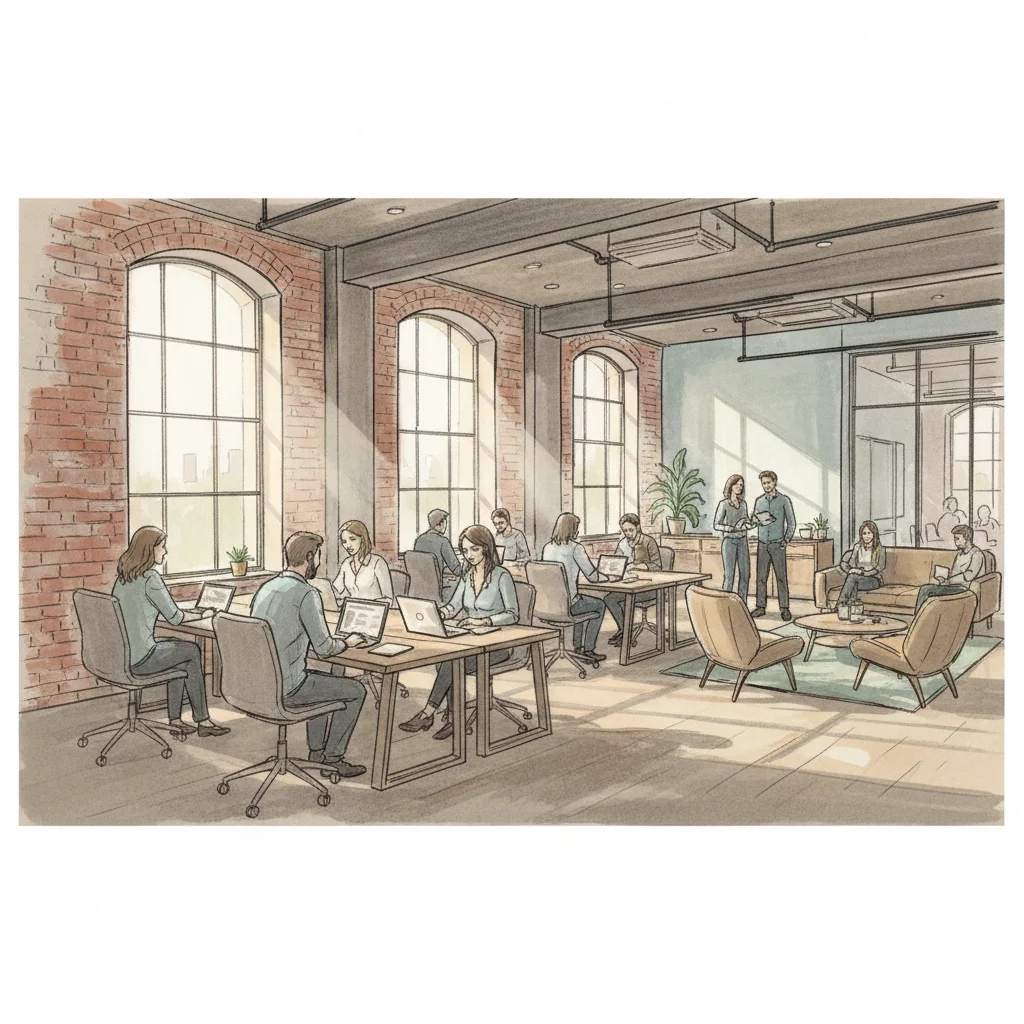
The best neighborhood for office space in Boston depends on your industry, team size, and commute priorities, with the Seaport and Financial District leading for enterprise tenants and Cambridge dominating life sciences.
Choosing the right submarket isn't just a real estate decision. It affects your ability to recruit talent, the commute experience for your team, and how much you pay per square foot. Each of Boston's major office corridors has a distinct identity.
Financial District: The traditional core of Boston's office market. Dense, transit-accessible, and home to financial services, law firms, and professional services. Buildings like those listed by Cabot & Company in this corridor offer full-service amenities and strong MBTA connections [6]. Rents are high, but so is the talent pool.
Seaport/Innovation District: Boston's fastest-growing office submarket over the past decade. Waterfront views, modern glass buildings, and a tech-forward tenant mix. Life sciences, biotech, and software companies dominate. Amenity-rich with restaurants and hotels, but parking is expensive and some MBTA connectivity gaps remain.
Back Bay: Prestigious and walkable, with Newbury Street retail and easy Amtrak/commuter rail access at Back Bay Station. Popular with consulting firms, media companies, and professional services. Rents are comparable to the Financial District but the neighborhood has a more residential feel.
Cambridge (Kendall Square and East Cambridge): Arguably the most competitive submarket in Greater Boston. MIT and Harvard proximity drives demand from biotech, pharma, and venture-backed startups. CIC Boston offers flexible coworking and private offices here, serving the innovation community [7]. Rents regularly exceed $70/sq ft for lab-enabled space.
South End and Midtown: More affordable Class B stock, increasingly popular with creative agencies, nonprofits, and professional firms seeking character-rich space. Good walkability and restaurant scene. Lower rents make this attractive for companies watching their real estate spend carefully.
Pro Tip: Before signing any lease, map your employees' home zip codes against each submarket's transit access. A Financial District office with poor Red Line access could add 30+ minutes to the commute for a large portion of your team, directly impacting in-office attendance rates.
Optimizing office space in Boston for hybrid work requires combining accurate attendance forecasting with flexible real estate strategies to avoid paying for space your team doesn't consistently use.
This is the core challenge facing corporate real estate leaders right now. Boston office utilization rates in 2026 hover between 30–50% on average, consistent with national trends. That means most companies are paying for significantly more space than their teams actually occupy on any given day.
Industry analysts at JLL note that hybrid work has fundamentally altered space demand patterns, with JLL's Boston listings reflecting a market where tenants increasingly prioritize quality over quantity [8]. The shift isn't just about fewer desks. It's about designing space that justifies the commute.
A SaaS company with a 200-person Boston team recently faced a familiar scenario: their 15,000 sq ft Seaport lease was up for renewal, but badge data showed average daily occupancy of only 60–80 people. They were paying for roughly twice the space they needed. Without reliable attendance forecasting, their options felt binary: renew at full size (expensive) or downsize and risk crowding on high-attendance days.
This is exactly where AI-powered workplace optimization changes the equation. Upflex's UnifyAI engine forecasts office attendance with 97% accuracy, giving corporate real estate leaders the data confidence to right-size their lease decisions. Rather than guessing, you know which days require 150 desks and which days need 60.
At Upflex, we've found that Boston-based enterprise clients consistently underestimate how much utilization data changes their lease negotiating position. Landlords respond differently when you walk in with 12 months of attendance analytics rather than a gut feeling about headcount.
Pro Tip: Don't wait for your lease renewal to start measuring utilization. Start collecting attendance data 18–24 months before your renewal date. That's the window where data-driven decisions can genuinely shift your negotiating leverage with Boston landlords.
The most common mistakes when leasing office space in Boston include over-sizing the footprint based on headcount projections rather than actual utilization data, and underestimating total occupancy costs beyond base rent.
These errors are expensive. Boston rents are high enough that a 20% overestimate on required square footage can cost a mid-sized company $500,000 or more over a five-year lease term. Here are the pitfalls that show up most consistently.
Research from Cushman & Wakefield consistently shows that tenants who engage in thorough market analysis and work with experienced advisors negotiate materially better lease terms than those who approach the market reactively [1].

The best practice for managing office space in Boston in 2026 is to combine a right-sized core lease with flexible workspace access and AI-driven attendance coordination to maximize utilization and minimize wasted spend.
The companies getting this right aren't just negotiating better leases. They're fundamentally rethinking how office space functions in a hybrid model. Here's what that looks like in practice.
The Core-Plus-Flex model is the most widely adopted framework for hybrid real estate in 2026. The principle is straightforward:
This model is documented to produce real results. Enterprises using Upflex's workplace optimization platform have reduced real estate spend by 40%+ while maintaining 88% co-attendance achievement for their teams. That's not a trade-off between cost and culture. It's both, simultaneously.
For companies exploring flexible options, providers like Regus offer multiple Boston locations including 75 State Street, 101 Arch Street, and 101 Federal Street [9]. These can serve as flex nodes in a broader Core-Plus-Flex strategy.
Our team at Upflex recommends treating your Boston office not as a fixed cost to minimize, but as a dynamic asset to optimize. The companies that do this well use data, not intuition, to make every square foot earn its keep.
Office space in Boston averages approximately $39–$41 per square foot annually, according to current market data from LoopNet and CommercialCafe. Class A space in premium submarkets like the Seaport or Kendall Square can reach $65–$75/sq ft, while Class B space in neighborhoods like the South End may be available from $28/sq ft. Total occupancy cost, including operating expenses, is typically 15–25% higher than the base rent figure.
The best neighborhood depends on your industry and priorities. The Financial District and Back Bay suit professional services and finance firms. The Seaport and Innovation District attract technology and life sciences companies. Cambridge's Kendall Square is the top choice for biotech and university-adjacent tenants. The South End and Midtown offer more affordable Class B options for growing companies watching their real estate spend.
Yes, flexible and coworking this practice is an excellent option for hybrid teams, particularly as a supplement to a smaller core lease. Coworking memberships typically run $250–$600 per desk per month and include amenities, IT infrastructure, and meeting rooms without long-term commitment. For teams with unpredictable attendance patterns, pairing a core lease with on-demand workspace access through a platform like Upflex provides both cost efficiency and flexibility.
Traditional direct leases in Boston typically run 5–10 years for Class A space, with landlords often requiring longer terms for significant tenant improvement allowances. Class B leases may be available on 3–5 year terms. Serviced offices and managed workspaces offer monthly to 12-month agreements. As of 2026, many tenants are negotiating shorter initial terms with renewal options, or insisting on contraction rights that allow footprint reduction mid-lease.
Class A this method refers to premium, modern buildings with high-end finishes, full-service amenities, strong building management, and excellent transit access. Class B buildings are functional and well-maintained but older, with fewer amenities and lower rents. Class C represents the oldest and most basic inventory, often requiring significant renovation. Most enterprise tenants target Class A or B space, with the choice often driven by budget constraints and brand positioning priorities.
Reducing office space costs in Boston starts with measuring actual utilization rather than allocating space based on headcount. Deploying AI-powered attendance forecasting, like Upflex's UnifyAI platform, lets you right-size your lease to actual demand. Supplementing with on-demand workspace access for peak days eliminates the need to pay for overflow space year-round. Upflex clients have documented 40%+ reductions in real estate spend using this combined approach.
Using a tenant representation broker is strongly recommended for leasing this strategy. Tenant rep brokers work exclusively for the tenant, not the landlord, and their commission is paid by the building owner, so there's no direct cost to you. They provide market comparables, negotiate lease terms, and identify incentive packages including tenant improvement allowances and free rent periods that most tenants wouldn't secure on their own.
In 2026, the amenities that most influence employee in-office attendance include high-quality food and beverage options, fitness facilities, outdoor terraces, conference and event spaces, and reliable high-speed internet infrastructure. Buildings with strong transit proximity (MBTA subway or commuter rail) consistently outperform car-dependent locations for hybrid attendance rates. Wellness amenities, bike storage, and shower facilities have also become standard expectations for top-tier Boston office buildings.
The Boston office market in 2026 is more nuanced than a simple cost-per-square-foot calculation. this approach spans a wide spectrum from premium Class A towers in the Seaport to affordable Class B suites in the South End, with flexible and on-demand options filling the gaps for hybrid teams. The companies making the smartest real estate decisions aren't just finding better buildings. They're using data to understand exactly how much space they need, on which days, and in which locations.
That's where workplace optimization becomes a genuine competitive advantage. When you combine accurate attendance forecasting with a flexible workspace strategy, you stop paying for empty desks and start investing in the in-person experiences that actually drive team performance. Upflex brings together AI-powered office orchestration and access to a global on-demand workspace network to give corporate real estate, finance, and HR leaders the tools to make those decisions with confidence, not guesswork.
Whether you're negotiating a lease renewal in the Financial District or building a hybrid policy for a distributed Boston team, the right data and the right platform make all the difference.
Explore more from our content library: