Share This Article
No items found.


Office space in Toronto ranges from premium downtown towers to flexible coworking desks, with lease rates averaging above $42 per square foot and climbing past $50 in core submarkets [1]. The city is Canada's largest commercial real estate market, and as of 2026, hybrid work has fundamentally reshaped how enterprises think about their Toronto footprint. Whether you're signing a long-term lease, exploring on-demand options, or right-sizing a portfolio under CFO pressure, understanding the market is the first step to making a decision you won't regret.
Office space in Toronto refers to commercial real estate leased or licensed for business use across the city's diverse neighborhoods, from the Financial District to Liberty Village to the emerging East End.
Toronto's office market is one of the most active in North America. The city hosts over 2,100 listed office spaces for lease at any given time [2], spanning traditional Class A towers, boutique mid-rise buildings, serviced office suites, and shared coworking environments. The Financial District along Bay Street anchors the premium end of the market, while neighborhoods like King West, Liberty Village, and Midtown offer a broader range of price points and building types.
The market segments broadly into three categories:
Toronto's office vacancy rate has been elevated since the pandemic-era shift to hybrid work, creating a buyer's and tenant's market in many submarkets. According to Cushman & Wakefield, rental rates vary widely depending on location, size, and amenities, and competition for the best-located, best-amenitized space remains fierce even as overall availability has increased [3].
For corporate real estate leaders, this creates both opportunity and complexity. There's more negotiating leverage than a decade ago, but the decision about how much space to commit to, and for how long, has never been harder to get right.
Pro Tip: Before touring any Toronto office space, pull your actual badge-swipe or desk utilization data for the past 12 months. Most enterprises discover they're using 40-60% of their leased space on peak days. That number should anchor every square footage conversation with a landlord.
Toronto offers five distinct office space formats, each suited to different team sizes, budget constraints, and flexibility requirements.
Traditional leases give you control and customization. You design the space, brand it, and operate it on your terms. The tradeoff is commitment: terms typically run three to ten years, and breaking a lease early is expensive. For enterprises with stable headcount projections and a strong cultural reason to have a dedicated space, this still makes sense.
Flexible options have matured significantly. Providers now offer:
| Submarket | Character | Typical Rate ($/sqft/yr) | Best For |
|---|---|---|---|
| Financial District | Class A towers, Bay Street prestige | $50–$70+ | Finance, law, enterprise HQ |
| King West / Entertainment District | Creative, tech-forward, mixed-use | $40–$55 | Tech companies, agencies, scale-ups |
| Liberty Village | Industrial-chic, startup ecosystem | $30–$45 | Startups, creative teams |
| Midtown (Yonge & Eglinton) | Professional services, residential adjacency | $35–$50 | Professional services, regional offices |
| North York / Scarborough | Suburban, value-oriented, accessible | $20–$35 | Cost-conscious teams, back-office functions |
According to New Office America's guide to Toronto, the city's office market ranges from high-end premium offices in downtown skyscrapers to innovative coworking spaces in creative districts, giving tenants genuine choice across budget levels [9].
The average asking rent for office space in Toronto exceeds $42 per square foot annually, with downtown core and premium submarkets pushing well above $50 [1]. Budgeting accurately requires understanding what's included and what isn't.
Most Toronto commercial leases are structured as net leases (also called TMI leases, for taxes, maintenance, and insurance). You pay a base rent plus your proportionate share of the building's operating costs. In a gross lease, the landlord bundles everything into one number. Serviced offices and coworking memberships are almost always gross, which makes budgeting simpler but typically costs more per square foot.
Here's a realistic cost breakdown for a 10-person team considering different formats:
| Space Type | Approx. Monthly Cost (10 ppl) | Commitment | Includes Fit-Out? |
|---|---|---|---|
| Traditional lease (Class B, downtown) | $8,000–$14,000 | 3–10 years | No (tenant improvement allowance may apply) |
| Serviced office suite | $10,000–$18,000 | 1–12 months | Yes, fully furnished |
| Coworking dedicated desks | $5,000–$9,000 | Month-to-month | Yes, shared amenities |
| On-demand / hot desking | $2,000–$5,000 | None (pay-as-you-go) | Yes, as needed |
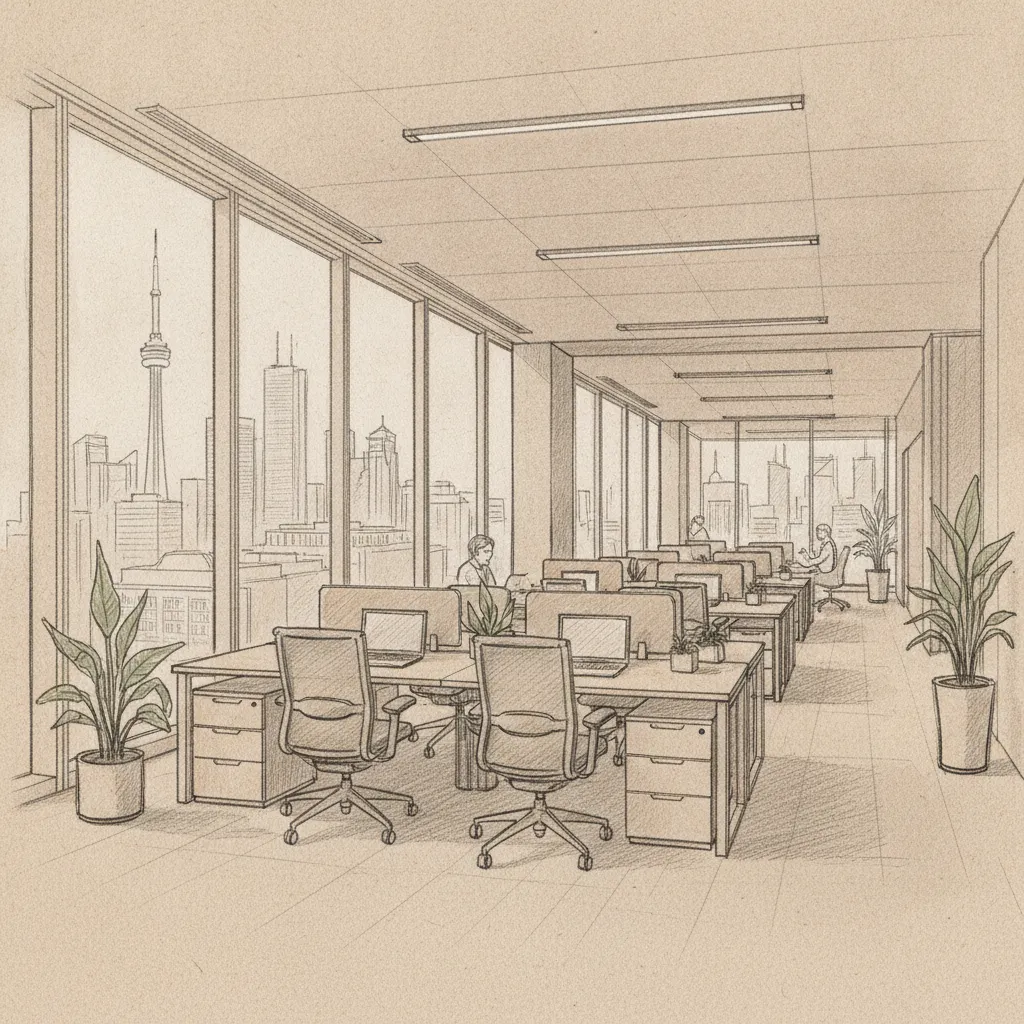
In practice, the sticker rate on a lease is rarely the full story. Watch for:
Industry analysts suggest that total occupancy cost (including fit-out amortization, operating costs, and services) often runs 30-40% above the headline rent figure. Listing platforms like LoopNet and Zolo are useful starting points for benchmarking asking rates across neighborhoods [10] [11].
Pro Tip: Ask every landlord for a 5-year total occupancy cost projection, not just base rent. Include estimated TMI, parking, and any known capital projects. This gives you a true apples-to-apples comparison across buildings and formats.
The most costly mistakes enterprises make with Toronto office space aren't about picking the wrong neighborhood. They're about committing to the wrong amount of space based on incomplete data.
A common mistake is sizing a lease based on headcount rather than actual utilization. In a hybrid work environment, peak-day attendance for most enterprises sits well below 70% of total headcount. A 200-person company signing for 200 workstations is almost certainly over-paying.
Research from the workplace optimization sector consistently shows that enterprises using AI-powered attendance forecasting, like the kind Upflex's UnifyAI engine delivers at 97% accuracy, make significantly more accurate space decisions than those relying on headcount ratios or historical badge data alone. The result: customers achieve 40%+ reductions in real estate spend without cutting the workplace experience.
Other common pitfalls include:
One pitfall to watch for is assuming that hybrid work means you need less space, full stop. The reality is more nuanced. You may need less individual workspace but more collaborative space, better meeting rooms, and more flexible configurations. Getting this balance wrong leads to offices that feel either empty or crowded depending on the day, and neither outcome serves your team well.
The Better Business Bureau's Toronto listings [12] and community marketplaces like Craigslist can surface smaller, more flexible options that traditional commercial brokers don't always present [13].
Managing office space in Toronto effectively in 2026 requires combining smart lease strategy with technology that gives you real-time visibility into how your space is actually being used.
The enterprises getting the most value from their Toronto office footprint share one common trait: they make decisions based on utilization data, not assumptions. Here's a practical framework for getting there:
Technology platforms that combine attendance forecasting, desk booking, and workspace network access are increasingly central to Toronto office strategy. The goal isn't just to manage space. It's to coordinate people so that the days your team comes in, they actually see each other.
Research from workplace management practitioners indicates that co-attendance, the metric measuring whether teammates are in the office on the same days, is more predictive of employee satisfaction with hybrid work than raw office quality. Platforms that automate co-attendance coordination, like Upflex's hybrid work orchestration tools, have helped enterprises achieve 88% co-attendance rates, a meaningful improvement over uncoordinated hybrid models.
Community-driven spaces like East Room in Toronto demonstrate that well-designed shared environments can serve both freelancers and enterprise teams effectively, offering a model for what flexible enterprise space can look like at its best [14].
Pro Tip: Don't manage your Toronto office in isolation from your broader real estate portfolio. If you have employees in other Canadian cities or traveling through Toronto, on-demand workspace access can replace satellite leases entirely, often at 60-70% lower cost than a dedicated lease.

Office space in Toronto averages just above $42 per square foot per year in asking rent, with downtown core and premium Financial District locations regularly exceeding $50 per square foot. Suburban submarkets like North York and Scarborough offer rates in the $20–$35 range. Serviced offices and coworking memberships are priced differently, typically on a per-desk or per-suite monthly basis, and often include operating costs in the headline figure.
The Financial District (Bay Street) is the traditional home of enterprise and professional services tenants. King West and the Entertainment District attract tech companies and creative agencies. Liberty Village is popular with startups. Midtown (Yonge and Eglinton) suits professional services firms that want proximity to residential areas. The best neighborhood for your team depends on commute patterns, budget, and the kind of environment that supports your culture.
It depends on your team size, growth trajectory, and hybrid work model. Traditional leases offer cost efficiency at scale and full customization, but require long-term commitment. Flexible and coworking options cost more per square foot but eliminate fit-out costs, reduce commitment risk, and scale up or down quickly. Many enterprises in 2026 use a hybrid approach: a smaller traditional lease for their core team, supplemented by on-demand workspace access for distributed or traveling employees.
Sublease space is office space that an existing tenant is offering to another company for the remainder of their lease term. It's often move-in ready and fully furnished, and typically priced below direct market rates because the original tenant is motivated to offset their ongoing rent obligation. Sublease terms are usually shorter than direct leases, which can be an advantage for companies that want flexibility. The main risk is that the term ends when the head lease expires, which may not align with your needs.
For small teams (1–20 people), the most efficient options are serviced office providers, coworking spaces with private office suites, and sublease listings. Platforms like Deskpass, LiquidSpace, and LoopNet list small private offices across downtown Toronto neighborhoods. Community spaces like the Centre for Social Innovation also offer private offices in distinctive environments at competitive rates.
Hybrid work typically reduces peak-day attendance to 50–70% of total headcount, which means most companies can operate effectively with significantly less dedicated workspace than a traditional 1:1 desk-to-employee ratio requires. The key is accurate attendance forecasting. Without reliable data on who's coming in and when, companies either over-commit on space (wasting money) or under-provision (frustrating employees). AI-powered platforms that forecast attendance with high accuracy help companies right-size their Toronto footprint with confidence.
Key provisions to scrutinize include: the TMI (taxes, maintenance, insurance) cap or estimate and how it escalates; any contraction, expansion, or termination rights; the tenant improvement allowance and any conditions attached; restoration obligations at lease end; subletting and assignment rights; and parking allocation and cost. Engaging a tenant representative broker familiar with the Toronto commercial market is strongly recommended, as they negotiate on your behalf at no direct cost to you.
Yes, significantly. Workplace optimization platforms combine desk booking, attendance forecasting, and utilization analytics to give corporate real estate leaders a real-time picture of how their this strategy is being used. This data directly informs lease decisions, space reconfiguration, and portfolio consolidation. Platforms that integrate AI-powered forecasting with on-demand workspace network access, like Upflex, allow enterprises to manage both their owned offices and external flex spaces from a single dashboard.
this approach is one of the most consequential cost decisions a corporate real estate leader makes. The market offers genuine options across formats, neighborhoods, and price points. But the difference between a smart decision and an expensive one usually comes down to data: how accurately you can forecast attendance, how well you understand your current utilization, and how much flexibility you've built into your commitments.
Enterprises that approach their Toronto office strategy with the same rigor they'd apply to any major capital decision, grounded in utilization data, informed by accurate attendance forecasting, and supplemented by flexible on-demand access, consistently outperform those that rely on headcount ratios and gut feel. The 40%+ real estate savings Upflex customers achieve aren't the result of cutting corners. They're the result of cutting waste.
If your Toronto office lease is coming up for renewal, or if you're questioning whether your current footprint still makes sense, start with the data. Upflex's AI-powered workplace optimization platform gives you the attendance forecasting accuracy and space management tools to make that decision with confidence.
Explore more from our content library: