Share This Article
No items found.


Office space rental rates are the per-square-foot costs businesses pay to lease commercial workspace, typically expressed as an annual figure ($/SF/YR) and then broken down into monthly payments. Rates vary significantly by market, building class, lease structure, and amenities. Understanding what drives these costs is the first step toward making smarter real estate decisions for your organization.
As of 2026, the national average asking rent for U.S. office space sits between $23 and $38 per square foot annually, depending on market tier and building quality. Data from CommercialCafe shows that Class A office space in Texas averaged $38.26 per square foot in 2024, while Class B came in at $24.71 per square foot [1]. Secondary markets like San Antonio offer significantly more affordable options, with CommercialSearch reporting an average of $26.70 per square foot across all classes [2]. The spread between premium and budget space is wide, and knowing how to navigate it can mean the difference between a lease that fits your strategy and one that drains your budget.
Office space rental rates represent the cost per square foot that a tenant pays to occupy commercial space, most commonly quoted on an annual basis and broken into monthly installments. They are the foundational metric in any commercial lease negotiation.
The standard format is $/SF/YR (dollars per square foot per year). A space listed at $30/SF/YR with 2,000 rentable square feet costs $60,000 annually, or $5,000 per month in base rent before any additional charges. Some landlords quote monthly ($/SF/MO), which you multiply by 12 to compare apples-to-apples with annual listings.
Beyond base rent, most leases include additional costs that can substantially raise your effective rate. The three dominant lease structures are:
According to guidance from the American Psychological Association's business services division, comparing the true all-in cost of a lease, not just the base rate, is essential before signing [3]. A gross lease at $35/SF may cost less than a NNN lease quoted at $28/SF once you factor in the pass-throughs.
Commercial real estate uses a Class A, B, and C classification system to signal building quality, location, and amenity level. This directly shapes office space rental rates:
| Building Class | Typical Rate Range ($/SF/YR) | Characteristics | Best For |
|---|---|---|---|
| Class A | $35 – $80+ | Premium locations, modern finishes, full amenities, on-site management | Headquarters, client-facing teams, talent attraction |
| Class B | $20 – $40 | Good locations, functional space, moderate amenities, older builds | Growing companies, back-office functions, regional offices |
| Class C | $10 – $22 | Older buildings, basic finishes, limited amenities, suburban or secondary locations | Budget-focused tenants, storage-heavy operations, startups |
| Flex / Coworking | $7/person/day – $500+/month/desk | Shared amenities, short-term commitments, all-inclusive pricing | Hybrid teams, distributed employees, project-based work |
Office space rental rates are shaped by a combination of location, lease term, building quality, and current market conditions. No single factor determines cost in isolation.
Geography remains the single biggest driver of price. Major gateway cities like New York, San Francisco, and Boston command the highest office space rental rates, often exceeding $70 to $100 per square foot annually for Class A space in central business districts. Secondary markets tell a very different story.
In San Antonio, for example, Cushman & Wakefield reports an average asking rent of $27.80 per square foot with a 16% vacancy rate as of 2026 [4]. LoopNet data puts the average even lower at approximately $23 per square foot [5]. These secondary market rates represent a compelling alternative for companies willing to locate teams outside of primary metros.
Micro-location within a city also matters. Central business district (CBD) space typically commands a 20 to 40% premium over suburban office parks in the same metro area. Proximity to transit, parking availability, and walkability to amenities all push rates up.
Longer lease terms generally produce lower effective rates. Landlords in markets with elevated vacancy (above 15%) are particularly willing to offer concessions in 2026, including:
Industry analysts at JLL note that in markets with vacancy rates above 18%, tenants hold significant negotiating leverage and should push for multiple concession types simultaneously. JLL's San Antonio listings reflect this dynamic, with a range of available spaces and incentive structures [6].
Pro Tip: Always negotiate the effective rate, not just the face rate. A lease at $35/SF with six months free rent and a $60/SF TI allowance can be cheaper over five years than a "lower" $30/SF lease with no concessions. Model the total occupancy cost across the full lease term before comparing options.
The format of your lease, not just the space itself, dramatically affects the true cost of office occupancy. Traditional long-term leases and flexible on-demand workspace operate on entirely different pricing models.
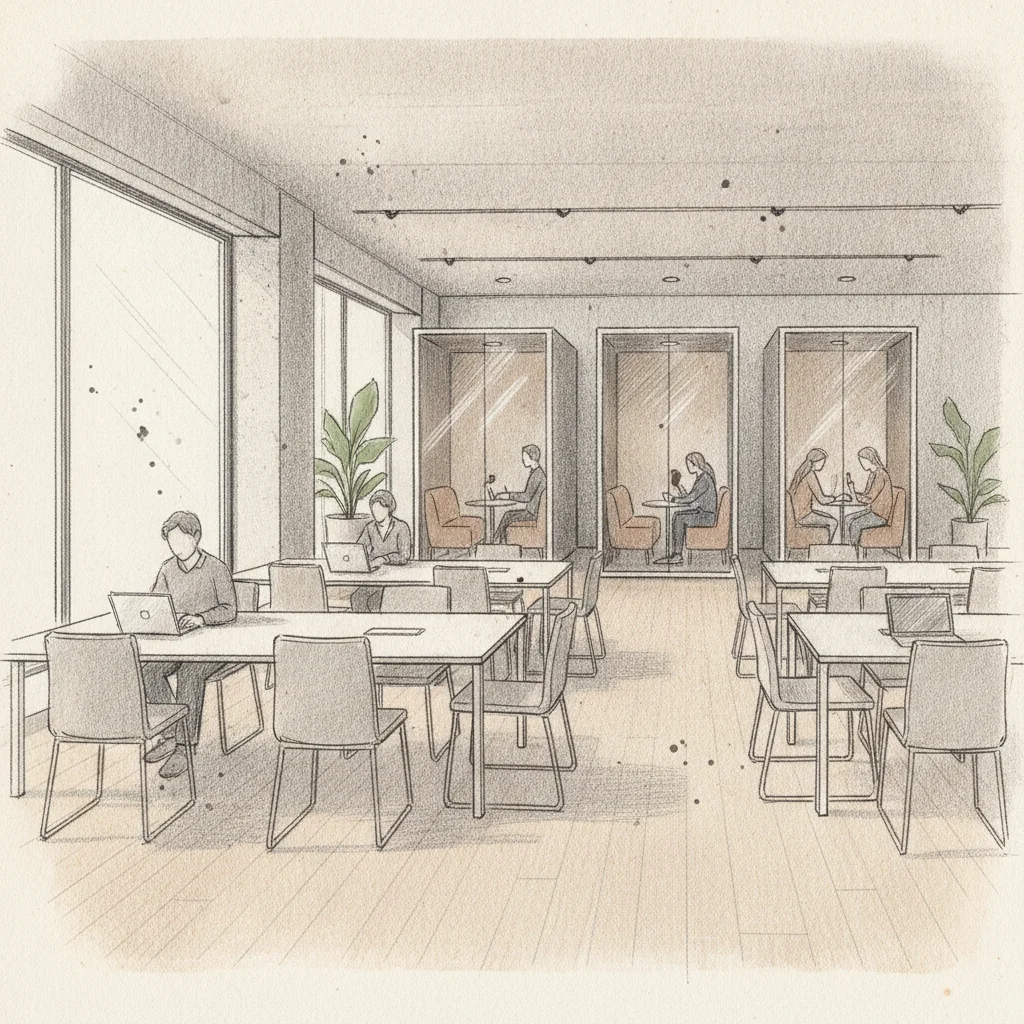
A traditional direct lease (typically three to ten years) offers price certainty and the ability to customize the space. You'll pay a negotiated rate per square foot, plus operating expenses under a NNN or modified gross structure. For a 2,500 SF space at $28/SF/YR NNN with $8/SF in pass-throughs, the all-in annual cost is $90,000, or $7,500 per month.
The challenge in 2026 is that hybrid work has reduced average office utilization to 30 to 50% in most enterprise portfolios. Paying for 2,500 square feet when your team occupies it two or three days per week means you're funding a significant amount of empty space. Research from real estate advisory firms consistently shows that enterprises are carrying 20 to 40% more space than their actual attendance patterns require.
Flexible workspace pricing operates on a per-person, per-day, or per-month model. Regus lists San Antonio office space starting from $7 per person per day on a 24-month agreement [7]. Hourly options through platforms like Peerspace start at $55 per hour [8], while LiquidSpace shows San Antonio hourly rates averaging $49, with private meeting rooms ranging from $38 to $54 per hour [9].
For distributed teams or hybrid workforces with unpredictable attendance, flexible workspace can reduce occupancy costs substantially. The trade-off is less control over the environment and potential cost spikes during high-demand periods.
| Workspace Format | Pricing Model | Commitment | Best Use Case |
|---|---|---|---|
| Traditional Lease (NNN) | $20–$80+/SF/YR + pass-throughs | 3–10 years | Stable headcount, HQ, branded space |
| Managed / Serviced Office | $400–$1,500/desk/month all-in | 1–24 months | Fast setup, small teams, project offices |
| Coworking Membership | $150–$600/person/month | Month-to-month | Distributed teams, individual contributors |
| On-Demand / Hourly | $7/person/day – $55+/hour | None | Occasional use, travel, overflow capacity |
Pro Tip: Don't treat your office lease and your flexible workspace budget as separate line items. The most cost-effective hybrid real estate strategy combines a right-sized core lease with on-demand workspace access for overflow and distributed employees. Platforms that unify both into a single portfolio view give you the data to optimize across the full spend.
The most costly errors in office leasing aren't about overpaying on the face rate. They're about misunderstanding the full cost structure and signing commitments that don't match actual usage patterns.
A common mistake is comparing leases purely on the quoted $/SF/YR rate. Two spaces can have identical base rents but wildly different all-in costs once you account for:
The APA's guidance on renting vs. buying office space specifically recommends modeling the full cost of occupancy across comparable properties before making a decision [3].
In practice, this is the most expensive mistake enterprise real estate teams make in 2026. With hybrid work driving average utilization to 30 to 50%, many organizations are paying for space that sits empty three to four days per week. A 10,000 SF lease at $35/SF costs $350,000 annually. If that space is occupied at 40% utilization, the effective cost per occupied square foot is closer to $87.50, not $35.
One pitfall to watch for: relying on badge swipe data or manual headcounts to estimate space needs. These inputs are lagging indicators. By the time you see the utilization data, you've already signed the lease. What you need is predictive attendance data, not historical averages.
At Upflex, we've found that organizations using AI-powered attendance forecasting to right-size their leases before signing can reduce committed real estate spend by 40% or more compared to teams that size space based on headcount alone. Upflex's UnifyAI engine forecasts who's coming in, on which days, with 97% accuracy, giving corporate real estate leaders the confidence to downsize or consolidate without sacrificing the employee experience.
Rental rate benchmarks vary enormously. Aquila Commercial's Austin market analysis shows parking alone can cost upwards of $200 per month per space, adding nearly $96,000 annually to a 40-person office's occupancy costs [10]. What's reasonable in San Antonio at $23/SF is dramatically different from what you'd pay in Austin, Dallas, or a coastal metro. Always benchmark against the specific submarket, not national averages.

The most effective approach to office space rental rates combines rigorous market analysis with real-time utilization data to make decisions that are defensible to both the CFO and the workforce.
Start with utilization data before you negotiate. The sequence matters:
Research from real estate advisory firms consistently shows that enterprises with formal space utilization measurement programs achieve 15 to 25% better lease economics than those relying on anecdotal estimates.
As of 2026, office vacancy rates in many U.S. markets remain elevated, giving tenants meaningful leverage. Some practical tactics:
Pro Tip: If your lease expires within 24 months, request utilization reports from your current space management system before entering negotiations. Showing a landlord that you're occupying 45% of your current space is the strongest argument for downsizing. If you don't have that data yet, start collecting it now.
$/SF/YR stands for dollars per square foot per year, the standard way office space rental rates are quoted in commercial leases. At $10/SF/YR on 2,500 rentable square feet, your annual base rent is $25,000, which equals $2,083.33 per month. However, if the lease is structured as a NNN (triple net), you'll also pay your proportionate share of property taxes, building insurance, and common area maintenance on top of that base. Always ask for the total estimated occupancy cost, not just the base rate, before signing.
As of 2026, average U.S. office space rental rates range from roughly $23 to $38 per square foot annually across all building classes, with wide variation by market. Class A space in gateway cities like New York or San Francisco can exceed $70 to $100/SF/YR, while secondary markets like San Antonio average $23 to $27/SF. Flexible and coworking space runs from $7 per person per day to $600 or more per desk per month, depending on location and amenities.
Small office space under $500 to $1,000 per month is most commonly found in Class C buildings, suburban office parks, shared executive suites, or coworking memberships in secondary markets. In San Antonio, for example, options are available starting from $7 per person per day through flexible workspace providers. Platforms like LoopNet, CommercialSearch, and office-hub.com list small private offices in the 100 to 500 SF range. Shared or serviced office arrangements often include utilities and internet, making them genuinely all-in at lower price points.
In a gross lease, the tenant pays one flat monthly amount and the landlord covers operating expenses including property taxes, insurance, and maintenance. In a NNN (triple net) lease, the tenant pays base rent plus their share of those three expense categories separately. NNN additions typically range from $5 to $15 per square foot annually. A gross lease offers cost predictability; a NNN lease can be cheaper in the base rate but carries variable expense risk. Always model the all-in annual cost for both structures before comparing them.
Class A buildings, typically newer or recently renovated with premium amenities and prime locations, command the highest this method, often $35 to $80+ per square foot annually. Class B buildings offer functional space in good locations at $20 to $40/SF, making them the most common choice for growing companies. Class C properties, older buildings with basic finishes and fewer amenities, range from $10 to $22/SF and suit budget-focused tenants. The right class depends on your client-facing needs, talent strategy, and budget constraints.
It depends entirely on how often your team actually uses the space. Hourly rates of $38 to $55 per hour add up quickly if used daily, easily exceeding a monthly lease at that volume. But for teams that only need a physical workspace a few days per month, on-demand hourly or daily pricing is significantly cheaper than committing to a monthly lease. The hybrid model that works best for most organizations in 2026 combines a right-sized core lease for regular team days with on-demand workspace access for overflow and distributed employees.
Beyond the base rent, the most impactful negotiating points are the tenant improvement allowance (TI), free rent periods, annual escalation rates, and flexibility provisions like expansion rights, contraction options, or early termination clauses. In markets with vacancy rates above 15%, landlords are generally open to all of these. A tenant-side broker with current transaction data is your strongest asset in these negotiations. Securing a $60/SF TI allowance or three months of free rent can often be worth more than a $2 to $3 per square foot reduction in the face rate.
this strategy in 2026 offer more flexibility than they have in years. Elevated vacancy in many markets, the normalization of hybrid work, and the maturation of flexible workspace options mean that corporate real estate leaders have genuine options, not just the traditional choice between signing a long lease or going without.
The organizations that manage this approach most effectively aren't just negotiating harder. They're making decisions with better data. They know their actual attendance patterns. They forecast demand before committing to square footage. And they treat their owned offices and flexible workspace access as a single, unified portfolio rather than separate budget lines.
That's exactly the approach Upflex is built to support. By combining AI-powered attendance forecasting through UnifyAI with access to the world's largest on-demand workspace network, Upflex gives corporate real estate and finance leaders the utilization data and workspace flexibility they need to right-size their real estate commitments with confidence. Customers achieve 40% or more in real estate spend reduction, and 88% co-attendance achievement, without mandating rigid schedules or signing leases they'll regret. If your next lease decision is approaching, the data you need to make it well is closer than you think.
Explore more from our content library: