Share This Article
No items found.

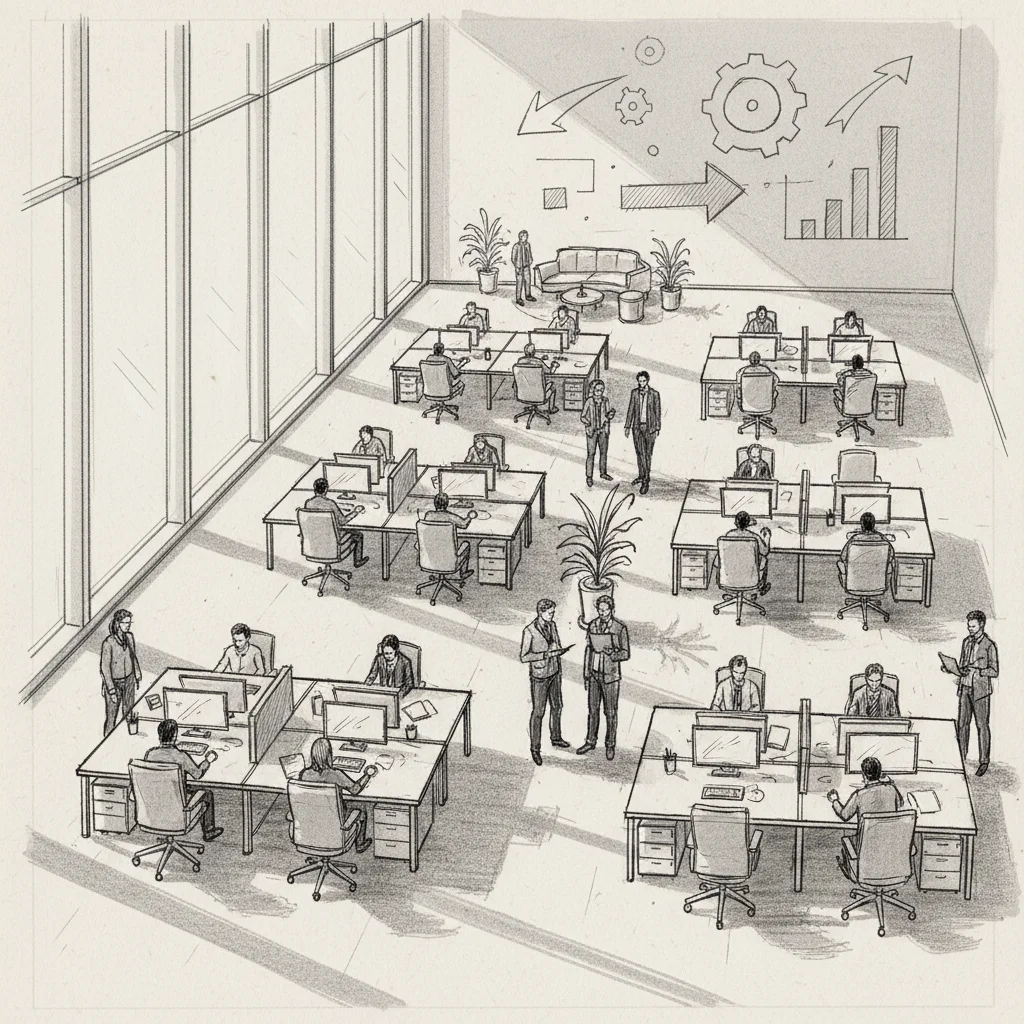
Facility management KPIs (key performance indicators) are the quantitative and qualitative metrics that tell you whether your buildings, teams, and vendors are delivering value against defined operational goals. Without them, you're making portfolio decisions on gut feel rather than data. And in 2026, with hybrid work reshaping how every square foot gets used, that's an expensive way to operate. According to the International Facility Management Association (IFMA), organizations that actively track and review KPIs consistently outperform those that don't on cost control, occupant satisfaction, and asset longevity [1]. This guide covers the 14 most important facility management KPIs, how to set targets for each, and how modern workplace platforms are changing what's measurable.
Facility management KPIs are standardized metrics used to evaluate the performance of physical workplaces, maintenance operations, and real estate portfolios against strategic objectives. They translate operational activity into business signals that executives can act on.
The stakes have risen sharply. Hybrid work has decoupled headcount from space demand, meaning a 500-person company might only need 60% of its pre-2023 footprint on any given day. Yet most organizations are still paying for 100% of it. Research published in the Construction Management and Economics journal confirms that without relevant, well-calculated KPIs, facility teams cannot systematically identify underperformance or justify investment decisions [2].
Facility costs typically rank as the second or third largest operating expense for an enterprise, behind payroll. That makes performance measurement not just an operational discipline but a financial imperative. A common mistake is treating KPIs as a reporting exercise rather than a decision-making tool. The data only creates value when it drives action.
The ISO/AWI 41020 Facility Management standard explicitly calls for KPIs to quantify performance and track progress against defined objectives [3]. This means your KPI framework isn't just a best practice; for organizations operating globally, it's part of recognized governance. Aligning your metrics to ISO 41020 gives your reporting credibility with auditors, boards, and external stakeholders.
Pro Tip: Don't launch with 20 KPIs at once. Start with five to seven metrics tied directly to your top business priorities, get clean data flowing, then expand. A KPI you can't measure accurately is worse than no KPI at all.
The most important facility management KPIs span six categories: maintenance, space utilization, financial performance, occupant experience, energy and sustainability, and safety. Here's a breakdown of each metric, what it measures, and what a healthy target looks like.
1. Work Order Completion Rate
This KPI measures the percentage of work orders completed within the agreed service level agreement (SLA) window. A strong benchmark is 90%+ completion within SLA. According to Limble's facility management research, work order resolution time is one of the most reliable indicators of internal process efficiency [4]. Low completion rates signal staffing gaps, poor prioritization, or inadequate CMMS (computerized maintenance management system) adoption.
2. Planned Maintenance Compliance (PMC)
PMC tracks the percentage of scheduled preventive maintenance tasks completed on time. Target: 85–95%. A high PMC ratio reduces emergency repairs, extends asset life, and lowers total maintenance spend. Omnia360 FM Solutions identifies the reactive-to-preventive maintenance ratio as one of the three most critical KPIs in facility management [5].
3. Mean Time to Repair (MTTR)
MTTR measures the average time required to restore a failed asset or system to full operation. It's calculated as total repair time divided by the number of repairs in a given period. Lower is better. MTTR above four hours for critical systems (HVAC, elevators, fire suppression) typically indicates a process or resourcing problem.
4. Backlog of Deferred Work Orders
This metric tracks maintenance tasks that have been delayed beyond their scheduled date. A growing backlog is a leading indicator of deferred capital expenditure risk. MRI Software lists deferred work order backlog as a top-ten facility management KPI precisely because it makes invisible financial risk visible [6].
5. Facility Condition Index (FCI)
The FCI, defined as the ratio of deferred maintenance costs to current replacement value, is one of the most widely used facility management KPIs for capital planning. Gordian describes it as measuring the "percent bad" within a facility [7]. An FCI below 0.10 (10%) is generally considered good; above 0.30 signals a facility in poor condition requiring significant investment.
6. Space Utilization Rate
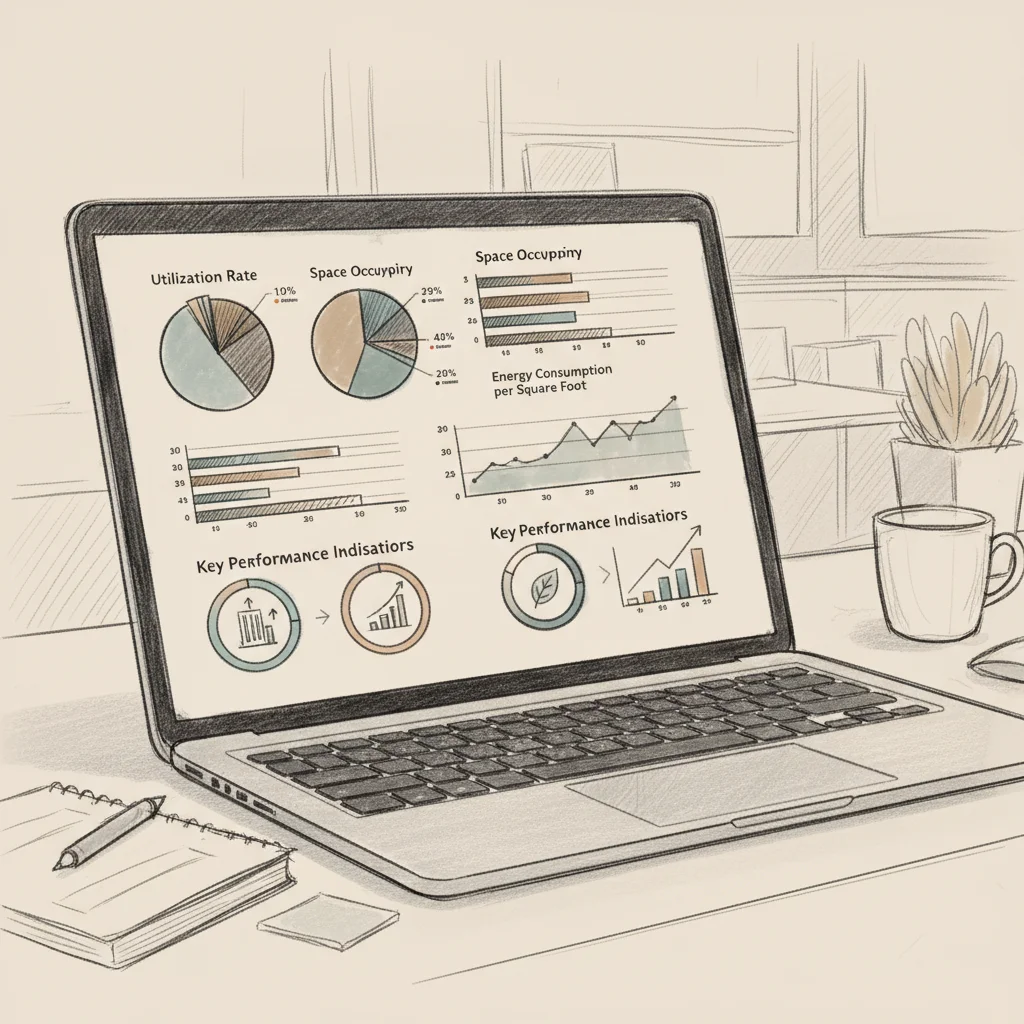
Space utilization rate measures the percentage of available workspace actually used during occupied hours. This is the KPI that hybrid work has made most urgent. A floor that shows 95% booking occupancy but only 55% actual desk usage is generating misleading data. Real utilization requires sensor data or badge-based tracking, not just booking records.
7. Cost per Square Foot
This financial KPI divides total facility operating costs by total managed square footage. It allows direct benchmarking against industry peers and tracks the efficiency of your real estate portfolio over time. FacilityONE identifies cost per square foot as a foundational financial metric for any FM program [8]. For hybrid portfolios, this number should be falling as you right-size.
8. Budget Variance
Budget variance compares actual facility spending against the approved budget, expressed as a percentage. A variance of +/- 5% is typically acceptable; anything beyond that requires investigation. Consistent overspend on utilities or reactive maintenance often points to underlying operational problems that other KPIs will surface.
9. Return on Investment (ROI) on Facility Improvements
This KPI measures the financial return generated by capital investments in facility upgrades, energy retrofits, or technology deployments. It's particularly important when justifying workplace technology purchases to CFOs. At Upflex, we've found that organizations tracking ROI on workplace investments are significantly more likely to secure budget approval for subsequent optimization initiatives.
10. Occupant Satisfaction Score
Measured through regular surveys, this KPI captures how employees and building occupants rate their workplace experience. Facilio's 2026 facility management KPI guide ranks occupant satisfaction as the top metric for FM teams focused on workplace experience [9]. Target scores above 4.0 out of 5.0. Low scores correlate with increased absenteeism and reduced productivity.
11. Energy Use Intensity (EUI)
EUI measures energy consumption per square foot per year, typically expressed in kBtu/sq ft/yr. It's the primary metric for benchmarking energy performance and tracking progress toward sustainability targets. Under ESG reporting frameworks like GRI 302, EUI is a required disclosure for many large enterprises as of 2026.
12. Carbon Footprint per Occupant
This sustainability KPI divides Scope 1 and Scope 2 greenhouse gas emissions by the number of building occupants. It's increasingly required by institutional investors and is now a standard component of corporate sustainability reporting. Tracking it at the portfolio level helps prioritize which buildings to retrofit or exit.
13. Safety Incident Rate
The safety incident rate tracks the number of recordable workplace incidents per 100 full-time employees, aligned with OSHA 300 log methodology. This KPI is non-negotiable from a legal and ethical standpoint. A rate above your industry benchmark should trigger immediate investigation of root causes.
14. SLA Compliance Rate
SLA (service level agreement) compliance rate measures the percentage of vendor and internal service commitments met within agreed timeframes across all facility services. ServiceChannel describes SLA compliance as a critical metric for evaluating both vendor performance and internal accountability [10]. Target 95%+ for critical services.
The table below summarizes all 14 facility management KPIs, their category, measurement method, and recommended 2026 benchmarks.
| # | KPI | Category | Measurement Method | 2026 Benchmark |
|---|---|---|---|---|
| 1 | Work Order Completion Rate | Maintenance | CMMS data | >90% within SLA |
| 2 | Planned Maintenance Compliance | Maintenance | CMMS / IWMS | 85–95% |
| 3 | Mean Time to Repair (MTTR) | Maintenance | Incident logs | <4 hrs (critical systems) |
| 4 | Deferred Work Order Backlog | Maintenance | CMMS data | Trending downward |
| 5 | Facility Condition Index (FCI) | Asset Management | Capital planning assessment | <0.10 (good) |
| 6 | Space Utilization Rate | Space | Sensors / badge data | 60–80% target |
| 7 | Cost per Square Foot | Financial | Finance / real estate data | Benchmark vs. peers |
| 8 | Budget Variance | Financial | Finance system | +/- 5% |
| 9 | ROI on Facility Improvements | Financial | Project tracking | Positive within 24 months |
| 10 | Occupant Satisfaction Score | Experience | Quarterly surveys | >4.0 / 5.0 |
| 11 | Energy Use Intensity (EUI) | Sustainability | Utility metering | Year-over-year reduction |
| 12 | Carbon Footprint per Occupant | Sustainability | GHG accounting | Aligned to net-zero roadmap |
| 13 | Safety Incident Rate | Safety | OSHA 300 log | Below industry average |
| 14 | SLA Compliance Rate | Vendor Management | Service management platform | >95% for critical services |
Hybrid work has fundamentally changed which facility management KPIs matter most, adding new metrics around attendance forecasting, co-attendance rates, and on-demand space utilization that simply didn't exist in traditional FM frameworks.
Consider a real-world scenario: a global financial services firm with 2,000 employees across four offices found that its traditional FM dashboard showed 85% desk booking rates. Sensor data told a different story: actual occupancy averaged 47%. The firm was paying for space it wasn't using, and its existing KPI set had no way to surface that gap. This is the problem hybrid work creates for teams still using pre-2022 performance frameworks.
Three metrics have become essential additions to any FM KPI framework in 2026:
Industry analysts at FMX note that proactive KPI tracking enables facility teams to set long-term goals and measure successes in ways that reactive reporting simply cannot [11]. The shift from lagging indicators (what happened) to leading indicators (what will happen) is the defining trend in FM performance management as of 2026.
Pro Tip: Pair your space utilization KPI with attendance forecast data, not just booking data. Bookings tell you what people intended; sensor-verified attendance tells you what actually happened. The gap between the two is where your real estate savings live.
Building an effective facility management KPI framework requires aligning metrics to business objectives, securing clean data sources, and establishing review cadences before you start reporting numbers.
A SaaS company we worked with recently made a common mistake: they launched a 22-KPI dashboard without first establishing data quality standards. Within 90 days, half the metrics were flagged as unreliable because source systems weren't integrated. The lesson: data infrastructure comes before KPI selection, not after.
According to peer-reviewed research on facility performance assessment, the chosen KPIs must be relevant to facility goals and must be systematically calculated, analyzed, and evaluated to drive meaningful improvement [13]. That sounds obvious. In practice, it's where most FM programs fall short.
Pro Tip: When presenting facility management KPIs to your CFO, always lead with financial impact. Frame space utilization as cost per occupied seat, not percentage utilization. Finance leaders respond to dollar figures, not operational percentages.
Choosing the right tools to track facility management KPIs determines whether your framework delivers real-time intelligence or a monthly spreadsheet nobody reads.
The tool landscape in 2026 spans four categories, each suited to different organizational maturities and budget levels.
| Tool Type | Best For | Key Advantage | Key Limitation |
|---|---|---|---|
| Excel / Google Sheets Template | Small FM teams, limited budget | Low cost, flexible | Manual, error-prone, not real-time |
| CMMS (e.g., Limble, Fiix) | Maintenance-heavy operations | Automated work order tracking | Limited space/financial KPIs |
| IWMS (e.g., Archibus, Planon) | Large, complex portfolios | Integrated across FM functions | Rigid, slow to adapt to hybrid work |
| Workplace Optimization Platform (e.g., Upflex) | Hybrid enterprises, multi-site | AI forecasting + utilization + flex space in one platform | Focused on hybrid work use cases |
For organizations managing hybrid portfolios, the most significant gap in traditional IWMS tools is the inability to forecast attendance and coordinate co-presence. That's where AI-powered workplace optimization platforms add measurable value. The IFMA consistently emphasizes that FM teams need tools that generate actionable intelligence, not just historical reports [1].
Our team at Upflex recommends starting with a free Excel-based KPI template to establish baselines, then migrating to an integrated platform once your data sources are clean and your KPI set is stable. Jumping straight to a complex platform before you've defined your metrics often results in a system that tracks the wrong things very efficiently.

Facility management KPIs are quantifiable metrics used to evaluate how effectively a facility team, building portfolio, or vendor network is performing against defined operational and strategic goals. They convert raw activity data (work orders completed, energy consumed, square footage occupied) into business signals that support decisions on maintenance investment, real estate consolidation, and service delivery. Unlike general performance metrics, facility management KPIs are tied to specific FM domains: maintenance efficiency, space utilization, financial performance, occupant experience, sustainability, and safety.
The five most universally tracked facility management KPIs are: (1) Work Order Completion Rate, which measures maintenance responsiveness against SLA commitments; (2) Space Utilization Rate, which tracks how efficiently occupied workspace is being used; (3) Cost per Square Foot, the primary financial efficiency benchmark; (4) Occupant Satisfaction Score, measuring the quality of the workplace experience; and (5) Planned Maintenance Compliance, which tracks the ratio of preventive to reactive maintenance. In hybrid work environments, Attendance Forecast Accuracy is rapidly becoming a sixth essential metric.
Facilities management performance indicators span six core domains: (1) Overall facility condition, measured by the Facility Condition Index (FCI); (2) Occupant and customer experience, measured through satisfaction surveys and SLA compliance; (3) People and operational performance, tracked via work order completion rates and planned maintenance compliance; (4) Financial performance, including cost per square foot and budget variance; (5) Sustainability, measured by Energy Use Intensity and carbon footprint per occupant; and (6) Safety, tracked through OSHA-aligned incident rates. A comprehensive FM KPI framework draws from all six areas simultaneously.
For facility management teams specifically, the seven most actionable performance metrics are: Work Order Completion Rate, Mean Time to Repair (MTTR), Planned Maintenance Compliance, Space Utilization Rate, Cost per Square Foot, Occupant Satisfaction Score, and SLA Compliance Rate. These seven cover the full operational spectrum from asset management to financial efficiency to service quality. In 2026, hybrid-work-focused FM teams should add Attendance Forecast Accuracy as an eighth metric to support real estate portfolio decisions.
An SLA (service level agreement) in facility management is a contractual or internal commitment defining the expected response time, quality standard, or completion rate for a specific service, such as HVAC repair, cleaning, or security response. KPIs measure actual performance against SLA commitments. SLA Compliance Rate (the percentage of services delivered within agreed parameters) is itself one of the most important facility management KPIs, particularly for organizations managing outsourced FM contracts where vendor accountability is critical.
A practical facility management KPI template should include six columns for each metric: KPI name, category (maintenance/space/financial/sustainability/safety), data source, current baseline, target value, and review frequency. Start with 7–10 KPIs mapped to your top three business objectives. Use Excel or Google Sheets to build your initial template, ensuring each KPI has a named owner and a defined data pull process. Once baselines are established over 60–90 days, set improvement targets using industry benchmarks from IFMA or sector-specific peer data.
this strategy are the difference between managing a building and managing a business asset. The 14 metrics covered in this guide span every dimension of FM performance, from maintenance efficiency and asset condition to space utilization, financial return, sustainability, and occupant experience. None of them operate in isolation. A low occupant satisfaction score often traces back to poor MTTR. A high cost per square foot usually reflects poor space utilization. The metrics are connected, and your framework should reflect that.
The most significant shift in 2026 is the addition of hybrid-work-specific KPIs, particularly attendance forecast accuracy and co-attendance rates, that traditional FM platforms weren't built to measure. Upflex addresses this gap directly. The platform's UnifyAI engine delivers 97% attendance forecast accuracy, automates workplace coordination, and gives corporate real estate leaders the utilization data they need to make confident portfolio decisions. Clients achieve 40%+ reductions in real estate spend while maintaining 88% team co-attendance rates, metrics that satisfy both the CFO and the CHRO simultaneously.
Start with five to seven KPIs, get your data sources clean, and build from there. The organizations that treat this approach as a living decision-making system rather than a static reporting exercise are the ones consistently outperforming their peers on cost, experience, and sustainability.
Explore more from our content library: