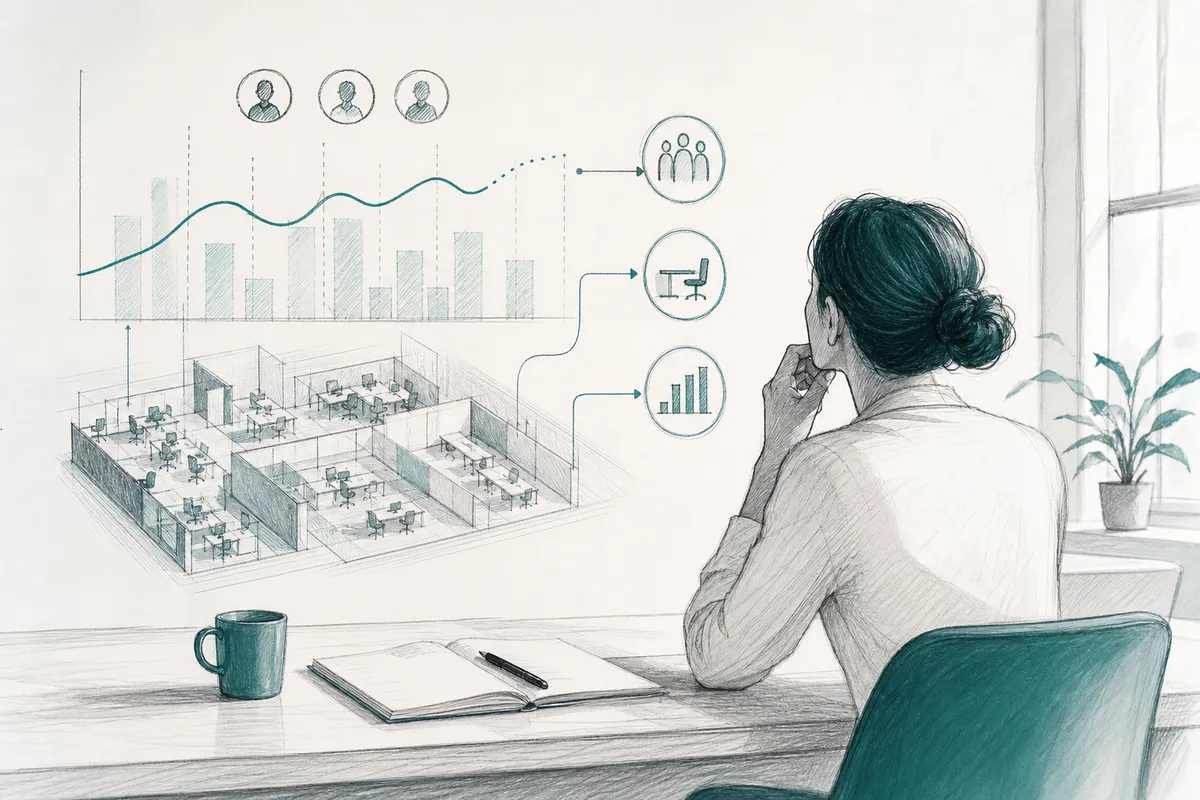
Share This Article
No items found.

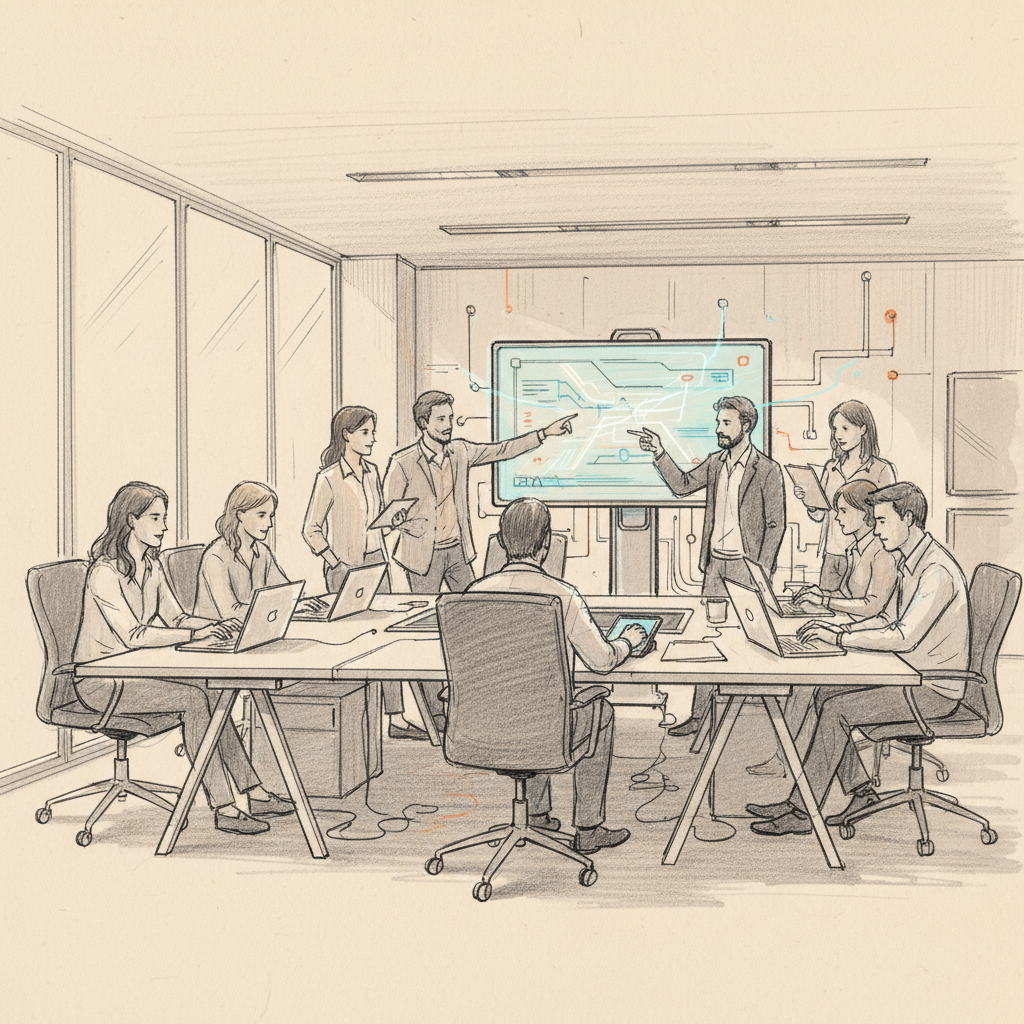
Workplace collaboration technology is the category of tools, platforms, and AI-powered systems that enable employees to communicate, coordinate, and produce work together, regardless of physical location. It spans everything from video conferencing and shared document editors to intelligent attendance forecasting and on-demand workspace networks. For enterprises running hybrid teams across multiple offices or countries, getting this technology stack right isn't optional. It directly determines whether your real estate spend is justified, whether your teams actually connect in person, and whether your workforce stays productive between office visits.
This guide covers what workplace collaboration technology actually includes in 2026, how it works at a mechanical level, which benefits are real versus overhyped, and what separates organizations that get measurable results from those that pile on tools without improving outcomes.
Workplace collaboration technology refers to any digital tool or integrated platform that helps employees work together more effectively, whether they're in the same room, across the building, or in different time zones.
At its core, workplace collaboration technology is software and hardware designed to remove friction from coordinated work. That friction shows up in many forms: missed context when someone works remotely, empty conference rooms that were booked but never used, teams that can't align on which days to come in, and managers who can't forecast whether a floor will be at 20% or 80% capacity on any given Tuesday.
According to the Digital Workplace Group, digital workplace collaboration enables teams to communicate and work together across different locations by integrating communication, knowledge management, and workflow tools into a coherent environment [1]. That's a useful framing, but it undersells the operational layer. Modern workplace collaboration technology isn't just about communication. It's about coordination, and increasingly, prediction.
As of 2026, the category includes six distinct technology types:
The University of Pennsylvania's Lifelong Learning program notes that virtual collaboration tools are now essential for consultants, startups, and large organizations alike, with adoption accelerating sharply since 2022 [2]. The challenge isn't access to tools. It's selecting the right combination and integrating them so they reinforce rather than duplicate each other.
| Technology Type | Primary Function | Example Tools | Hybrid Work Relevance |
|---|---|---|---|
| Synchronous Communication | Real-time meetings and calls | Zoom, Teams, Google Meet | High |
| Asynchronous Communication | Messaging, document sharing | Slack, Notion, Google Docs | High |
| Project Management | Task tracking, workflow automation | Asana, Jira, Monday.com | Medium-High |
| Workplace Management | Desk booking, space analytics | Upflex, Robin, Envoy | Critical |
| On-Demand Workspaces | Flexible access to external offices | Upflex Network | Critical |
| AI Orchestration | Attendance forecasting, automation | Upflex UnifyAI | Emerging, high-impact |
Workplace collaboration technology works by capturing data about how, when, and where employees work, then using that data to coordinate communication, space, and schedules more efficiently.
Most platforms begin with inputs: calendar data, badge swipes, desk booking records, meeting room usage, and employee scheduling preferences. These inputs feed into a central system that surfaces patterns. Which teams tend to come in together? Which floors are consistently underused? Which employees are traveling between offices and need flexible workspace access?
Microsoft's research on collaboration tools identifies five core technology types that improve productivity: video conferencing, cloud storage, project management software, communication platforms, and AI-assisted scheduling [3]. What's changed in 2026 is that these layers are increasingly integrated rather than siloed. A modern workplace management platform doesn't just show you where people sat yesterday. It tells you who's coming in tomorrow and coordinates their teams accordingly.
The most significant development in workplace collaboration technology over the past two years is the emergence of AI-powered orchestration. This is the layer that moves the category from reactive (showing you what happened) to predictive (telling you what will happen and automating the response).
Upflex's UnifyAI engine is a practical example of this shift. It processes scheduling inputs and behavioral data to forecast office attendance with 97% accuracy. That forecast then drives automated coordination recommendations: which teams should plan in-office days together, how many desks to activate on a given floor, and whether employees in satellite locations need access to the on-demand workspace network. The result is a system that achieves 88% co-attendance rates without requiring managers to manually coordinate schedules.
Pro Tip: Don't evaluate collaboration platforms in isolation. The real test is whether your workplace management software can share data with your communication and scheduling tools. Platforms that don't integrate force your team to manually reconcile information across systems, which defeats the purpose.
Research published in PLOS ONE examining virtual workplace environments found that the mode of collaboration (physical presence, video conferencing, or immersive environments) significantly affects both collaboration quality and cognitive load for participants [4]. This reinforces why the physical and digital layers of workplace collaboration technology need to be designed together, not treated as separate problems.
The right workplace collaboration technology stack delivers measurable improvements across four dimensions: productivity, real estate cost, employee experience, and organizational decision-making.

The productivity case for collaboration technology is well-documented. According to research cited by Harvard Business Review, matching the right collaboration tool to the right type of work task is the key variable, and most organizations systematically get this wrong by defaulting to synchronous tools (meetings, video calls) for work that would be better handled asynchronously [5].
For hybrid teams specifically, the productivity gains from good workplace collaboration technology come from three sources:
This is where workplace collaboration technology delivers its most financially significant impact. Most enterprises are paying for significantly more office space than they actually use on any given day. Industry analysts estimate that average office occupancy in hybrid environments runs between 40% and 60% of capacity, meaning organizations are effectively paying double for the space they need.
Workplace management platforms that provide accurate utilization data enable corporate real estate leaders to make defensible consolidation decisions. Upflex customers have reduced real estate spend by 40% or more by using utilization data to right-size their portfolios, supplementing reduced owned office space with on-demand workspace network access for employees who need flexibility.
The Engage for Success research organization notes that technology-enabled coordination directly supports employee engagement and reduces the friction that causes employees to avoid the office entirely, creating a virtuous cycle where better-utilized space justifies its cost [6].
Pro Tip: When presenting a real estate consolidation case to your CFO, lead with utilization data from your workplace management platform, not anecdotal observation. A 97% accurate attendance forecast gives you a defensible basis for reducing your footprint that badge data and meeting room logs can't match.
Most organizations that struggle with workplace collaboration technology make one of three predictable mistakes: they over-invest in communication tools while under-investing in coordination infrastructure, they treat the physical and digital workplace as separate problems, or they deploy platforms without a change management plan.
Tool sprawl (the accumulation of overlapping platforms that don't share data) is the most common failure mode. A company might use Slack for messaging, Zoom for video, Asana for project management, a legacy IWMS for desk booking, and a separate system for visitor management, none of which are integrated. Employees end up context-switching constantly, and workplace managers can't get a consolidated view of how space is being used.
According to Scalable.com's analysis of collaborative platform implementations, a structured and systematic implementation plan is essential because the sophistication of modern platforms creates significant adoption risk when organizations skip the integration design phase [7]. In practice, this means mapping your existing tool landscape before adding new platforms, not after.
A common mistake we see at Upflex is organizations that deploy a desk booking tool and expect it to solve their hybrid coordination problem. Desk booking tells you where someone sat. It doesn't tell you who's coming in tomorrow, whether their team will be there, or whether it's worth the commute. That requires an AI forecasting layer on top of the booking infrastructure.
Many technology leaders treat collaboration technology as a purely digital problem. They invest in communication platforms but leave the physical workspace unmanaged. The result is a familiar scenario: employees come in on different days, miss their teams, have a poor experience, and stop coming in altogether. The office becomes a cost center with no demonstrable value.
The LumApps framework for digital workplace collaboration identifies eight distinct collaboration types, from cross-functional teams to communities of practice [8]. Each requires a different combination of digital tools and physical space configuration. Organizations that design for only one dimension consistently underperform on both.
Organizations that get the most from their this share a set of common practices: they integrate the physical and digital layers, they use AI to move from reactive to predictive coordination, and they measure outcomes rather than tool usage.
Most enterprises already have adequate communication tools. The unsolved problem in 2026 is coordination: getting the right people in the right place at the right time without rigid mandates. The technology stack should be built to solve that specific problem first.
Industry analysts at Innovecs note that the right collaboration technology stack depends heavily on an organization's current maturity level, with early-stage hybrid programs needing different tooling than mature, data-driven workplace optimization programs [9].
At Upflex, we've found that the most successful implementations start with a clear baseline: utilization data from the existing office environment, a defined co-attendance target, and executive alignment on the real estate outcome they're trying to achieve. Technology selection follows from those inputs, not the other way around.
Pro Tip: Set a co-attendance target before you select a workplace management platform. A target like "85% of team members in the office on the same day at least twice per week" gives you a concrete benchmark to evaluate whether your collaboration technology is actually working, and it gives the CFO a number to hold you accountable to.
The GSA's Technology Transformation Services handbook for collaboration tools emphasizes that tool selection should be driven by the specific work tasks and team structures involved, not by market popularity or vendor relationships [10]. This is sound guidance. The Slack-versus-Teams debate matters far less than whether your workplace management platform integrates with your HR and calendar systems.
| Maturity Stage | Primary Challenge | Recommended Technology Focus | Key Metric |
|---|---|---|---|
| Early Hybrid (0-12 months) | Basic communication and desk access | Communication platforms + basic desk booking | Occupancy rate |
| Developing (1-2 years) | Unpredictable attendance, poor co-attendance | Attendance forecasting + space analytics | Co-attendance rate |
| Optimizing (2-3 years) | Real estate cost vs. utilization mismatch | AI orchestration + on-demand workspace network | Real estate cost per seat |
| Mature (3+ years) | Portfolio consolidation and global coordination | Integrated workplace optimization platform | Total real estate spend reduction |
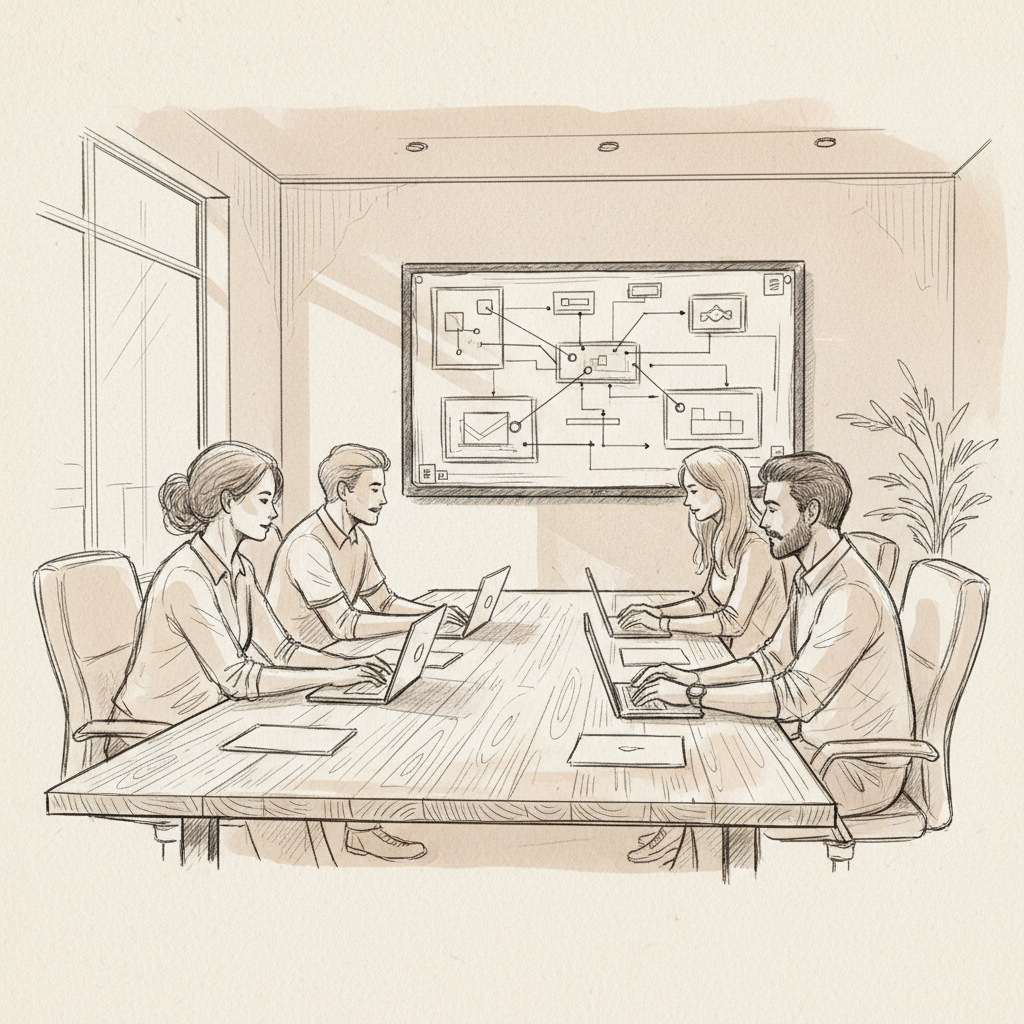
it is the category of digital tools and platforms that help employees communicate, coordinate, and complete work together across different locations and schedules. It includes communication software, project management tools, desk booking systems, AI-powered attendance forecasting platforms, and on-demand workspace networks. In 2026, the most advanced implementations combine all of these layers into a single integrated platform.
Collaboration tools (like Slack or Zoom) focus on communication and task coordination. Workplace management software focuses on the physical office layer: desk booking, space utilization, attendance forecasting, and real estate optimization. The most effective organizations use both categories together. Platforms like Upflex bridge the gap by combining AI-powered attendance coordination with access to a global on-demand workspace network, addressing both the digital and physical dimensions of hybrid work.
AI adds a predictive layer to this method that reactive tools can't provide. Instead of showing you what happened last week, AI-powered platforms forecast who will be in the office tomorrow, which teams are likely to overlap, and how much space to activate. Upflex's UnifyAI engine achieves 97% attendance forecast accuracy, which enables automated coordination that drives measurable co-attendance outcomes without requiring rigid scheduling mandates.
Accurate utilization data from workplace management platforms reveals how much office space is actually being used versus paid for. Most hybrid organizations are running at 40-60% of their leased capacity. With reliable attendance forecasting and utilization analytics, corporate real estate leaders can make defensible decisions to consolidate or reduce their footprint. Upflex customers have achieved 40% or more reductions in real estate spend by pairing AI-driven utilization insights with on-demand workspace access for employees who need flexibility.
Co-attendance measures whether team members are in the office on the same days rather than simply whether the office is occupied. It's a more meaningful metric than raw occupancy because it reflects whether the office is actually enabling collaboration. High occupancy with low co-attendance means people are coming in but not connecting with their teams, which undermines the case for maintaining office space. Upflex tracks co-attendance as a primary outcome metric, with customers achieving 88% co-attendance rates.
The three most common mistakes are: deploying too many overlapping tools without integrating them (tool sprawl), investing only in communication software while ignoring physical space coordination, and skipping change management so that adoption rates remain low regardless of software quality. A fourth mistake, specific to hybrid work, is treating desk booking as a complete solution when it only captures historical data rather than forecasting future attendance.
On-demand workspace networks give employees access to professional workspaces outside their primary office, which is essential for distributed or traveling employees who need a productive environment between office visits. Strategically, they allow organizations to reduce their owned office footprint without eliminating workspace access entirely. Upflex operates the world's largest on-demand workspace network, enabling enterprises to replace expensive long-term leases in secondary locations with flexible, usage-based access that scales with actual demand.
ROI measurement should combine financial and operational metrics. On the financial side, track real estate cost per seat before and after implementation, along with any reductions in total leased square footage. On the operational side, measure co-attendance rates, desk utilization, and employee satisfaction with the in-office experience. Organizations that set clear baseline metrics before deployment are significantly better positioned to demonstrate value to CFOs and CHROs within 12 to 18 months of going live.
this strategy has moved well past the era of video calls and shared drives. In 2026, the organizations extracting the most value from their investment are the ones that treat collaboration technology as an integrated system: communication tools, AI-powered attendance forecasting, desk booking, and on-demand workspace access working together rather than in parallel.
The financial case is real. Accurate utilization data and AI-driven coordination enable corporate real estate leaders to make defensible portfolio consolidation decisions that cut costs by 40% or more without sacrificing employee experience or team cohesion.
The operational case is equally strong. When teams know who's coming in and when, they show up more deliberately, collaborate more effectively, and get more value from the office. That's the outcome that justifies both the real estate spend and the technology investment.
Upflex combines AI-powered office orchestration with access to the world's largest on-demand workspace network to solve exactly these problems. If your organization is still managing hybrid work through spreadsheets, badge data, and manual scheduling, this approach has advanced significantly beyond what those tools can offer.
Explore more from our content library: