Share This Article
No items found.


Energy bills don't lie. The average commercial office building wastes roughly 30% of the energy it consumes, according to the U.S. Environmental Protection Agency. For corporate real estate leaders managing multi-site portfolios, that's not an inconvenience — it's a material cost problem. Workplace energy efficiency is the practice of reducing energy consumption across office environments without compromising occupant comfort, productivity, or operational performance. It spans lighting, HVAC, equipment, building controls, and increasingly, how space itself is scheduled and used. This guide covers every layer: the core strategies, the common mistakes, the 2026 best practices, and how smarter space utilization — powered by AI — is becoming one of the most overlooked levers in the energy-saving toolkit.
Workplace energy efficiency is the systematic reduction of energy use in office and commercial environments through smarter technology, behavioral change, and space optimization. It directly lowers operating costs, shrinks carbon footprints, and supports corporate sustainability commitments.
Commercial buildings account for approximately 40% of total energy consumption in the United States, according to the U.S. Energy Information Administration. Offices are a significant slice of that figure. As of 2026, energy costs continue to rank among the top three operating expenses for most corporate real estate portfolios, alongside rent and labor.
The pressure isn't only financial. Regulators across the EU, UK, and increasingly in U.S. states are tightening mandatory energy performance standards for commercial buildings. The EU's Energy Performance of Buildings Directive (EPBD), recast in 2024, now requires all new commercial buildings to be zero-emission by 2030, with existing stock facing staged retrofit obligations. Ignoring efficiency isn't just expensive — it's becoming a compliance risk.
There's also a talent dimension. Research from the World Green Building Council indicates that employees in energy-efficient, well-ventilated offices report up to 11% higher cognitive function scores than those in conventional buildings. Efficiency and experience aren't in conflict. Done right, they reinforce each other.
Most organizations underestimate how fragmented their energy picture actually is. Energy consumption in a typical office breaks down roughly as follows:
| Energy Category | Typical Share of Office Energy Use | Primary Optimization Lever |
|---|---|---|
| HVAC (Heating, Ventilation, Air Conditioning) | ~40–50% | Occupancy-based controls, zoning |
| Lighting | ~25–35% | LED upgrades, sensors, daylight harvesting |
| Office Equipment & Plug Loads | ~20–30% | Power management, ENERGY STAR procurement |
| Other (elevators, water heating, etc.) | ~5–10% | Equipment upgrades, behavioral nudges |
Understanding this breakdown is the starting point. You can't optimize what you haven't measured — and most efficiency programs fail because they address symptoms rather than root causes. [1]
Improving workplace energy efficiency works through three interconnected mechanisms: reducing baseline consumption, automating controls to match actual occupancy, and right-sizing the physical footprint itself. Each layer builds on the one before it.
The foundation of any credible efficiency program is hardware. Replacing incandescent or fluorescent lighting with LED fixtures is the most immediate win available to most offices. LEDs use up to 75% less energy than incandescent bulbs and last roughly 25 times longer, according to the U.S. Department of Energy. That's not a rounding error — it's a budget line item. [2]
Beyond LED upgrades, the real gains come from control systems. Occupancy sensors (which detect motion) and vacancy sensors (which require manual activation) ensure lighting runs only when spaces are actually in use. Daylight harvesting systems adjust artificial lighting levels automatically based on available natural light. Combined, these approaches can reduce lighting energy use by 30–60% in a typical office. [3]
HVAC optimization follows a similar logic. Demand-controlled ventilation (DCV) adjusts airflow based on real-time CO2 readings, which correlate with occupancy. Smart thermostats and building management systems (BMS) allow zone-by-zone temperature control rather than conditioning entire floors uniformly. According to the Energy Saving Trust, poor HVAC controls are among the top three causes of commercial energy waste in the UK. [4]
Office equipment is the third pillar. Enabling power management settings on all computers, monitors, and peripherals costs nothing and consistently delivers measurable savings. Procuring ENERGY STAR-certified equipment sets a baseline standard for new purchases. [5]
Technology alone doesn't close the loop. Research from Constellation Energy shows that employee behavior accounts for a significant portion of avoidable energy waste — lights left on in empty rooms, equipment running overnight, thermostats overridden manually. [6]
Effective behavioral programs share three characteristics:
Pro Tip: Assign an "energy champion" in each department — someone who monitors local consumption, shares monthly updates, and recognizes colleagues for efficiency contributions. This peer accountability model consistently outperforms top-down mandates in driving sustained behavioral change.
The benefits of workplace energy efficiency extend well beyond reduced utility bills, touching financial performance, regulatory compliance, employee wellbeing, and long-term asset value.
The direct cost case is straightforward. The WWF estimates that the most energy-efficient buildings use up to 75% less energy than average commercial stock — a gap that translates directly into operating cost reduction. [7] For a 50,000-square-foot office spending $200,000 annually on energy, even a 30% reduction frees up $60,000 per year with no reduction in headcount or capability.
The returns compound when you factor in the hybrid work dimension. Many organizations are still conditioning, lighting, and servicing office space for peak capacity on days when actual attendance is a fraction of that. That's not an energy problem — it's a space utilization problem that creates an energy problem.
At Upflex, we've found that organizations using AI-powered attendance forecasting to predict which spaces will actually be occupied can match HVAC and lighting schedules to real demand rather than assumed demand. The result is a meaningful reduction in energy waste without any change to the physical building.
As of 2026, environmental, social, and governance (ESG) reporting is no longer optional for most large enterprises. Scope 2 emissions — those from purchased electricity — are a primary disclosure target under frameworks like the GHG Protocol and the SEC's climate disclosure rules. Workplace energy efficiency directly reduces Scope 2 emissions, improving your ESG scorecard.
There's also a property value argument. Buildings with strong Energy Performance Certificate (EPC) ratings command measurable rental premiums in most major markets. A poorly rated building faces both lower demand and higher retrofit costs as standards tighten. Proactive efficiency investment protects asset value over a multi-year horizon.
| Benefit Category | Typical Impact | Time to Realize |
|---|---|---|
| Reduced energy bills | 15–40% cost reduction | Immediate to 12 months |
| Lower carbon emissions (Scope 2) | Proportional to energy reduction | Immediate |
| ESG reporting improvement | Measurable Scope 2 reduction | Next reporting cycle |
| Higher EPC rating | Rental premium, reduced compliance risk | Post-retrofit assessment |
| Improved occupant wellbeing | Up to 11% cognitive function gain | Ongoing |

Most workplace energy efficiency programs underperform not because the technology fails, but because organizations make predictable strategic and operational mistakes. Knowing what to avoid is half the battle.
A common mistake is treating energy efficiency as a capital project with a start and end date rather than an ongoing operational discipline. Organizations invest in LED retrofits or a new BMS, declare success, and move on. Within two to three years, occupancy patterns shift, equipment ages, and controls drift out of calibration — and energy consumption creeps back up.
Effective programs build in quarterly energy reviews, annual audits, and continuous monitoring via sub-metering or a dedicated energy management information system (EMIS). The ISO 50001 energy management standard provides a structured framework for exactly this kind of continuous improvement cycle. Organizations certified to ISO 50001 demonstrate a systematic, auditable approach to energy performance — increasingly valued by enterprise procurement and ESG-focused investors.
One pitfall to watch for: organizations that optimize their building systems without ever questioning whether they're running those systems for the right amount of space. In a hybrid work environment, this is a significant oversight.
Consider a 10-floor office building where, on any given Tuesday, only four floors are actively occupied. If HVAC and lighting are running at full capacity across all ten floors, the building is consuming energy for six floors of empty space. That's not a building systems problem — it's a space scheduling problem. [8]
This is where workplace management technology changes the equation. Platforms that accurately forecast attendance — like Upflex's UnifyAI engine, which delivers 97% attendance forecast accuracy — allow facilities teams to pre-condition only the floors and zones that will actually be used. The energy savings are real, and they compound across every working day.
Other common mistakes include:
Pro Tip: Before investing in new hardware, commission a professional energy audit. In practice, audits routinely surface "no-cost" or "low-cost" fixes — scheduling adjustments, setpoint corrections, and controls reconfigurations — that deliver 10–20% savings before a single piece of equipment is replaced.
The most effective workplace energy efficiency programs in 2026 combine smart building technology, occupancy intelligence, and a right-sized real estate footprint into a single coordinated strategy.
The single most underutilized lever in workplace energy efficiency today is the hybrid work schedule itself. Most organizations manage hybrid attendance reactively — employees choose when to come in, and the building runs at full capacity regardless. That's an enormous source of avoidable waste.
Organizations that use AI-powered office orchestration to coordinate team attendance can consolidate presence into fewer, better-utilized days and zones. This doesn't just reduce energy consumption — it also builds the data case for real estate consolidation. Upflex customers have achieved 40%+ reductions in real estate spend by combining attendance forecasting with portfolio right-sizing. Smaller footprint means less space to heat, cool, and light. The energy and real estate savings are two sides of the same coin.
Industry analysts suggest that integrating space utilization data with building management systems will become standard practice for large enterprises by 2027. Organizations that build this capability now will be ahead of both the cost curve and the regulatory curve.
Pro Tip: Map your attendance forecast data against your energy consumption data by floor or zone. In most hybrid offices, you'll find a significant mismatch between when the building is conditioned and when it's actually occupied. That gap is your efficiency opportunity — and it costs nothing to close except better scheduling.
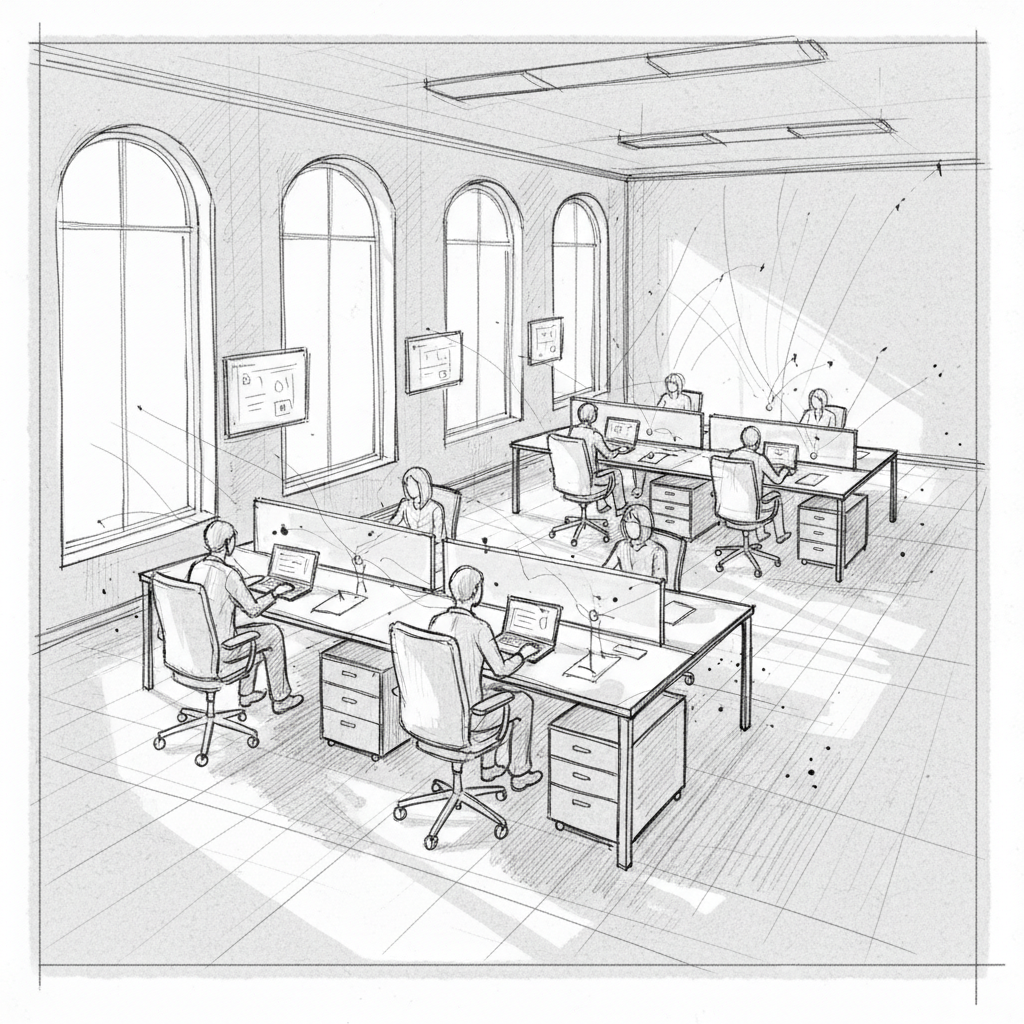
Effective workplace energy efficiency strategies include upgrading all lighting to LED with occupancy sensors, optimizing HVAC systems with demand-controlled ventilation and zone-based scheduling, enabling power management on all office equipment, and conducting regular energy audits to identify waste. Critically, integrating attendance forecasting with building controls — so HVAC and lighting only run in occupied zones — is one of the highest-impact and most underused strategies available to hybrid-work organizations today. Employee engagement programs that make energy-saving the default behavior round out a comprehensive approach. [4][6]
They're related but not identical. An Energy Performance Certificate (EPC) is a standardized document that rates a building's overall energy efficiency, typically on an A-to-G scale, and is required for commercial property transactions and lettings in many jurisdictions. The Energy Efficiency Rating (EER) is the specific numerical score embedded within an EPC that captures the building's overall performance. In short, the EPC is the certificate and the EER is the metric within it — you need both to fully understand a building's energy performance standing and compliance position.
In the context of commercial buildings and workplace operations, energy efficiency means achieving the same level of output — comfort, productivity, operational function — while consuming less energy input. This differs from the physics definition (useful energy transferred divided by total energy input). In practice, workplace energy efficiency focuses on eliminating waste: energy consumed for spaces that aren't occupied, equipment left running idle, and systems operating at full capacity when partial capacity would suffice. The goal is maximum useful output per unit of energy consumed.
Hybrid work creates a significant mismatch between building capacity and actual occupancy. Most office buildings are designed and operated for peak headcount, but in a hybrid model, attendance on any given day may be 30–60% of capacity. If HVAC, lighting, and equipment systems run at full capacity regardless of attendance, the building wastes energy proportional to that vacancy. Organizations that forecast attendance accurately and link those forecasts to building management systems can reduce energy consumption by conditioning only the zones that will actually be used — a direct and measurable efficiency gain.
An energy audit is a systematic assessment of how and where a building consumes energy. A qualified auditor analyzes utility bills, inspects building systems, reviews equipment inventories, and identifies specific opportunities for reduction ranked by cost and impact. Audits are the essential starting point for any workplace energy efficiency program because they replace guesswork with data. Without a baseline audit, organizations typically over-invest in low-impact fixes and miss the high-impact opportunities. Many utilities offer subsidized or free energy audits for commercial customers — it's worth checking with your provider before commissioning a private audit. [1]
AI is changing workplace energy efficiency by making occupancy prediction accurate enough to automate building system scheduling. Traditional BMS systems run on fixed schedules based on assumed occupancy. AI-powered platforms can forecast, with high accuracy, which floors and zones will be occupied on a given day and at what times — allowing HVAC and lighting to pre-condition only those areas. This occupancy-driven approach eliminates the energy cost of conditioning empty space, which in a hybrid office can represent a substantial share of total consumption. The result is efficiency that scales automatically as attendance patterns shift, without manual intervention.
Workplace energy efficiency is one of the most actionable levers available to corporate real estate and finance leaders right now. The technology is proven, the ROI is measurable, and the regulatory pressure to act is only increasing. The organizations that win in 2026 and beyond won't be the ones that swap out a few light bulbs — they'll be the ones that treat energy efficiency as a strategic discipline, integrating building systems, occupancy data, and space utilization into a single coherent program.
The hybrid work transition has created a new and underappreciated efficiency opportunity: the gap between building capacity and actual attendance. Closing that gap doesn't require a capital project. It requires accurate attendance forecasting and the operational discipline to act on it.
Upflex's UnifyAI platform delivers 97% attendance forecast accuracy and automates workplace coordination across your owned offices and on-demand workspace network. Customers achieve 40%+ reductions in real estate spend — and the energy savings that come with a right-sized, intelligently managed portfolio follow naturally. If your organization is ready to move from reactive energy management to proactive workplace optimization, the data and the tools are available today.
Explore more from our content library: