Share This Article
No items found.

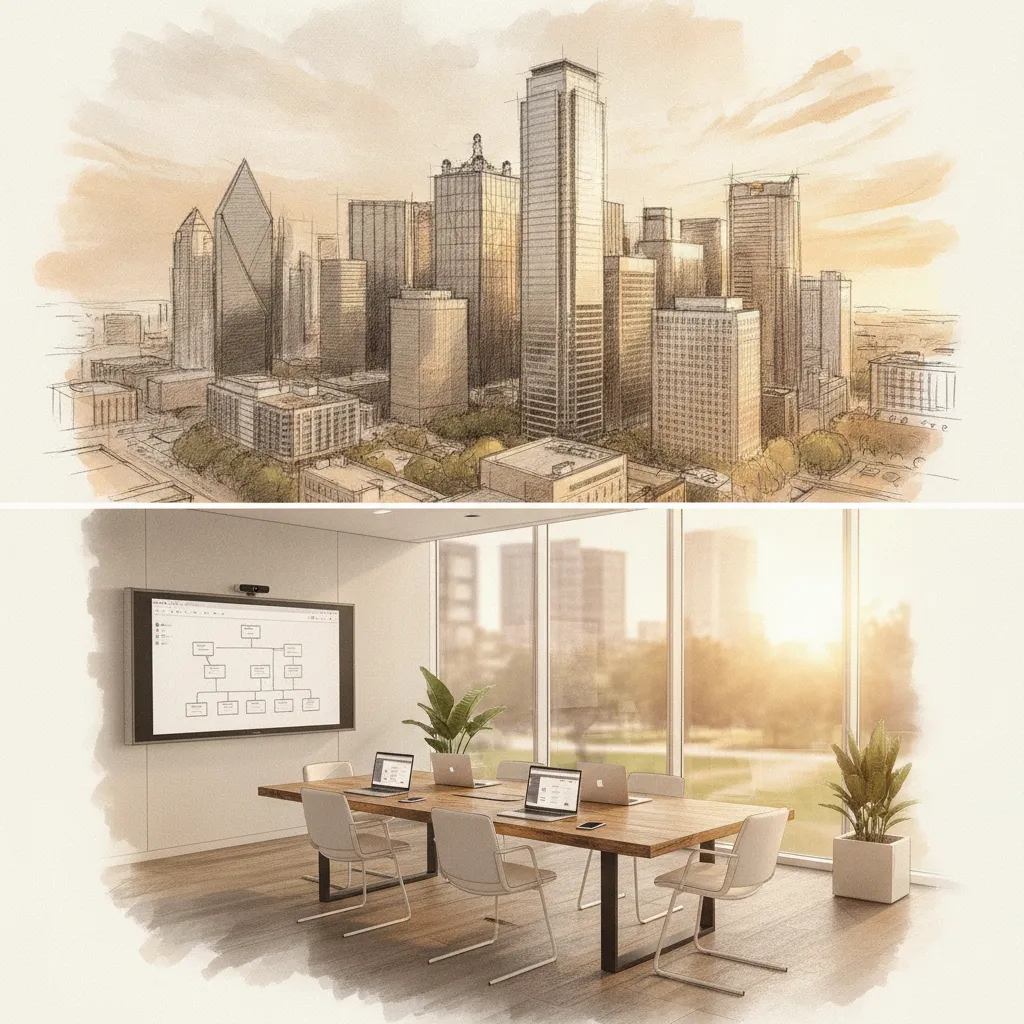
Office space in Dallas ranges from downtown Class A towers to flexible coworking desks, with asking rents averaging around $26 per square foot annually as of 2026 — making it one of the more competitive yet accessible major markets in the United States. Whether you're a startup hunting for a single private suite or a corporate real estate leader managing a multi-floor portfolio, Dallas offers more options per square mile than almost any other Sun Belt city. This guide breaks down every major office type, the neighborhoods that matter, what you'll actually pay, and how smart companies are using workplace optimization technology to stop overpaying for space they don't fully use.
Dallas offers at least six distinct office space categories, each suited to a different business size, budget, and working style — from fully serviced executive suites to raw shell space in suburban business parks.
Traditional leases give you dedicated, branded space in a commercial building. According to LoopNet, Dallas currently lists over 5,000 office spaces for lease, with an average asking price of $26 per square foot and an average available size of roughly 53,000 square feet [1]. Rates at Boxer Property typically run $20 to $50 per square foot annually, depending on location, floor, and included amenities [2].
Traditional leases usually run three to ten years. That's a significant commitment in a hybrid work environment where headcount and space needs can shift quarter to quarter.
Flexible office space has expanded dramatically across Dallas since 2023. Providers like Regus offer private offices, serviced suites, and executive spaces across key submarkets including Downtown, Uptown, and Deep Ellum [3]. According to Instant Offices, the average cost to rent flexible office space in Dallas runs about $490 per person per month [4].
Pro Tip: If your team comes into the office fewer than three days per week on average, a flexible or serviced office will almost always cost less than a traditional lease — even at a higher per-desk rate — because you're not paying for empty desks on the days nobody shows up.
The right Dallas submarket depends on your industry, commute patterns, and budget — Uptown commands premium rents for good reason, while suburban corridors like Las Colinas offer significantly more space per dollar.
Downtown Dallas anchors the city's legal, financial, and government sectors. The Arts District and Main Street corridor offer Class A and B inventory within walking distance of DART light rail. Uptown, just north of downtown, is the preferred address for financial services, consulting, and tech firms that want walkable amenity density — restaurants, hotels, and residential towers all within a few blocks.
The Dallas West End deserves a mention here too. It's home to some of the city's most architecturally distinctive buildings, with mixed-use spaces walking distance to restaurants, parks, and transit [7]. Rents in the West End often undercut Uptown by 20 to 30 percent while offering genuine character.
Las Colinas, Plano, Frisco, and the Galleria corridor in North Dallas all offer strong alternatives to core urban space. These submarkets attract corporate headquarters and regional offices because of highway access, abundant parking, and lower per-square-foot costs.
| Submarket | Typical Rent ($/SF/yr) | Best For | Transit Access |
|---|---|---|---|
| Downtown | $28–$50 | Legal, finance, government | Excellent (DART) |
| Uptown | $35–$55 | Tech, consulting, financial services | Good (McKinney Ave Trolley) |
| Las Colinas | $22–$35 | Corporate HQ, energy, financial | Moderate (DART Orange Line) |
| Plano/Frisco | $20–$32 | Tech, healthcare, regional offices | Moderate (DART Red Line) |
| Deep Ellum | $18–$28 | Creative, media, startups | Good (DART Green/Blue Line) |
| Galleria/North Dallas | $24–$40 | Professional services, coworking | Limited (car-dependent) |
Office space in Dallas costs between $18 and $55 per square foot annually for traditional leases, or roughly $391 to $1,015 per month for small private suites — making it meaningfully cheaper than gateway markets like New York or San Francisco while still offering world-class amenities.
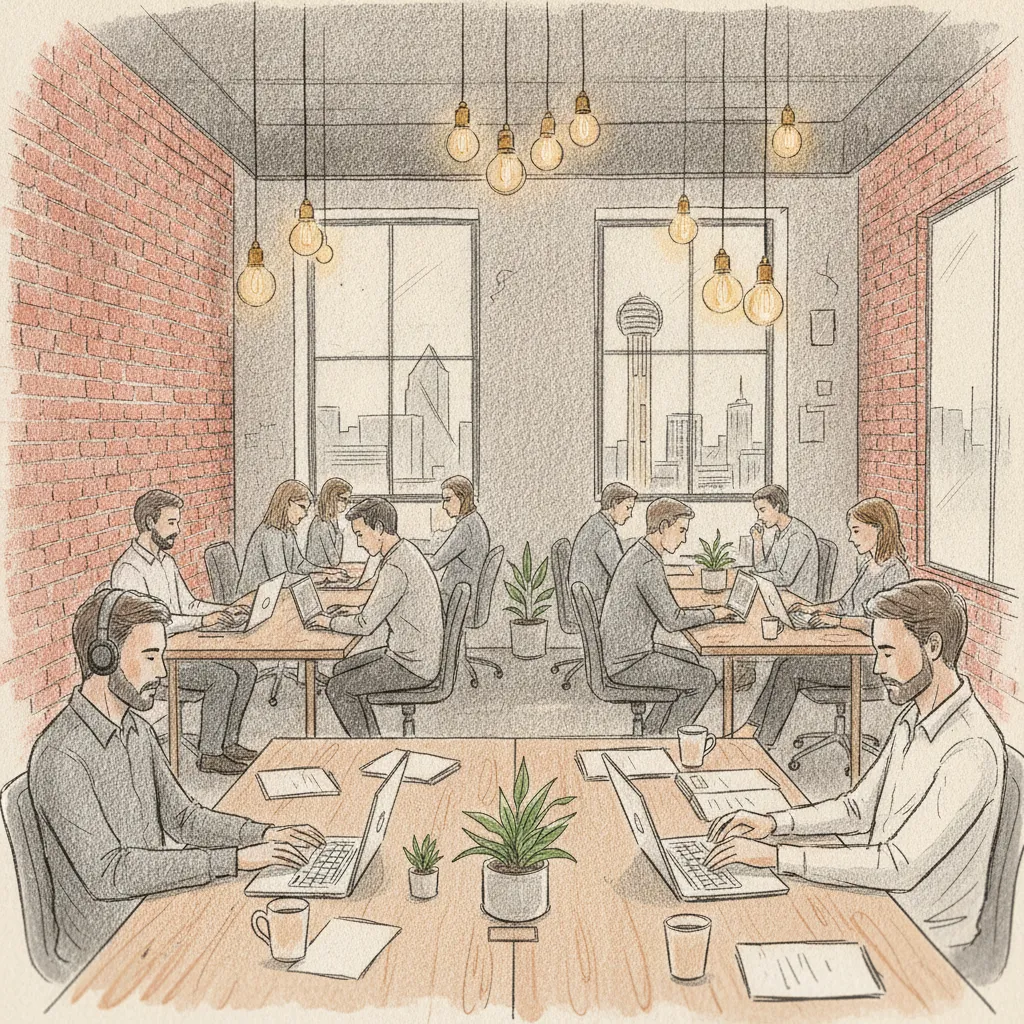
Quoted rent is rarely the full story. Understanding the lease structure matters as much as the headline rate. Most Dallas commercial leases fall into one of three structures:
For small businesses, serviced offices and coworking memberships often make more financial sense than traditional leases. Craigslist Dallas lists fully serviced small office spaces starting at $391 per month in suburban locations like Allen [9]. At the other end of the spectrum, premium private offices in managed buildings in Uptown can run $1,500 or more per month for a single-person suite.
A common mistake is anchoring entirely on the per-square-foot rate and ignoring the full cost picture. In practice, these additional line items add up fast:
Industry analysts at JLL consistently note that total occupancy cost (TOC) — the true all-in cost per employee per year — runs 20 to 40 percent higher than base rent alone in most U.S. markets, and Dallas is no exception [10].
Pro Tip: Before signing any lease, calculate your cost per occupied seat, not cost per square foot. If your team uses the office two days per week, your effective cost per occupied seat is roughly 2.5 times the headline rate. That math changes the ROI calculation entirely.
Hybrid work has permanently changed how Dallas companies think about office space — most enterprises now carry 30 to 50 percent office utilization rates while paying for 100 percent of their leased square footage, creating a costly and increasingly unsustainable gap.
A corporate real estate director at a mid-sized financial services firm recently described a situation that's become almost universal: their Uptown floor is packed on Tuesdays and Wednesdays, nearly empty on Mondays and Fridays, and they have no reliable way to predict which days different teams will actually show up. The result is a space sized for peak capacity but rarely used at that level.
Research consistently shows this isn't a Dallas-specific problem. According to JLL's global workplace data, average office utilization across major U.S. markets sits well below 60 percent on any given day [10]. In Dallas, where suburban commute distances are significant, the incentive to come in drops further when employees aren't sure their teammates will be there.
This is precisely the problem that AI-powered workplace optimization platforms are built to solve. At Upflex, we've found that companies using intelligent attendance forecasting — specifically, AI that predicts who's coming in, when, and where — can achieve 97% forecast accuracy and 88% co-attendance rates. That means teams actually coordinate their in-office days, which makes the commute worthwhile and the office feel alive.
The data-driven approach to Dallas office space starts with measuring actual utilization before making any lease decisions. Here's a practical framework:
Organizations using Upflex's platform have documented 40%+ reductions in real estate spend by following exactly this kind of data-driven consolidation process. The key is replacing guesswork with actual occupancy intelligence.
Pro Tip: Dallas lease renewals are your single biggest leverage point. Start your utilization audit at least 18 months before any lease expiration. Landlords know you're locked in once you're inside the 12-month window — and they price accordingly.
Choosing office space in Dallas comes down to five core variables: location relative to your workforce, space type and flexibility, total occupancy cost, lease term risk, and whether the space supports your hybrid work model.
One pitfall to watch for is falling in love with a space before you've stress-tested the operational assumptions. In practice, the best-looking office in the best building can become a liability if it doesn't match how your team actually works.
| Business Stage | Recommended Space Type | Typical Dallas Cost | Lease Flexibility |
|---|---|---|---|
| Solo / Freelancer | Coworking hot desk | $150–$350/mo | Month-to-month |
| Small Team (2–10) | Private suite / serviced office | $815–$2,500/mo | 3–12 months |
| Growing SMB (10–50) | Executive suite or Class B lease | $20–$35/SF/yr | 1–3 years |
| Mid-Market (50–500) | Class A/B lease + flex overflow | $25–$45/SF/yr | 3–7 years |
| Enterprise (500+) | Portfolio strategy + on-demand network | $28–$55/SF/yr | 5–10 years (with options) |

Office space in Dallas costs anywhere from $391 per month for a small serviced suite in suburban locations to $1,015 or more per month for a private office in a managed building in Uptown or Downtown. Traditional leases average around $26 per square foot annually across the broader market. Flexible coworking memberships average about $490 per person per month. Your actual cost depends heavily on location, space type, and lease structure.
Uptown and Downtown Dallas are the most prestigious and expensive submarkets, best suited for financial services, legal, and consulting firms. Deep Ellum and the West End offer lower rents with strong character and transit access. For suburban value, Las Colinas, Plano, and Frisco offer newer inventory at $20 to $35 per square foot annually with excellent highway access and ample parking.
Yes. Fully serviced small office spaces in suburban Dallas markets like Allen and Plano are available from around $391 per month. Coworking hot desks in shared spaces across the metro area also fall well under $500 per month. Private suites in managed buildings typically start closer to $800 per month, so the under-$500 range is primarily coworking memberships and micro-offices in outer suburbs.
A coworking space provides a shared working environment — open desks, common areas, and shared amenities — typically on a membership or day-pass basis. A private office is a dedicated, lockable room within a managed building. Private offices cost more but offer confidentiality, consistent desk assignments, and a professional address. Many Dallas providers offer both options within the same building.
Hybrid work means most Dallas companies are using only 30 to 50 percent of their leased space on any given day. That means a company with 100 employees doesn't need 100 dedicated desks — a well-managed hybrid model typically requires 50 to 70 seats supplemented by on-demand workspace access for overflow days. AI-powered attendance forecasting tools can predict which days teams will be in, allowing real estate leaders to right-size their footprint with confidence.
Key lease provisions to scrutinize include: the base rent escalation schedule (typically 2 to 3 percent annually), the lease structure (FSG vs. NNN), tenant improvement allowances, parking terms, expansion and contraction rights, and early termination clauses. In 2026, many Dallas landlords are more willing to negotiate flexibility provisions than they were pre-pandemic — especially in Class B and suburban buildings with higher vacancy rates.
Downtown Dallas is better for companies that need proximity to courts, government offices, and major financial institutions, and that benefit from DART rail access. Uptown is better for firms competing for talent that values walkable amenities, restaurant density, and a more energetic street-level environment. Uptown rents run slightly higher. Both are strong choices; the right answer depends on your workforce demographics and client-facing needs.
Workplace optimization platforms use AI-powered attendance forecasting to predict which days employees will use this strategy, enabling companies to right-size their real estate footprint based on actual demand rather than assumptions. Platforms like Upflex combine desk booking, utilization analytics, and access to on-demand workspace networks, helping corporate real estate leaders cut real estate spend by 40% or more while maintaining team co-attendance and collaboration.
Dallas remains one of the most dynamic office markets in the United States, with enough variety in pricing, location, and lease structure to suit businesses of every size. The core challenge in 2026 isn't finding this approach — it's making sure the space you commit to actually matches how your team works.
Traditional leases sized for pre-hybrid headcounts are the most common and costly mistake we see corporate real estate leaders make. The companies getting this right are the ones measuring actual utilization, forecasting attendance with real data, and supplementing their owned or leased space with on-demand workspace access for the days and locations where demand spikes.
Upflex's platform combines AI-powered office orchestration with access to the world's largest on-demand workspace network, giving Dallas-based corporate real estate and HR leaders the tools to stop paying for empty desks and start managing their real estate portfolio with the precision the CFO demands. The result: 40%+ reductions in real estate spend and 88% team co-attendance achievement — numbers that make the business case for smarter space management impossible to ignore.
Explore more from our content library: