Share This Article
No items found.


Finding the right office space in Philadelphia comes down to three variables: location, lease structure, and utilization strategy. As of 2026, average asking rents sit at roughly $26–$27 per square foot annually [1], though rates range from $15/SF in emerging neighborhoods to $34+ in historic districts like Old City [2]. Whether you're a growing team hunting for your first lease or a corporate real estate leader rethinking a large footprint, Philadelphia's office market offers real options across every budget and format.
This guide walks you through everything you need to make a confident decision: current pricing, the city's most active submarkets, lease structures, workspace formats, and how smart organizations are reducing their real estate spend while improving the employee experience. Estimated reading time: 12 minutes. No real estate background required.
Before touring a single property, gather four data points: your headcount today, your projected headcount in 24 months, your target days-per-week in-office, and your maximum monthly budget. These four numbers will eliminate 80% of options before you waste time on them.
Philadelphia's commercial market lists over 1,100 office properties at any given time [3], so going in without a defined scope is a fast way to get overwhelmed. Work through this checklist before you start:
Pro Tip: Before signing any lease, run at least 90 days of attendance data. Organizations that skip this step routinely lease 30–40% more space than they actually need, especially under hybrid work models where Tuesday–Thursday peaks mask Monday and Friday vacancy.
Philadelphia's office market divides into distinct submarkets, each with different pricing, amenities, and tenant profiles. Choosing the right submarket is often more important than the specific building.
Here's a practical breakdown of Philadelphia's primary office submarkets as of 2026:
| Submarket | Avg. Asking Rent ($/SF/yr) | Best For | Transit Access |
|---|---|---|---|
| Center City (CBD) | $28–$38 | Law firms, financial services, enterprise HQ | Excellent (SEPTA, Amtrak) |
| Old City / Society Hill | $33–$35 | Creative agencies, professional services | Good (Market-Frankford Line) |
| University City | $24–$32 | Life sciences, biotech, research orgs | Excellent (30th Street Station) |
| Northern Liberties / Fishtown | $18–$26 | Startups, tech companies, creative firms | Moderate (SEPTA bus, El) |
| Market East / Midtown | $20–$28 | Mid-size firms, nonprofits, government contractors | Excellent |
| Suburbs (King of Prussia, Conshohocken) | $15–$22 | Manufacturing support, regional offices | Car-dependent |
Northern Liberties and Fishtown have seen the sharpest tenant interest growth in 2024–2026, driven by younger workforce preferences and lower base rents [6]. Old City remains a premium option for firms that value historic character and walkability [2].
Class A office buildings in Philadelphia are typically post-2000 construction or fully renovated assets with modern HVAC, high-speed fiber, building management systems, and on-site amenities. Class B offers functional space at 20–30% lower rents, often in older stock with fewer amenities. For most hybrid teams, Class B in a great location beats Class A in an inconvenient one.
Philadelphia offers three primary lease structures for office space, and the right choice depends on your team size, growth trajectory, and hybrid work model. Getting this decision wrong is expensive.
Industry analysts at JLL note that flexible workspace now accounts for a growing share of new office commitments in major U.S. cities, as enterprises prioritize optionality over long-term fixed commitments [4]. Here's how the three structures compare:
| Lease Type | Typical Term | Cost Range (Phila.) | Pros | Cons |
|---|---|---|---|---|
| Traditional Direct Lease | 3–10 years | $15–$38/SF/yr | Full control, branding, customization | Long commitment, fit-out costs, inflexible |
| Managed / Serviced Office | 1–24 months | $400–$900/desk/mo | All-inclusive, move-in ready, scalable | Higher per-desk cost, less brand control |
| Coworking / Shared Space | Month-to-month | $300–$600/desk/mo [7] | Maximum flexibility, community, no fit-out | Shared amenities, noise, limited privacy |
A mid-size professional services firm we've seen work through this decision found that a hybrid approach, anchoring on a smaller direct lease supplemented by on-demand workspace access for overflow days, cut their total occupancy cost by over 35% compared to their previous full-floor lease.
Pro Tip: Negotiate a "blend and extend" clause into any traditional lease. If your space needs change mid-term, this lets you renegotiate square footage and term simultaneously rather than breaking the lease. Philadelphia landlords have been more receptive to these terms in 2025–2026 as vacancy rates remain elevated in some Class B corridors.
Small office space in Philadelphia is genuinely accessible at a range of price points, with options starting well under $500 per month for solo practitioners and small teams willing to explore shared or serviced formats.
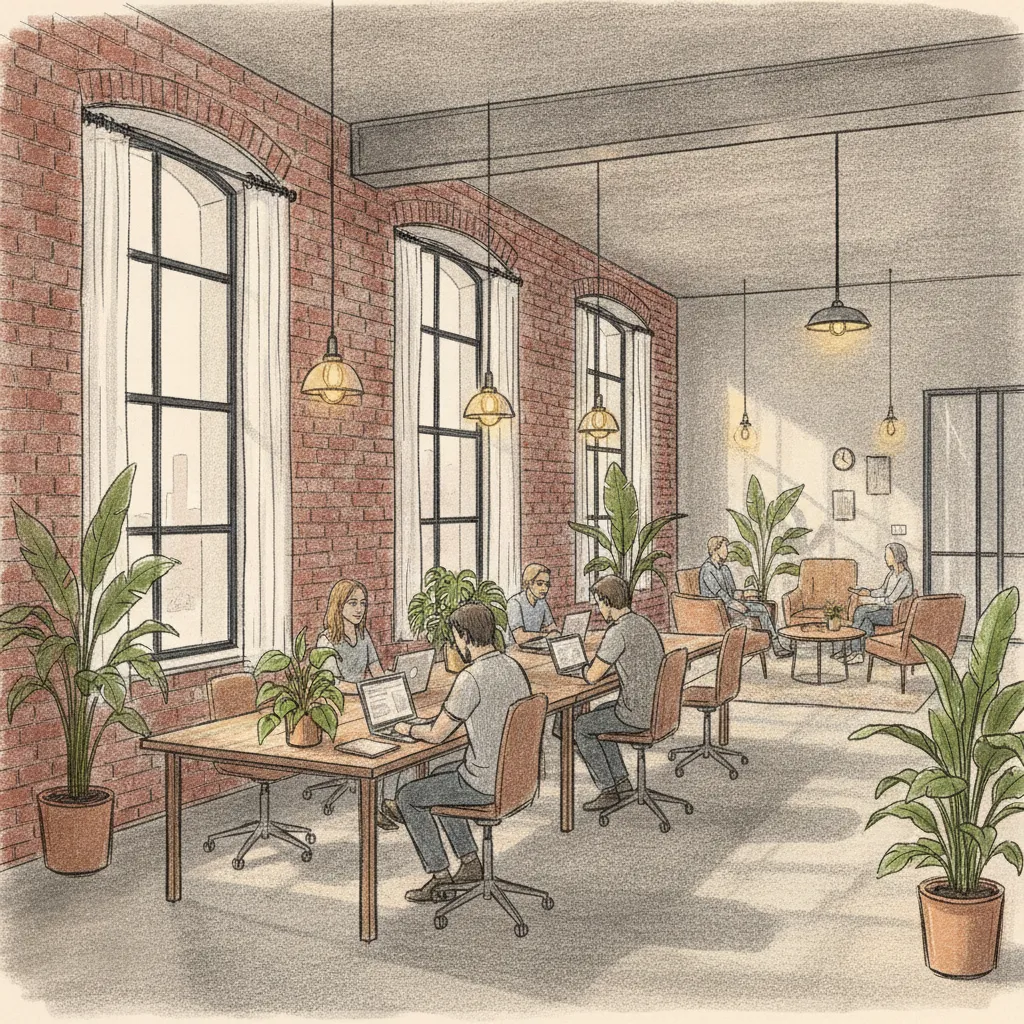
Budget-conscious renters have more options than they might expect. Here's where to look:
Office space for rent in Philadelphia under $500 per month typically means a single private office or hot desk in a shared environment. Expect to get high-speed internet and basic utilities. Don't expect dedicated reception, private conference rooms on demand, or 24/7 building access without paying extra.
One limitation worth acknowledging: the cheapest options often come with trade-offs in location, building quality, or lease stability. A $244/month office in a less-trafficked neighborhood may cost more in employee commute friction than it saves in rent. Factor in the full picture before optimizing purely on price.
Most organizations lease more office space in Philadelphia than they actually use. Utilization data consistently shows that even in companies with return-to-office policies, actual peak occupancy rarely exceeds 60–70% of leased capacity.
Traditional space planning uses headcount as a proxy for space need. That approach made sense when everyone came in five days a week. It doesn't work for hybrid teams.
At Upflex, we've found that organizations using AI-powered attendance forecasting, specifically tools that predict who's coming in, when, and at which location, consistently identify 20–40% more space than they need before signing or renewing a lease. Upflex's UnifyAI engine delivers 97% attendance forecast accuracy, giving corporate real estate leaders a defensible data foundation for right-sizing decisions rather than gut-feel estimates.
The practical outcome: one enterprise client reduced their Philadelphia-area real estate spend by over 40% by replacing a fixed large-floor lease with a smaller anchor office supplemented by on-demand workspace access through Upflex's global network. Their teams still achieved 88% co-attendance on collaboration days because the scheduling was coordinated automatically, not left to chance.
Pro Tip: Request badge swipe or access control data from your current building before your lease expires. Even imperfect data showing actual entry counts by day will reveal utilization patterns that justify a smaller footprint or a more flexible lease structure to your CFO.
Philadelphia's office leasing market in 2026 favors tenants in most submarkets, with elevated vacancy in Class B and some Class A buildings giving renters real negotiating leverage. Use it.
Base rent is the headline number, but it's rarely the most important variable. Research from commercial real estate advisors consistently shows that tenant improvement allowances (TI allowances), free rent periods, and operating expense caps often deliver more total value than a lower base rent. In Philadelphia's current market, tenants can reasonably expect:
Tenant representation brokers in Philadelphia are paid by the landlord through a commission split, which means their services cost you nothing directly. JLL, CBRE, Colliers, and a range of boutique Philadelphia firms all offer tenant rep services [4]. For any lease over 2,000 SF or longer than 12 months, using a broker is almost always worth it. They know which landlords are under financial pressure, which buildings have hidden costs, and where the real negotiating room is.
The most expensive errors in Philadelphia office leasing aren't about overpaying on rent. They're about structural mismatches between the space you commit to and the way your team actually works.
As of 2026, the average asking rent for office space in Philadelphia is approximately $26–$27 per square foot per year, according to CommercialCafe and LoopNet data. Rates vary significantly by submarket, ranging from $15/SF in suburban and emerging neighborhoods to $38/SF in premium Center City Class A buildings. Total occupancy cost, including operating expenses, typically adds another $10–$15/SF annually.
Affordable office space in Philadelphia under $500/month is available through several channels. Community-based organizations like Xiente in Norris Square offer low-cost private offices for small businesses. Craigslist commercial listings regularly show fully serviced small offices starting at $244/month. Coworking memberships at shared spaces start around $300/month. The trade-off is usually location, shared amenities, or limited lease flexibility.
Northern Liberties and Fishtown have become Philadelphia's most active startup office corridors, offering rents of $18–$26/SF in a creative, amenity-rich environment. University City is strong for life sciences and tech companies, particularly those with ties to Penn or Drexel. Center City remains the default for professional services firms that need a prestigious address and strong transit access.
It depends on your team size and hybrid work model. Teams under 10 people with uncertain growth often benefit from coworking's flexibility. Teams of 20+ with stable headcount and a need for branding and privacy typically get better value from a direct lease or managed office. A growing number of organizations use both: a smaller anchor office for regular collaboration days and on-demand workspace access for overflow, remote employees, or satellite locations.
Standard planning ratios are 150–200 SF per person for open-plan layouts and 200–300 SF for private offices. But for hybrid teams, the more relevant number is peak daily attendance, not total headcount. If your 100-person team averages 50% in-office attendance, plan for 50–60 people on a typical day, with buffer capacity for peak days. Attendance forecasting tools can give you this number with precision before you commit to a lease.
Activity-based working (ABW) is a space design methodology that allocates workspace by work type rather than by assigned person. Instead of one desk per employee, ABW environments offer a mix of focus rooms, collaboration zones, phone booths, and social areas. For hybrid teams in Philadelphia, ABW typically reduces space requirements by 20–30% compared to traditional assigned-desk layouts, making it a strong fit for organizations right-sizing their footprint.
Philadelphia's 2026 office market favors tenants in most submarkets, so negotiate aggressively. Key levers include tenant improvement allowances ($40–$80/SF is reasonable for multi-year Class A leases), free rent periods of 3–6 months, operating expense caps, sublease rights, and early termination options. Always use a tenant's broker for leases over 2,000 SF; their fee is paid by the landlord, and their market knowledge typically delivers more value than their cost.
Yes. Therapy and professional office space for rent in Philadelphia is widely available through platforms like Deskpass, which lists private, move-in-ready offices suited to solo practitioners and clinical professionals. These spaces typically include soundproofing, private entrances, and flexible scheduling. Coworking directories and commercial listing sites also carry dedicated medical and wellness office suites in Center City and surrounding neighborhoods.
Finding the right office space in Philadelphia is a function of three decisions made in the right order: choose your submarket based on where your team actually lives, select a lease structure that matches your hybrid work model, and size the space to your real utilization data, not your headcount. Getting any one of these wrong is costly. Getting all three right is how organizations cut real estate spend by 40% or more without sacrificing the employee experience.
The organizations doing this best in 2026 aren't guessing at attendance patterns. They're using AI-powered workplace optimization platforms like Upflex to forecast who's coming in, coordinate team co-attendance, and supplement their anchor office with on-demand workspace access for distributed employees. The result is a leaner, smarter real estate portfolio that serves both the CFO's cost targets and the CHRO's culture goals.
Whether you're signing your first Philadelphia office lease or renegotiating a large footprint, start with the data. The decisions follow naturally from there.
Explore more from our content library: